



- Private equity is investing in unlisted companies through funds that buy, improve, and sell them.
- Access depends on your investor status and geographic location (such as the US, UK, India, and the Middle East).
- It involves unique options, fees, risks, and return profiles (provided for educational purposes only).
Private equity is buying shares in privately held businesses rather than on a public exchange. Private equity typically involves investing via a fund that purchases, enhances and then sells the private business. If you ask me what are the ways to invest in private equity, I’ll tell you it depends upon who you are and where you reside. This article will explain the different types of investments, the risks associated with them, and the possible returns using plain language. This is educational material and not financial advice.
What Is Private Equity and How Does It Work?
A private equity firm gets cash from investors and uses that cash to invest in a fund. The firm buys companies and works with those companies for a short period of time. During this time, the private equity firm can reduce expenses, find new management for the companies, and/or assist the companies in growing. When the private equity firm is done working with the company, the firm will either sell the company or list the company on a stock exchange. Some examples of private equity firms include Blackstone, KKR, Apollo, and Carlyle. These are only examples. We are not recommending any of these firms.
The investors in this fund are known as limited partners.
The company that manages this fund is the general partner. When you make a commitment to invest in a fund, you indicate how much money you plan to contribute. The company will request that you provide that money at various times. This explains why private equity appears to be so slow.
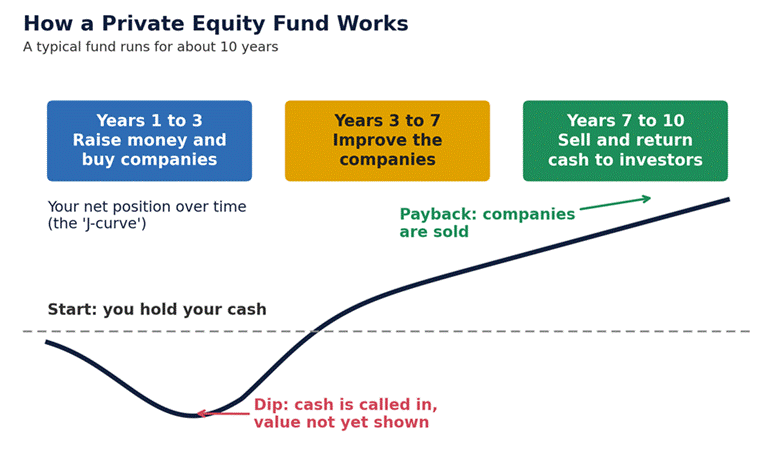
Image 1: timeline for a standard 10-year private equity fund. Years 1-3 are spent raising capital and investing into businesses. The Years 3-7 are used to improve those businesses. Years 7-10 are when the fund will sell its investments. Below is a graphical representation showing the investor’s return dip in the early stages, then rise as cash is returned.
Returns only come from when the firm sells a business. However, returns cannot be guaranteed. There are some funds that perform exceptionally well and others that experience loss.
Why do investors want private equity? Two primary reasons. Private companies do not face the same short-term pressures as publicly traded companies on the stock exchange. They may take a longer view of their business plans. Private companies are able to make large strategic moves which would be difficult for publicly traded companies to do. Some research indicates that private equity buyout funds out-perform public stocks over extended time frames. Other research indicates that once fees are taken into account the performance difference between the two types of investments decreases significantly. Performance varies greatly among the top performing funds and bottom performing funds. Selecting a poor performing manager can lead to substantial losses.
Types of Private Equity: Buyouts, Venture Capital, and Growth Equity
Buyouts represent the largest portion of the market. Buyouts occur when a firm purchases a mature business, frequently using borrowed funds, and attempts to increase profitability. Venture Capital supports emerging, young businesses. A majority of venture-capital backed businesses will fail; however, some will succeed dramatically. Growth Equity lies in-between buyouts and Venture Capital. Growth Equity invests funds into mature, currently profitable businesses requiring additional funding for expansion purposes. Typically, Growth Equity utilizes significantly less debt than buyouts.
Venture Capital deals are small investments. A fund can invest in 30 different startup companies. Many will produce little return. However, one or two can generate enough profit to cover all of the other investments. Buyouts are the exact opposite. They seek more consistent returns; however, they use borrowed funds that increase the level of risk should earnings decline. Growth Equity is generally found somewhere in-between both of these types of investment regarding risk.
How to Invest in Private Equity: Direct, Funds, and Public Routes
The following table shows the four most common options for getting your money out of a plan. It lists the minimum amount that is usually required to be withdrawn, which type of person is able to withdraw money from each option, and how easy it is to withdraw money from that option. Please note that figures will vary depending upon the company providing the plan.
| Route | Typical minimum | Access | Liquidity |
| Private equity funds | $250,000 to $5 million or more | Accredited or qualified investors | Very low. Locked up 7 to 10 years |
| Feeder funds and platforms | About $10,000 to $100,000 | Often accredited investors; some wider | Low. Several years |
| Listed companies and ETFs | Price of one share | Any broker account | High. Trade daily |
| Crowdfunding | About $100 to $1,000 per deal | Many retail investors, with limits | Very low. Often no exit for years |
Listed options are the simplest place to begin. Examples of listed options include firms such as 3i Group or Blackstone, and ETFs that contain listed private equity firms. As before, these are examples only. You should be aware that the price of each listed option will change daily like any other stock. This is very different than owning a private fund.
Feeder funds take a large number of smaller investors and combine them into one larger fund. While this reduces the initial investment required by each investor, it also adds an additional set of fees. Crowdfunding allows you to invest in a variety of small privately held companies on-line. A significant percentage of these companies will ultimately fail. Therefore, never use funds that you cannot afford to lose. It is important to know who operates the crowdfunding platform and if the platform is subject to regulatory oversight.
Who Can Invest in Private Equity? Requirements and Minimums
The access to the Internet is based upon your geographical location. These regulations will vary depending upon which country you reside in, and may also be modified throughout the years. Therefore, it is important to always consult with your regional regulatory authority.
The majority of private equity funds in the United States require their investors to be “accredited.” Accreditation is typically achieved by having an annual income of at least $200,000 ($300,000 if married) for the last two years, or by having a total net worth of at least $1 million, excluding the value of one’s primary residence. Read the SEC definition.
United Kingdom: firms can promote riskier funds only to certain people, such as high net worth or sophisticated investors. The Financial Conduct Authority sets the rules.
India: private equity funds are usually Alternative Investment Funds. The minimum commitment is generally 1 crore rupees. The Securities and Exchange Board of India regulates them.
Middle East: in the UAE, financial centres such as DIFC and ADGM mostly limit private funds to professional or qualified investors with a net worth test. The Dubai Financial Services Authority publishes its rules. Other countries have their own.
If you are not eligible, do not hunt for loopholes. Stick to listed options and regulated platforms. The rules exist for a reason. Check your local rules first.
Private Equity Risks: Illiquidity, Fees, and Long Lock-Ups
Be direct with yourself about the risks. Your money is often locked up for 7 to 10 years. You cannot sell when you want. Returns are not guaranteed. Fees are high. Values are reported with a delay, often every quarter, and they are estimates. Most direct private equity funds are not suitable for beginners. Our guide to risk management explains how to size a position you can afford to lose.

Delaying reports of performance can help smooth out the ups and downs of a portfolio. For example, if a fund only re-values its investments quarterly, its returns will appear to be very consistent over time. On the other hand, the value of a publicly traded company can drop by 20 percent in just one week. However, a private equity fund would likely report no change in value. The difference isn’t that there is less risk associated with the private equity fund; it’s simply that the investor is aware of the risk much later than they would be if they were invested in the public stock. It’s also important to remember the J-curve effect. Fees charged by the fund in the first few years of the investment can actually cause the overall return of the investment to fall below zero.
Now let’s examine fees.
Most funds employ “2 & 20” – a 2% annual management fee and 20% of the profit. Suppose you invest $100,000. Before fees, the fund generates a 12% return or $12,000. Management fees reduce that by $2,000. A performance fee will then take 20% of the remaining $10,000 ($2,000). You will have $8,000 left. Your actual return will be 8% and not 12%. The examples above are only meant to provide an illustration. Actual funds may include a hurdle rate and additional expenses.
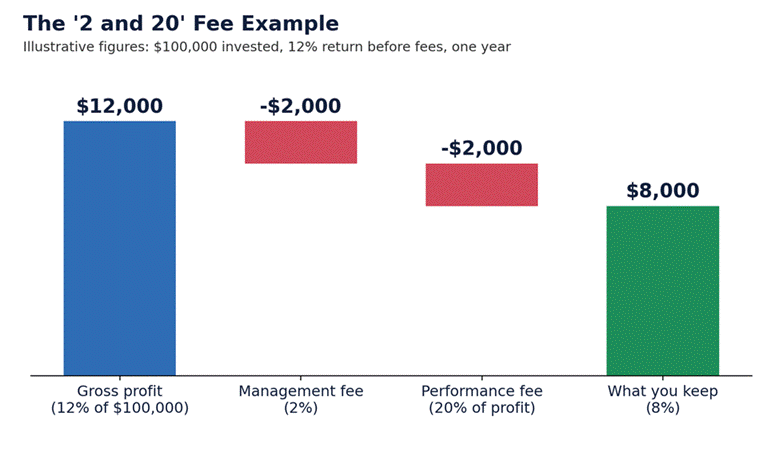
Image 2: A bar chart of the fee example. Gross profit is $12,000. A management fee removes $2,000. A performance fee removes another $2,000. The investor keeps $8,000, which is an 8% return.
How Private Equity Fits in Your Portfolio
Treat private equity as a small slice, if you use it at all. Only use money you will not need for at least a decade. There is no fixed rule. Some advisers suggest a small share, such as 5% to 10%, for investors who qualify. Keep your core in simple, liquid assets first.
Ask yourself three questions first. Do I have an emergency fund? Do I have steady income? Could I live without this money for ten years? If any answer is no, wait. Many people do better with low-cost funds and a clear plan first.
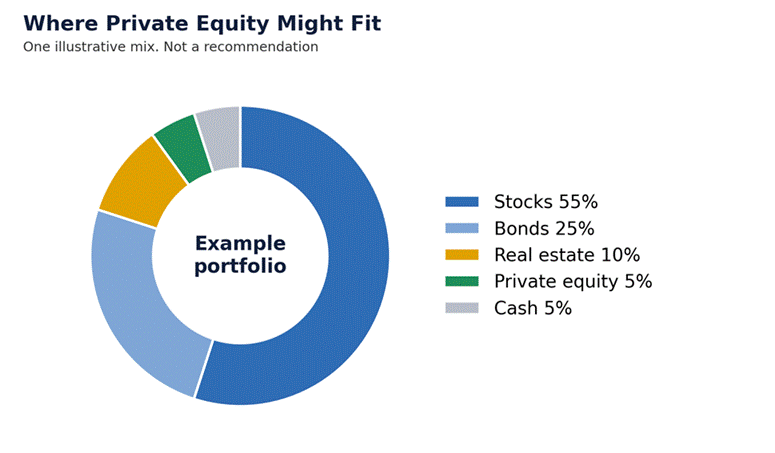
Image 3: A pie chart showing a representative sample of a portfolio (Stocks 55%, Bonds 25%, Real Estate 10%, Private Equity 5%, Cash 5%). This is an example of what could be in a portfolio, it is not meant to imply that this is how someone should invest.
Read our other guides regarding portfolio management and asset allocation, ETFs, real estate investment for beginners, and how to begin investing. It is best to start with the fundamentals. Once you have done so, determine whether private equity investing is appropriate for your long-term investment objectives and timeframe.
Frequently Asked Questions About Investing in Private Equity
Can retail investors invest in private equity?
Yes, however, most of the time it is done through indirect methods. For example, buying listed private equity firms and exchange traded funds (ETFs); utilizing crowdfunding; and participating on feeder platforms when rules permit. Accredited and/or qualified investors are typically required for direct fund investing.
How much money do you need to invest in private equity?
The range is broad. The cost of a publicly traded stock will be the price of each individual share. Crowdfunding can begin at approximately $100. Feeder platforms will generally require a minimum investment of $10,000, while direct funds will frequently require a minimum investment of $250,000, if not much higher.
How do private equity funds make money?
The firm earns a management fee on an annual basis (usually approximately 2%), as well as a portion of the profit generated by the investment (typically 20%). When the fund sells its holdings for a price higher than what was used to acquire them, investors will realize a return.
How long is your money locked up in a private equity fund?
Most funds will typically run for 7-10 years. A small number of funds may go beyond that timeframe. Early exit from a fund is unusual and expensive.
What is the difference between private equity and venture capital?
Venture capital is a form of private equity that provides financial backing to early-stage start-ups who have significant risk. On the other hand, buyout funds typically invest in established businesses and will most likely acquire majority ownership.