



- The USD/INR is down for the 3rd day in a row as de-escalatory headlines from the Middle East pulls down oil prices.
Current Setup and Live Chart
The Rupee has been a beneficiary of the de-escalatory headlines that filtered through the newswires over the weekend. This has culminated in the Rupee’s 3-day winning streak against the US Dollar. After hitting new record highs on 20 May at 96.96, the USD/INR has pulled back from those levels and is now testing a major support level at 95.24.
Bolstering the Rupee this Monday was the drop in oil prices after US President Donald Trump tweeted over the weekend about an impending peace deal between the US and Iran, brokered by several Middle Eastern heads of state. Brent crude fell 10.18% this Monday, and now trades at 93.63 as of writing. For India, a net oil importer, this was good news for the Rupee.
The USD/INR remains a highly followed currency pair among emerging markets, as India continues to navigate the turbulence created by the oil shock risk premium.
USD/INR: Current Macro Drivers
1. Oil price direction
Oil prices remain the dominant macro driver. India is the 3rd-largest oil importer, with 80% of its domestic needs met by these imports. The majority of India’s oil imports come through the blockaded Strait of Hormuz. Falling prices have boosted the Rupee’s recovery, after previous oil price spikes had pushed the Rupee to record lows against the greenback.
2. RBI intervention is supportive
The Reserve Bank of India managed the Rupee’s weakness through a series of interventions, making the USD/INR’s jump to record highs more manageable rather than disorderly and oversized. The effort to slow the Rupee’s decline and preserve market stability is said to have cost the RBI billions of dollars in currency interventions. The RBI’s moves have also helped the Rupee’s recent advances.
3. Geopolitics remains a macro driver

The Rupee’s recovery has followed recent optimism after the US President’s weekend announcement. The fall in oil prices shows just how sensitive the Rupee is to oil price movements, largely due to geopolitical factors.
This Week’s USD/INR Catalysts
1. Oil prices: This remains the biggest price catalyst for the USD/INR and has been discussed several times. The Rupee gains support from sustained declines in crude oil prices. However, a new oil price spike will reverse the Rupee’s gains.
2. RBI policy moves: Any additional intervention by the RBI will usually follow another uptick in USD/INR. The Rupee will not strengthen beyond the impact of oil prices, even with the RBI’s moves alone.
3. Global risk sentiment: The broader global risk sentiment in response to the geopolitical situation will have a major impact on emerging-market currencies such as the Rupee. Stock market pressures that lead to the exit of foreign portfolio funds are a consequence of global risk-off sentiment, which also negatively impacts the Rupee. When foreign portfolio funds flow in, they have to be converted to Rupees before reaching the investment destination, a Rupee-supportive scenario.
USD/INR Forecast Scenarios for the Week
Base Case: Despite the 3-day advance of the Rupee vs the US Dollar, the pair will remain range-bound while retaining a modest downside bias. This is dependent on oil prices staying below $100 and the de-escalatory process continuing well into the week.
Bull case (USD/INR higher): The pair will resume its price uptrend if tensions in the Middle East resume. Any escalations that push oil prices back above $100, along with increased foreign portfolio outflows, are all Rupee-negative factors. Additionally, the risk-off environment will promote a flight to safety in the US Dollar.
Bear Case (USD/INR lower): A further decline in oil prices and stronger foreign portfolio inflows will allow the Rupee to gain further. This will push USD/INR below the current support level it is testing.
USD/INR Technical Outlook
The USD/INR is currently testing the 95.24 support, which was previously a resistance level formed by the 30 March high. If this support is degraded, the next downside target of note resides at 94.04, the 7 May low and the 61.8% Fibonacci retracement level of the 8 April to 20 May upswing. Additional price pivots are found at the 93.25 price mark (78.6% Fibonacci retracement and the neckline of the double bottom pattern of 8 April and 20 April) and at the 92.24 support level, which houses the 8 April low.
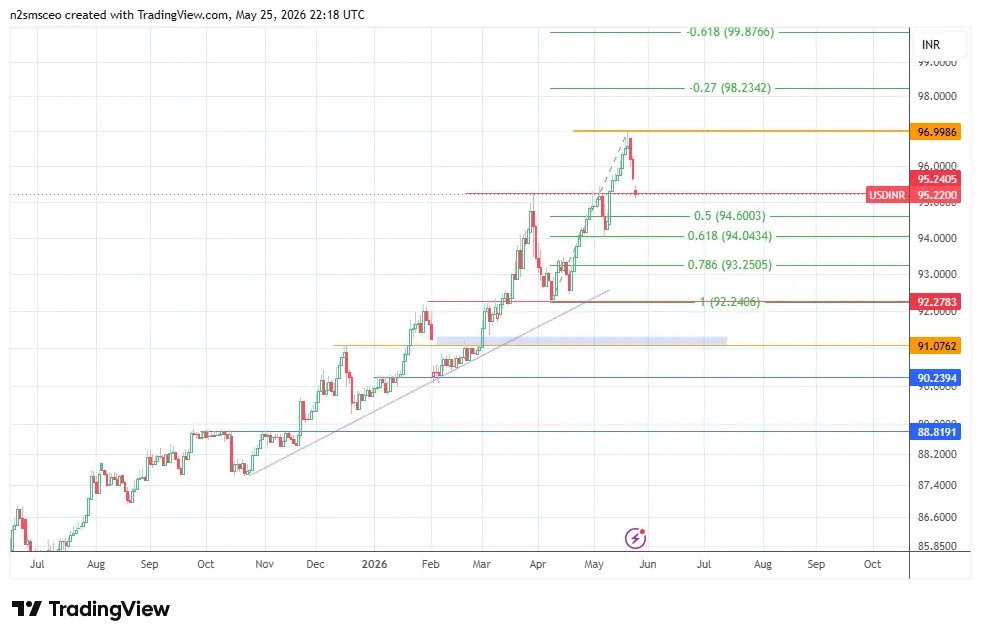
On the other hand, upside continuation requires a bounce from the 95.24 support level, which eventually uncaps the existing all-time high and the 96.96 resistance. This will allow the bulls to set sights on the 27% Fibonacci extension level at 98.23, with a further target at the 61.8% Fibonacci extension at 99.87.