




- The US-Iran peace deal announced over the weekend has led to a crash in oil prices, which has initiated a retracement in the USD/INR.
Current Setup and Live Chart
The biggest news of the weekend regarding the financial markets is the tentative U.S.-Iran Peace Agreement, which has effectively evaporated the geopolitical risk premium. The news crushed oil prices, with Brent crude falling 0.52% and now trading around $82 a barrel. The Indian rupee is one of the biggest beneficiaries of these developments.
India is the third-largest crude oil importer, which makes the rupee gain strongly whenever oil prices are down. The tentative peace deal between the US and Iran also includes reopening the Strait of Hormuz, which is expected to restore oil shipments to countries like India. This is why crude oil prices have fallen sharply: the oil-shock risk premium that has dominated markets since the beginning of March has evaporated.
For net oil importers like India, a lower crude oil price is a significant macroeconomic positive, as they ease inflation pressures and improves the trade balance, which is why the Indian rupee is currently up 0.4% against the US dollar, representing a five-week high.
USD/INR: This Week’s Macro Drivers
1. Sharply Declining Oil Prices
The biggest macro driver for USD/INR is the steep fall in crude oil prices following the announcement of a tentative peace agreement to end the US-Iran war. Brent crude is currently trading at multi-month lows after falling about 5% in overnight trading. Lower oil prices are typically supportive of the rupee due to reduced oil import bills. Furthermore, pressure on the current account will ease, reducing inflationary expectations. The risk-on environment thus created also promotes foreign capital inflows, which in turn create rupee demand.
Collectively, these factors that are induced by lower oil prices provide a supportive environment for the rupee to gain against the greenback.
2. Loss of Safe-Haven Appeal for the US Dollar
The US Dollar has fallen to a 10-day low amid a risk-on scenario, reducing the greenback’s appeal. Investors are now expected to rotate out of the safe-haven US Dollar and into riskier emerging-market FX. Also, carry trade strategies become more attractive at this point, thereby promoting rupee demand relative to the US Dollar.
3. Reduced Need for RBI Intervention

The Reserve Bank of India has spent billions of dollars to defend the rupee and force a managed depreciation amid surging oil prices. Retreating oil prices will ease that pressure, and the RBI can save some of its foreign currency reserves by no longer needing to intervene to maintain rupee stability.
What Markets Should Watch This Week
Progress of the Peace Deal: The deal remains tentative, with signing scheduled for Friday. The biggest risk to the rupee is whether both sides will stick to the terms of the peace agreement. A closer look will have to be taken at whether Iran will maintain its promise to reopen the Strait of Hormuz, which is the main reason for the oil price adjustment. Several key issues, such as long-term security and Iran’s nuclear ambitions, remain unresolved. These are areas of uncertainty that remain as a cloud despite the peace deal. Any headlines suggesting a lack of compliance with the key points in the tentative deal could cap gains in the rupee.
Federal Reserve Meeting: Wednesday 17 June is Fed decision day. Now that a peace deal is in place, what does it do to the Fed’s interest rate expectations that had moved away from easing towards a cautious outlook? Will the Fed retain its recent hawkish tone (which will push US Treasury yields higher and reverse the rupee’s gains against the USD), or will it shift back towards a potential easing path later in the year or in early 2027? These questions will be answered by the Fed decision, rate statement, and press conference (the first by the new FOMC Chair and noted hawk, Kevin Warsh).
USD/INR Weekly Forecast Scenarios
Base Case: the bias is for the USD/INR to remain bearish due to falling oil prices, risk-on sentiment, and a weaker USD. Also, rupee demand from foreign capital looking to enter the Indian markets is expected to support the rupee.
Bear Case: (strongly bearish USD/INR): Headlines that point to smooth implementation of the peace deal with adherence to its conditions, especially the reopening of the Strait of Hormuz, will be strongly supportive of the rupee. If oil prices remain below $85, this will promote further weakness in USD/INR.
Bull Case (rebound in the USD/INR): Signs that the peace deal is not fully adhered to, stalls in the reopening of the Strait of Hormuz, renewed escalations, or a hawkish surprise from the Federal Reserve could promote a rebound in USD/INR. If oil prices start heading back north, this will put pressure on the rupee and cause a reversal of its recent gains against the US Dollar.
Takeaway
The USD/INR is currently on a fundamentally bearish trajectory as the peace deal removes the oil shock risk premium from markets. Net oil importers like India benefit from falling oil prices and a strengthening of the local currency. If the peace deal holds, we will see the USD/INR retracing further towards the ₹92-93 price levels.
The USD/INR’s decline has breached the 95.24 support level and the prior high from 30 March 2026. This unlocks access to the 7 May 2026 low at 94.04, which also serves as the 61.8% Fibonacci retracement of the 8 April – 20 May price upswing. A further breakdown of this support makes a case for price to rediscover the neckline of the 8/17 April double bottom at 93.25, leaving the 8 April trough at 92.24 as the next downside target if the pair declines more aggressively.
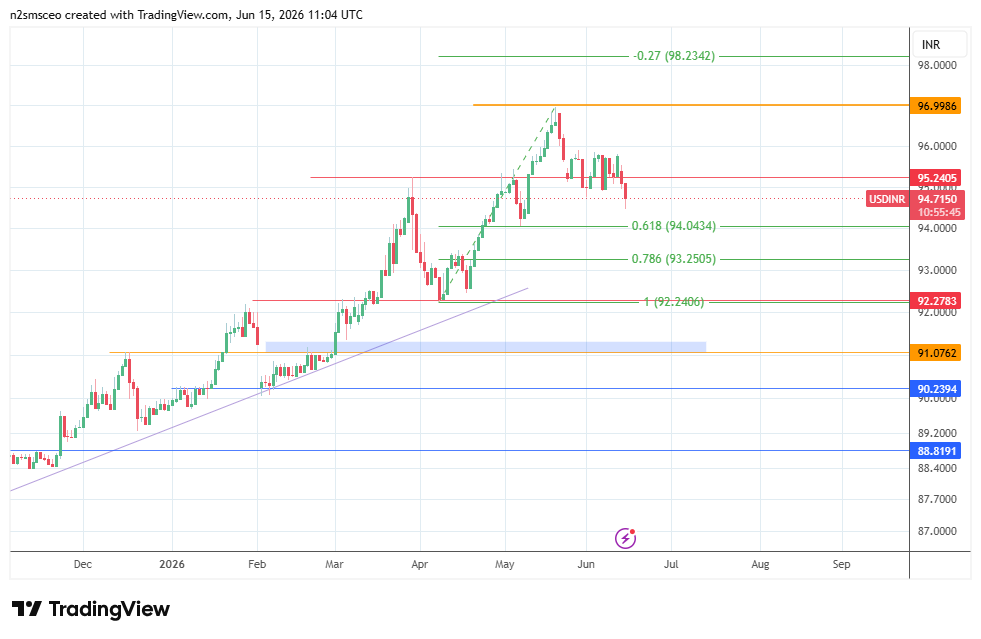
However, the 20 May all-time high at 96.96 will come back into focus if the current retracement fizzles out and the bulls manage to uncap the nearest resistance at 95.24. 98.23 is the 27% Fibonacci extension level and will become the next target to the upside if the bulls manage to uncap 96.96.