



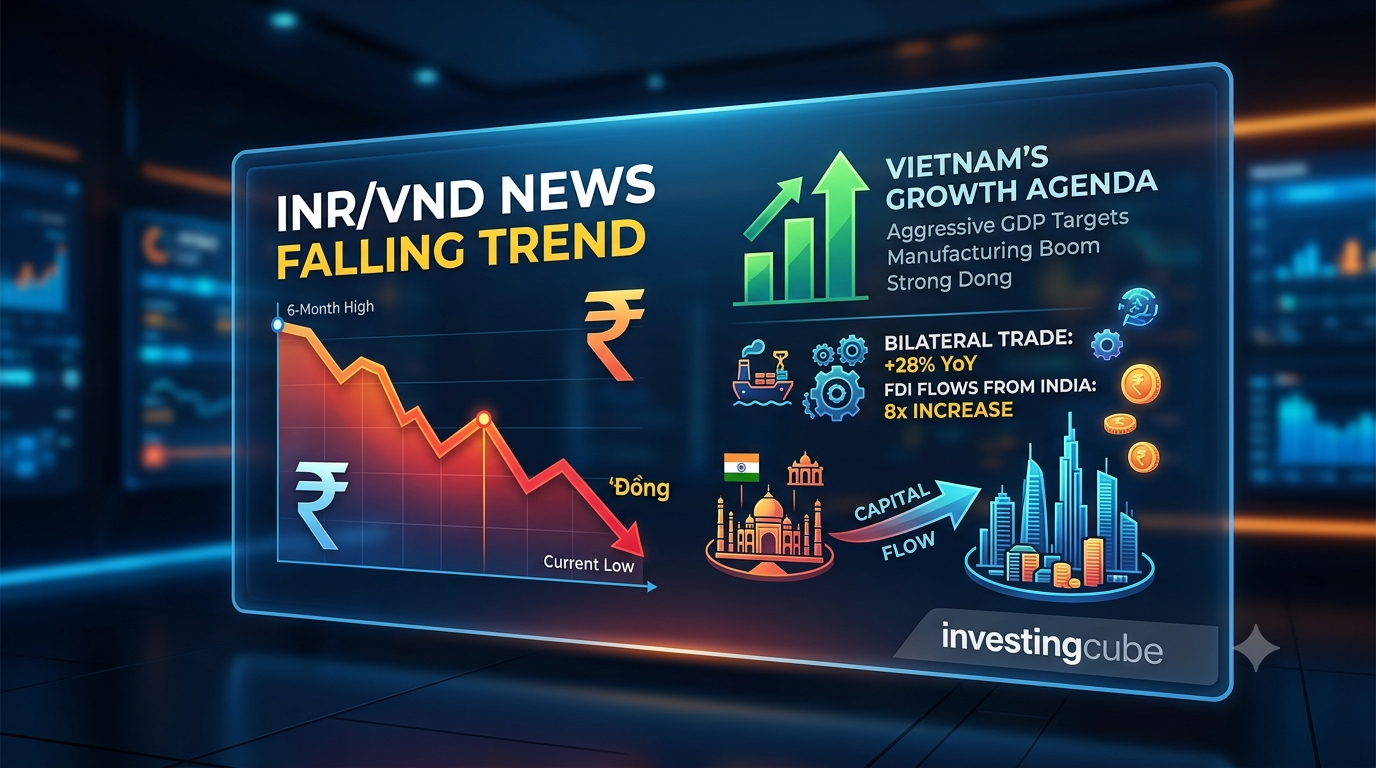
The Indian Rupee continued its steady decline against the Vietnamese Dong in mid-week trading, drifting toward six-month lows as a stark divergence in regional macroeconomic policies weights on the cross-rate.
By late evening trade on Wednesday, the INR/VND pair was hovering near 274.01, down roughly 6.2% from its January opening levels near 292.12. The persistent downward trajectory highlights a shifting dynamic across South Asian trade corridors, where Vietnam’s aggressive state-backed industrial expansion is giving the Dong a distinct structural edge.
Dual Speed Macro Economies
The primary catalyst behind the pair’s technical breakdown remains the relentless growth agenda driven by Vietnamese authorities. Headwinds in global trade have done little to cool domestic momentum in Hanoi and Ho Chi Minh City, where local manufacturing hubs continue to draw heavy capital inflows. At the same time, the State Bank of Vietnam (SBV) has maintained a tightly managed reference exchange rate framework, instilling deep institutional confidence and keeping the Dong remarkably resilient compared to its emerging-market peers.
Conversely, while India’s macro indicators remain robust on a standalone basis, the Rupee has struggled to maintain structural momentum against a hyper-accelerating Dong.
Rising Investment Between India and Vietnam
Interestingly, the weakness in INR/VND comes despite record levels of economic cooperation between the two countries.
India and Vietnam continue strengthening their Comprehensive Strategic Partnership, with bilateral trade reaching $4.8 billion during the first quarter of 2026, representing a 28% increase compared to the same period last year.
Investment flows have accelerated even faster.
Indian companies launched 30 new foreign direct investment projects in Vietnam during the first quarter, with combined investments totaling approximately $95.2 million, an eightfold increase from a year earlier.
Major Indian corporations, including Reliance Industries, KCP Group and Tata Group, continue expanding their presence across Vietnamese manufacturing, construction materials, renewable energy and consumer supply chains.
Reliance Retail has also announced plans to deepen sourcing relationships with Vietnamese manufacturers and agricultural suppliers, highlighting Vietnam’s growing role in regional supply chains.
Why Is INR/VND Falling Despite Strong Trade?
At first glance, stronger bilateral trade would normally be expected to support both currencies.
However, foreign direct investment creates a different dynamic.

As Indian companies expand operations in Vietnam, they convert capital into foreign currencies to finance acquisitions, manufacturing facilities and business expansion abroad. This increases demand for Vietnamese assets while creating additional pressure on the Indian rupee within the INR/VND exchange rate.
At the same time, Vietnam’s superior growth outlook, expanding exports and disciplined monetary policy continue attracting international capital into the country. Rather than reflecting weakness in India’s economy, the decline in INR/VND illustrates how quickly Vietnam has become one of Asia’s fastest-growing investment destinations.
Outlook for INR/VND
Looking ahead, the medium-term outlook for INR/VND will largely depend on whether Vietnam can sustain its current growth trajectory while maintaining currency stability.
Investors will closely monitor Vietnam’s export performance, manufacturing activity and central bank policy over the coming months. Continued foreign investment and infrastructure spending could keep supporting the dong.
On the Indian side, stronger domestic growth, improving capital inflows or a broader recovery in emerging-market currencies could help stabilize the rupee.
For now, however, momentum continues to favor Vietnam. The combination of strong economic fundamentals, disciplined exchange rate management and rising global investment suggests the INR/VND pair may remain under pressure unless market conditions shift significantly.
INR/VND FAQs
The pair has declined primarily because the Vietnamese dong has strengthened on the back of strong economic growth, stable monetary policy and rising foreign investment, while Indian companies continue investing heavily in Vietnam.
Not necessarily. The decline reflects Vietnam’s stronger relative economic performance and capital inflows rather than a deterioration in India’s broader economy.
The dong has been supported by robust manufacturing growth, export demand, strong foreign direct investment, government infrastructure spending and active exchange rate management by the State Bank of Vietnam.
When Indian companies invest in Vietnam, they convert capital into foreign currencies to fund overseas projects. These cross-border investment flows can increase demand for Vietnamese assets and contribute to weakness in the INR/VND exchange rate.
Key catalysts include Vietnam’s GDP growth, export data, foreign investment trends, decisions by the State Bank of Vietnam, and broader movements in emerging-market currencies.