



- The DAX continues to outperform despite Germany's weak domestic economy, supported by global revenue exposure, improving investor sentiment, and strong corporate resilience.
- Looking ahead, geopolitical developments, central bank policy, and the upcoming corporate earnings season will be the key factors determining whether the DAX can extend its rally or face a near-term correction.
The DAX 40 has been on a strong run, breaking out to new all-time highs above 25,700 points. The aggressiveness on this breakout faded as the new geopolitical tensions in the Middle East weighed on the DAX on Wednesday. On the other hand, Germany’s domestic economy faces weaknesses and increasing pressure on its exports.
This article explores the key drivers behind the DAX index’s momentum. It looks at fiscal policy shifts, global macro trends, and corporate restructuring. It also examines whether these factors can lift the index to new highs or if renewed US-Iran tensions could pressure market sentiment.
How Do Renewed US-Iran Tensions Affect the DAX Index?
Iran has launched attacks on three tankers in the Strait of Hormuz. Following that, the United States has launched a new wave of air strikes against Iran and revoked the key license for Tehran to sell oil. At the time being, fears regarding the fragile ceasefire between Iran and the US that could be put at risk have risen.
In response to the escalation, oil prices rose sharply. Brent crude oil and U.S. WTI have each climbed by more than 6% to $76.59 and $72.73 a barrel. Germany’s blue-chip index fell 1.1% as an immediate reaction to 25,184 points. The index moved back well away from its recent high of 25,900.10.
Let’s take a technical look at the DAX 40 index chart to assess how these geopolitical developments have affected the price action:
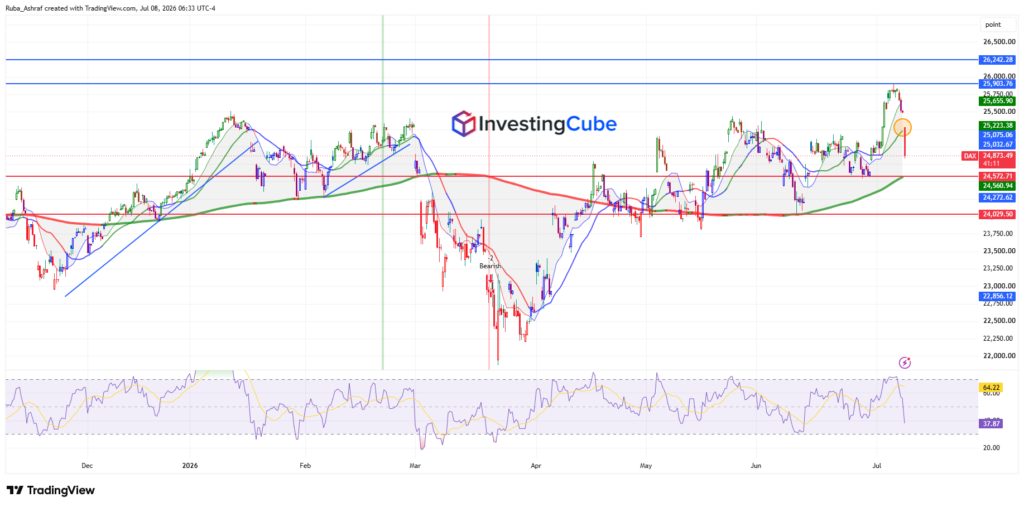
The DAX-40 price action shows that the broader trend remains bullish. The index continues trading above its long-term 200-period moving average. This reinforces the positive medium-term outlook. However, the latest price action indicates a sharp wave of profit-taking after rejection near the 25,900 resistance.
At the same time, the RSI has dropped sharply from overbought territory to around 39, indicating that the buying power is fading and increasing downside momentum in the near term.

Despite the recent sell-off, the broader trend remains constructive as long as the DAX holds above the key support region around 24,560. This aligns with the rising 200-period moving average’s location. A decisive break below this level could expose the next support at 25,290. Which potentially triggers a deeper corrective move.
On the upside, if buyers regain control and defend the long-term trend support, the index could attempt another rebound toward 25,520, followed by the recent high near 25,900. At this point. The renewed bullish momentum would be needed to resume the broader uptrend.
Global Macro Drivers & Central Bank Policies Affect the DAX-40:
- US labor market & Federal Reserve expectations:
The DAX is highly sensitive to US economic data because many of its largest companies generate a significant share of their revenue overseas. As a result, changes in Federal Reserve policy often influence global investor sentiment.
Recently, weaker-than-expected US non-farm payroll data eased concerns that the Fed would keep interest rates higher for longer. Lower rate expectations improve market liquidity and encourage investors to shift back toward equities. This change in sentiment helped support the DAX’s rally to fresh record highs in July.
Investors are now turning their attention to the minutes from the first Federal Reserve interest rate meeting under its new chair, Kevin Warsh. The minutes, due later today, could provide fresh clues about the Fed’s policy outlook. Any signs of a more dovish stance could further support global equity markets, while a more cautious tone may increase volatility. - The ECB’s Balancing Act:
At the same time, investors are closely watching the European Central Bank’s policy path. On June 12, the ECB surprised markets by raising its key deposit rate by 25 basis points to 2.25% after inflation remained more persistent than expected. While higher interest rates can increase borrowing costs for businesses and limit economic growth, investors are looking for signs that inflation is easing.
If price pressures continue to moderate, the ECB could eventually move toward a more accommodative policy, providing additional support for German equities. However, if inflation remains elevated, interest rates may stay higher for longer, which could limit further gains in the DAX.
Why Is the DAX Outperforming Germany’s Economy?
The DAX’s strong performance is not happening by chance. It is being driven by two main factors that continue to support investor confidence.
Corporate Resilience and Global Revenue Exposure:
Despite weak consumer spending and slow economic growth in Germany, the DAX has continued to perform strongly. This is because most DAX companies generate a large share of their revenue from international markets rather than the domestic economy. Their global operations help reduce the impact of weaker demand at home and provide more stable earnings.
Cost Control and AI Investment:
Many companies are also protecting their profits by cutting costs and improving efficiency. At the same time, they continue to invest in long-term growth areas such as artificial intelligence. For example, SAP has reduced hiring and travel expenses to redirect more capital toward AI development. These efforts have strengthened investor confidence and supported higher company valuations.