




- EUR/USD remains under pressure after the Federal Reserve's hawkish outlook strengthened the U.S. dollar, pushing the pair toward the 1.1400 support zone.
- The pair is attempting to stabilize above support, but upcoming U.S. inflation and labor market data could determine whether buyers regain control or sellers extend the decline.
- Momentum indicators suggest downside pressure is fading, although EUR/USD still needs to reclaim key resistance levels before confirming a broader recovery.
Current Setup and Live Chart
EUR/USD remains on the defensive after suffering one of its sharpest declines this month, with the pair trading near 1.1396 after briefly testing the 1.1380-1.1400 support region.
The stronger U.S. dollar continues to dominate the narrative following the Federal Reserve’s hawkish June meeting, where policymakers signaled another potential rate hike before year-end. Meanwhile, the European Central Bank has become increasingly cautious after its latest policy decisions, leaving interest-rate expectations tilted in favor of the dollar.
Despite the recent weakness, the pair appears to be stabilizing near an important technical support zone. The latest bounce, combined with improving momentum indicators, suggests sellers may be losing some control, although confirmation is still needed.
EUR/USD Macro Drivers
1. Fed Policy Continues Supporting the Dollar
The Federal Reserve remains the biggest driver of EUR/USD.
Although policymakers left interest rates unchanged, updated projections continue to point toward one additional rate hike this year. Higher U.S. Treasury yields have helped maintain demand for the dollar, keeping pressure on EUR/USD throughout June.
Unless incoming economic data weakens significantly, the Fed’s higher-for-longer message is likely to continue supporting the greenback.
2. ECB Rate Outlook Has Become Less Supportive
The European Central Bank has already delivered much of its tightening cycle, with investors increasingly expecting policymakers to pause after recent inflation improvements.
That has narrowed expectations for additional ECB tightening while the Fed remains relatively hawkish.
This widening policy divergence continues to favor the U.S. dollar over the euro.
3. Economic Data Could Shift the Narrative
Markets are now focused on upcoming U.S. Nonfarm Payrolls and Consumer Price Index (CPI) data.
A stronger labor market or hotter inflation reading would reinforce expectations for another Fed hike and could send EUR/USD toward fresh multi-month lows.
On the other hand, softer U.S. data would likely weaken the dollar and provide the euro with an opportunity to recover.
Near-Term Price Catalysts for EUR/USD
1. U.S. Inflation Data
The next CPI report could become the biggest catalyst for the pair. Sticky inflation would likely strengthen the dollar, while cooling price pressures may encourage profit-taking in long-dollar positions.
2. Nonfarm Payrolls Report
Employment data remains one of the Federal Reserve’s most closely watched indicators.

A strong payrolls report would reinforce the Fed’s current stance. A weaker reading could trigger a broad dollar pullback.
3. Treasury Yields
EUR/USD continues to show a strong inverse relationship with U.S. Treasury yields.
Should yields begin falling again, the euro would likely benefit as the dollar’s yield advantage narrows.
EUR/USD Weekly Forecast Scenarios
Base Case
EUR/USD continues consolidating above the 1.1380-1.1400 support area before attempting a gradual recovery toward 1.1450 and 1.1500. The current technical setup suggests selling momentum is slowing, although buyers still need stronger macro support.
Bull Case
A weaker-than-expected U.S. jobs report or softer inflation data could weaken the dollar, allowing EUR/USD to reclaim 1.1450 before targeting 1.1500. A break above 1.1500 would strengthen the medium-term bullish outlook.
Bear Case
If U.S. inflation surprises to the upside or Treasury yields resume climbing, EUR/USD could break below 1.1380, exposing 1.1330 as the next major support. A sustained move below that level would likely confirm a continuation of the broader downtrend.
Takeaway
EUR/USD remains caught between two competing forces.
The Federal Reserve continues supporting the U.S. dollar through its hawkish stance, while technical indicators suggest the recent selloff may be approaching exhaustion.
For now, the 1.1380-1.1400 support zone remains the most important level on the chart. Whether buyers successfully defend that area will likely determine the pair’s direction over the coming sessions.
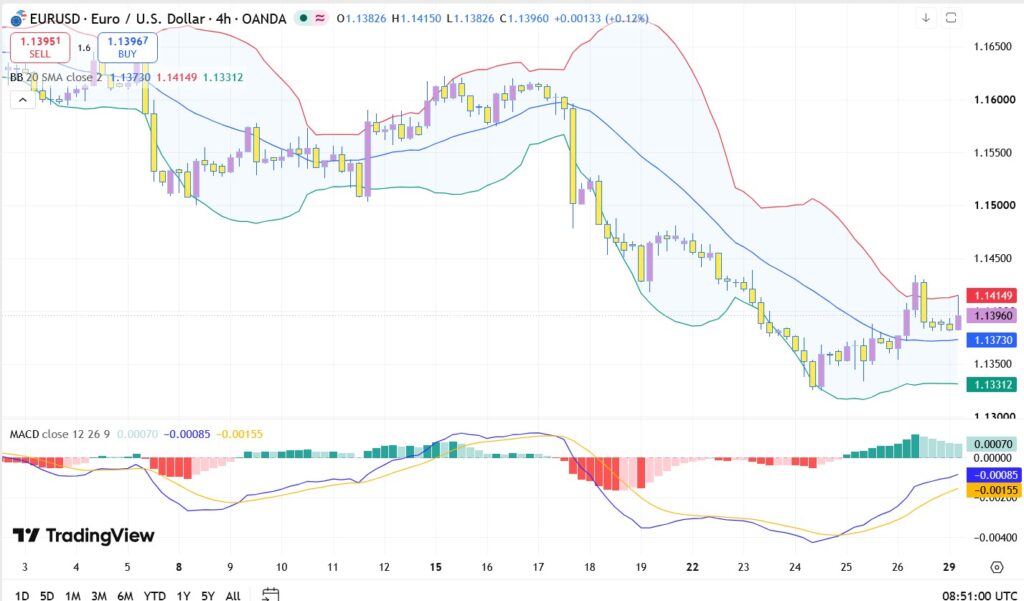
EUR/USD Technical Outlook
The technical picture remains cautiously bearish but is beginning to improve.
On the 4-hour chart, EUR/USD continues trading below the 20-period Bollinger Band moving average near 1.1437, confirming that sellers still hold the short-term advantage.
However, price has repeatedly found buying interest around 1.1380, preventing a deeper breakdown.
The MACD histogram has turned positive, while the MACD line is attempting to cross higher above its signal line, suggesting bearish momentum is fading and a short-term recovery could be developing.
For bulls, the first resistance sits at 1.1415, followed by the moving average near 1.1437. A sustained move above these levels would strengthen the case for a recovery toward 1.1500.
On the downside, immediate support remains at 1.1380, followed by the lower Bollinger Band near 1.1331. A decisive break beneath those levels would likely expose fresh multi-month lows and hand control back to sellers.