




- The EUR/USD remains under pressure as the new week begins. The Fed Chair and the NFP report could shed more light on Fed rate expectations.
Current Setup and Live Chart
Stronger-than-expected US data has reinforced the recent hawkish tilt of the U.S. Federal Reserve, ensuring that the U.S. Dollar ended the week very much as it started, on a very strong footing. The EUR/USD thus remains under pressure after declining towards the 1.13-1.14 price zone, as the higher Fed rate expectations and upbeat data sustain the greenback’s upside momentum.
The Core PCE Price Index came in as expected at 0.3%, with an upward revision of the prior number to 0.3%. The Final GDP QoQ registered at 2.1%, up from the prior and expected print of 1.6%. Unemployment claims dipped from 227K to 215K, while Core Durable Goods Orders came in at 1.3%, well above the 0.5% consensus.
Despite the DXY easing slightly, the U.S. Dollar remains in a strong uptrend versus the Euro, as investors continue to buy into the Fed’s hawkish rate expectation at the expense of the European Central Bank’s hawkish push.
EUR/USD Macro Drivers
Three macro drivers are presently driving the pair:
- More hawkish Federal rate policy expectations when compared to those of the ECB.
- The ECB expressed caution about further tightening at its last meeting, when it raised interest rates. So, as it were, the ECB’s action is already priced in, whereas the Fed’s is not yet fully priced in.
- Geopolitical uncertainty regarding elevated oil prices promotes safe-haven demand for the U.S. Dollar at the expense of the Euro, the single currency of the Eurozone, a net oil importer.
1. Fed Expectations
With the latest U.S. PCE inflation report showing a 4/1% rise in annual inflation, the Fed still has a lot of work to do to bring this metric within its 2% target. Higher rates are probably the best way to achieve this, and markets are responding accordingly. Expectations of a late 2026 rate hike remain firmly on the table. Furthermore, Personal Income and Personal Spending came in at 0.7% and 0.6%, respectively, higher than the 0.4% and 0.6% expectations. This means that consumers still have enough disposable income to exercise the kind of spending required to keep the U.S. economy robust.
2. Cautious ECB
The ECB emphasizes that future rate decisions will remain data-dependent, despite the rate hike at its last meeting. That is another way of saying the ECB may not be in a hurry to raise rates further, especially as energy prices have cooled, allowing the inflationary chokehold to loosen its grip on the oil-import-dependent Eurozone.
3. Safe-haven Demand

Oil prices may have eased after the recent truce between the U.S. and Iran, but all is not settled yet. There remains a remote chance that the final negotiations can break down, leading to a resumption of hostilities. If this is the case, another blockade of the Strait of Hormuz may push oil prices higher and trigger a return of risk-off sentiment, which favors the USD over the Euro.
Price Catalysts for the Week
1. Fed Speakers and U.S. data: Markets remain vulnerable to any decision by the Fed to raise rates later this year. The next event that could shed some light on this is when the New Fed Chair, Kevin Warsh, speaks at an ECB event titled “Policy Panel” on 1 July. On 2 July, the NFP figures for June will be released. These are the biggest price catalysts in what otherwise would be a quiet week on the economic news calendar.
2. Eurozone inflation expectations: Euro Flash CPI estimates will be due this week. The markets will check whether the oil-shock risk premium that drove up energy prices has begun to feed into the Eurozone’s core inflation. This is important for future ECB rate expectations, especially if the data prints exceed market expectations.
3. Risk sentiment: This will depend on further developments in the US-Iran talks. Any geopolitical escalations will trigger risk-off sentiment, further boosting the Dollar. Further progress is a risk-on trigger, which favors EUR/USD recovery.
EUR/USD Weekly Forecast
Base Case: A neutral-to-mildly bearish EUR/USD is the base case, given the relative dearth of market-moving data from the Eurozone against two high-impact news events from the U.S. Continued consolidation below recent highs is likely as markets await this week’s data.
Bull Case: softer U.S. data and higher-than-expected Eurozone Flash CPI estimates could promote a bull case scenario. Furthermore, if the Fed Chair walks back the recent hawkish signals at the ECB event midweek, this could favor a EUR/USD relief rally.
Bear Case: further bearishness awaits EUR/USD if NFP data and Fed Chair’s comments at the midweek ECB event reinforce hawkish rhetoric, suggesting a potential rate hike later in the year. A dip towards 1.12 cannot be ruled out in this scenario.
Takeaway
The pair continues to trade as an interest-rate-differential story, with the Fed’s hawkish expectations not yet fully priced in, while the ECB is seen as having done a sort of once-and-done rate hike until further data supports any further moves.
EUR/USD Technical Outlook
A decline below 1.1414 support and a pullback to retest this level as resistance are on the cards. If the bears reject this new attempt to reclaim the price area above this support, the stage could be set for a further decline towards the 1.1269 support in the first instance. A further decline brings in the support zone at 1.1142-1080 previously seen in mid-May 2025 as the next downside target.
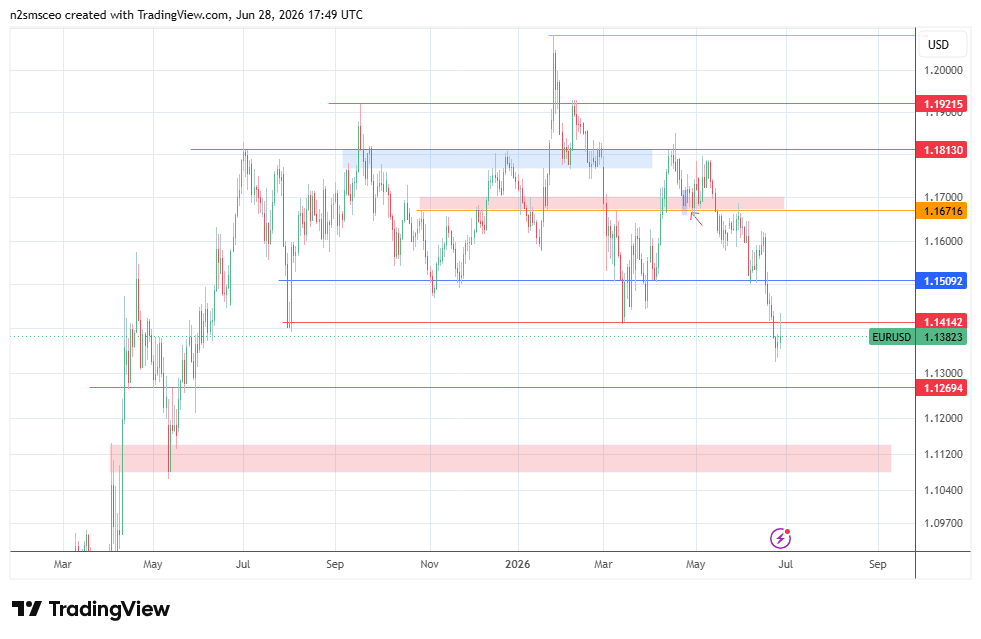
However, success in uncapping 1.1414 allows for an upside retracement targeting 1.1509 initially (the 24 November 2025 and 5 June 2026 lows), leaving the 1 June 2026 top at 1.1671 as the next viable upside target if the recovery move is more extensive.