



- The USD/JPY is under focus as the Bank of Japan considers a change in its policy statements following a retest of multi-year highs.
Current Setup and Live Chart
The US Dollar has so far been on the front foot against several of its peers, including the Yen. This has helped the USD/JPY recover from last week’s lows, triggered by Fed Chair’s remarks in Sintra and lower-than-expected US jobs numbers. The decline after the NFP release provided an opportunity for a relief rally in Yen, as the pair was already at a level where prior interventions by Japanese financial authorities had occurred.
The USD/JPY entered the new week trading higher, as elevated US Treasury yields provided support. In the meantime, relatively low domestic interest rates compared with those in the US meant that capital flowed more into the US Dollar and away from the lower-yielding Yen. This has left interest-rate differentials firmly in favor of the US Dollar.
USD/JPY Macro Drivers
1) US Treasury Yields
The differential between US bond yields and Japanese Government Bonds (JGBs) continues to be the dominant driver of the pair’s upside move. If you are seeking a currency pair with a strong positive correlation with US Treasury Yields, USD/JPY fits the bill. Higher US bond yields are associated with higher returns on USD-denominated assets. Foreign portfolio investors must convert their currencies into USD to invest in these assets, driving USD demand and sending the pair higher. Furthermore, carry trade participants typically borrow the Yen due to its low interest rates and invest in currencies with higher interest rates, such as the US Dollar. These yield dynamics continue to support the pair.
2) Slow Pace of Bank of Japan’s Normalization
Investors feel that the Bank of Japan’s interest rate normalization has not been as fast as they had hoped. The BoJ has delivered fewer rate hikes than initially predicted, as wages rose after several years of stagnation. The situation means Japan’s interest rates remain lower than those of its G10 peers. This provides limited support for the Yen, making it particularly vulnerable to higher-yielding currencies.
3) Intervention Risk Remains if USD/JPY> 160.00
Japanese authorities previously intervened when the price got to 160.00 in May 2026. There is usually communication from the financial authorities when action is about to be taken to stabilize the Yen. Any further acceleration above the 162.00 price level could prompt policy communication or direct intervention (by selling USD and buying Yen).

Price Catalysts (Near Term)
1) US Data: The Fed is now shifting to a data-dependent approach for future Federal Reserve policy. Therefore, US data, such as inflation (CPI, PPI) and employment, will be critical to the Fed’s policy formulation. This will impact US bond yields and, subsequently, USD/JPY.
2) US Treasury yields: The USD/JPY is tightly correlated with US bond yields. Any factor that causes movement of the US bond yields in either direction will take the USD/JPY along with it in the direction of the bond yields’ move.
3) Bank of Japan communication: Any commentary by the Bank of Japan regarding its policy normalization trajectory, or potential intervention via the sale of US Dollars for Japanese Yen, remains a key catalyst for price movement.
USD/JPY Weekly forecast scenarios
Base case: the pair is expected to remain bullish if US bond yields remain elevated and the BoJ either does not intervene or proceeds with normalization policy with the same level of caution currently shown.
Bull case: if US macroeconomic data continue to show stronger-than-expected prints, US Treasury yields will keep rising and yield differentials will widen. Further USD strength is driven by dollar demand, and if the BoJ supplements these factors with dovish guidance, we could see the pair challenge multi-year highs above the 163.00 price mark.
Bear case: cooler-than-expected US inflation and downbeat US data will lower US bond yields. If the BoJ turns more hawkish than expected in subsequent communication, we could see a strong pullback in USD/JPY, with the potential to dip below the 160.50 support level.
USD/JPY Technical Outlook
The pair is now poised to challenge the 162.67 resistance level formed by the prior high on 1 July. It is also the 27% Fibonacci extension level of the 13 February – 30 April price swing. If the bulls uncap this barrier, the path to the 165.44 resistance opens.
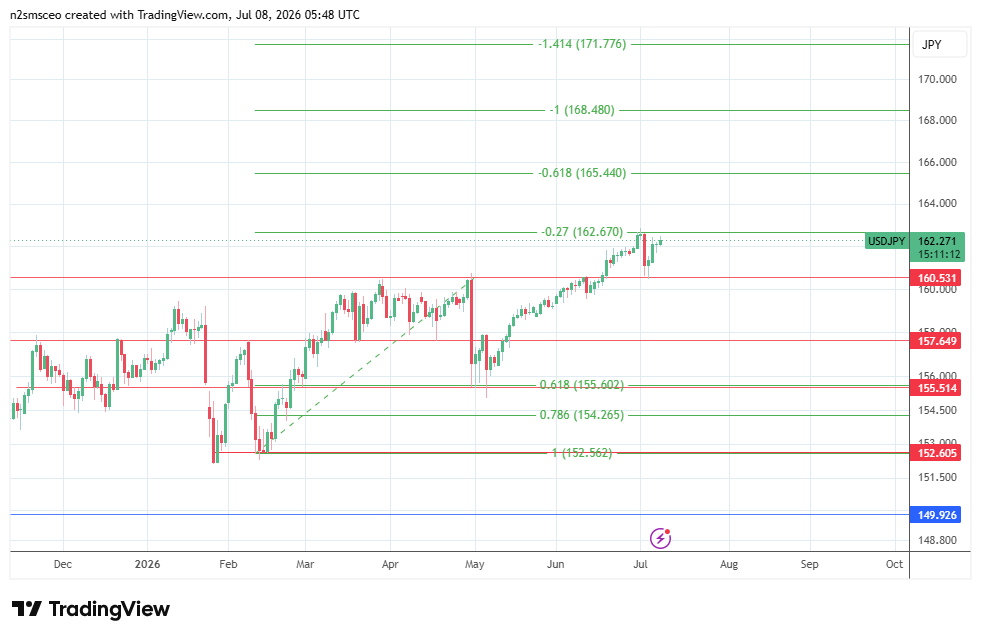
However, a rejection at the 162.67 resistance level makes a case for a retracement toward the 160.53 support. If this support is degraded, a deeper retrace towards the 157.64 support will be on the cards. Below this level, the 61.8% Fibonacci retracement level and the prior low of 30 April at 155.51 become the next downside target.