



- The pair between the Peso and the Dollar (USD/MXN) is currently consolidating as traders await further triggers from the macroeconomic front.
Current Setup and Live Chart
The USD/MXN pair is currently trading in a consolidation between 17.1016 and 17.6417, with the former acting as the price floor and the latter acting as the ceiling. This consolidation comes as traders juggle between U.S. interest rate expectations, global risk sentiment, and Mexico’s relatively high interest rates.
The pair has seen the recent uptick rejected at the price ceiling following the relatively dovish comments from new Fed Chair Kevin Warsh at the Sintra Central Banking Forum. While these comments and the downbeat NFP data have not heavily dented the U.S. dollar’s recent strength, they have contributed to the counterbalance between the U.S. Dollar and the Mexican Peso.
Macro Drivers of the USD/MXN
1) Interest Rate Differentials
The Mexican Peso has one of the highest real interest rates among emerging market currencies. This has led to carry trades between the USD and the Mexican Peso. Now that the Fed has indicated it will adopt a cautious stance to interest rate adjustments, interest rate expectations in the U.S. have been repriced lower. The high interest-rate differential between the two currencies continues to promote foreign bond investments, carry-trade strategies, and Peso-leaning institutional capital flows.
2) Oil Prices
The Peso is a commodity currency that has a positive correlation to oil prices. During the oil price shock, the Peso gained sharply against the U.S. dollar despite safe-haven flows into the dollar. The Peso remained stable and maintained a strong 25% gain from February 2025 to date against the greenback.
3) Fed Rate Expectations
Expectations for the Federal Reserve’s interest rate policy continue to be a key driver for the pair’s price movements. Now that the Fed is shifting to a data-dependent approach to monetary policy, U.S. data will become important drivers of price movements in the USD/MXN pair. The pair is expected to remain sensitive to the direction of U.S. Treasury yields. Declining yields will encourage demand for the higher-yielding Peso, while rising U.S. bond yields will shift focus towards the USD.
4) Nearshoring

Mexico continues to benefit from the nearshoring trend. Nearshoring is the process by which investments shift to countries with lower production costs. Mexico has relatively lower production costs for companies in the United States, as wages are lower and the operating environment has a lower cost of moving than the United States. This nearshoring investment potential continues to support foreign direct investment into the Mexican market, which requires foreign capital denominated in U.S. dollars to be converted into the local Peso. This also boosts Mexico’s industrial production, export growth potential, and employment, all of which together provide confidence in Mexico’s economic outlook.
Price Catalysts (Near Term)
1) U.S. economic data: U.S. data, especially those around employment, labor market conditions and inflation, look set to assume greater importance now that the Fed is shifting towards a data-dependent approach to monetary policy. Stronger-than-expected US data are supportive of USD/MXN. In contrast, downbeat data will limit near-term recovery potential, as the pair is now in a consolidation phase following a 16-month downtrend.
2) Global risk sentiment: The USD/MXN is a pair that is highly sensitive to global risk sentiment. The greenback benefits from risk aversion, while the Peso thrives when investor appetite for risk is high.
3) Mexican inflation and central bank expectations: the market will keep watch over Mexico’s data, especially those around inflation and Banxico’s rate policy. Higher domestic inflation will support the Peso, as it increases the risk of a rate hike from the Mexican central bank.
USD/MXN Weekly Forecast Scenarios
Base case: neutral to bearish, as the interest rate differential and the dovish shift of the Fed should allow for a further retracement from the range top, even as a resilient USD prevents a downside continuation.
Bull case: stronger-than-expected U.S. macroeconomic data and rising U.S. bond yields. Furthermore, any conditions that lead to a deterioration in global risk sentiment can trigger a safe-haven flight to the U.S. Dollar, drawing capital away from emerging-market currencies. In this situation, the pair will break out of the consolidation and aim for the 18.15-18.60 price range.
Bear case: softer-than-expected U.S. inflation, global risk-on sentiment, strong Mexican data (especially local inflation), and falling U.S. bond yields will trigger the bear case scenario. Add in the carry trade dynamics, and we could see a continuation of the downward trend in place since February 2025. A move toward 16.60 cannot be ruled out under this scenario.
USD/MXN Technical Outlook
The pair is trading within a consolidation. 17.1016 is the range floor, and 17.6473 is the range ceiling. Currently, price is retracing after rejection at the range ceiling. The range’s floor is next in line, and if the bears succeed in eroding this support, a continuation of the downtrend towards 16.6272 (the 28 July 2023 and 17 May 2024 lows) could be on the cards.
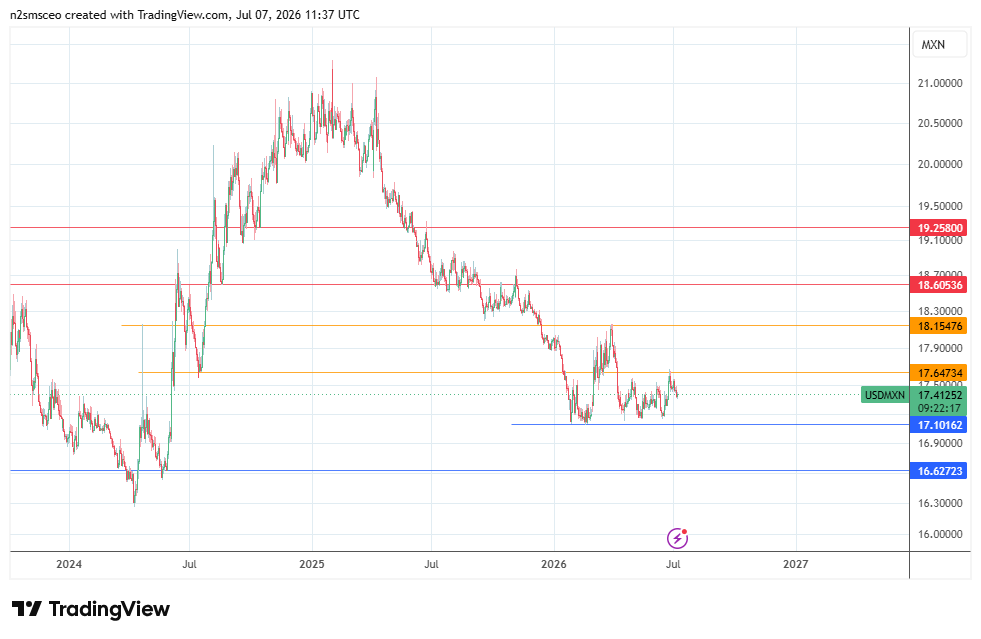
On the flip side, recovery in the pair follows an uncapping of the 17.6473 range ceiling. This move lines up the 18.1547 high of 18 April 2024 with the 31 March 2026 high as the next upside target. A further upside extension brings in 18.6053 as the next target in line for the bulls.