


- Silver prices have begin the week on a lower note after US bond yields started to rise once more, following a 4-day winning streak.
Current Setup and Live Chart
Silver prices have started the week on a lower note, down 0.42% as of writing. This comes after a four-day winning streak, which came on the back of resilient industrial demand and generally dovish comments from the central bankers meeting at Sintra last week.
Silver is a high-beta asset that continues to benefit from upbeat industrial consumption and demand, as well as from flows into metal assets when U.S. bond yields decline.
Silver’s latest uptick came on the back of the bearish week in review for the U.S. dollar. Firstly, the new U.S. Fed Chair, Kevin Walsh, indicated that the Fed was moving away from forward guidance toward a data-dependent approach to determining interest rates. The markets considered these comments as more dovish than expected, leading to a lower repricing of Fed rate-hike expectations for 2026.
The downbeat U.S. non-farm payroll data put the U.S. on the back foot and allowed metal assets such as silver to push up from lows. Silver prices are also underpinned by sustained demand from the AI, EV, solar, and semiconductor industries.
Silver Price Catalysts in the Near Term
1) US data and Federal Reserve expectations: Now that the Fed is shifting to a data-dependent approach to determining future monetary policy, US data have gained an additional measure of importance. Any US data, such as the US CPI, that could alter the Fed’s future rate expectations will have a direct bearing on US bond yields, the US Dollar, and, by extension, silver prices.
2) US Treasury Yields: US bond yields, especially those of the US 10-year Treasury Note, directly impact silver prices because silver pairs with the US Dollar in the XAG/USD asset. This is the asset pair that is used to represent silver prices. Therefore, lower bond yields lead to a weaker US Dollar and higher silver prices, while firmer bond yields lead to lower silver prices.
3) Global manufacturing data: Data surrounding business conditions in the manufacturing sector (PMI surveys and Chinese industrial production) will provide critical insight into the state of physical demand for silver. Improving manufacturing activity ramps up silver demand, which is supportive of silver prices.
Silver Price Macro Drivers
1) Industrial Demand
Silver is an industrial metal that is used in a variety of fast-growing industries. The market is starting to see strong demand from the EV sector, semiconductor manufacturers, and companies behind artificial intelligence infrastructure, power grid modernization, and solar power manufacturing. This is what makes silver distinct from other metals: its strong industrial consumption drives macro demand for the asset.

2) U.S. Monetary Policy Expectations
U.S. monetary policy expectations remain a strong driver of solar prices. The recent comments by the Fed chair at the Sintra forum have led to a dovish repricing of the Fed’s policy stance. The market will continue to view Fed rate expectations as a driver of silver prices, given their impact on U.S. bond yields. If the Fed is more dovish, it typically lowers real interest rates, reducing the opportunity cost of holding precious metals like silver and encouraging investment demand for silver through ETFs. This is partly what led to the 4-day winning streak in silver prices last week. However, if deferred rate expectations turn hawkish, this will exert the opposite effect on silver prices, leading to a price decline.
3) Geopolitics
Geopolitics remains a key driver of silver prices. Despite the US-Iran truce, there remains the possibility of geopolitical escalation, especially as the weekend burial of former Iranian Supreme Leader Khamenei has restored political tensions in Iran, especially among those calling for Iran to exert some form of retaliation against the U.S. government for Khamenei’s killing. Typically, any safe-haven buying into precious metals starts with gold, but it also has a spillover effect on silver as investment flows begin to cross the precious metals divide. Therefore, any escalation of geopolitical tensions could spill over into silver prices, leading to increased volatility.
Silver Price: Near-term Forecast Scenarios
Base case: as long as industrial demand remains strong, a recovery in silver prices remains the base case scenario, even as the markets continue to digest the dovish comments of the Fed Chair at last week’s Sintra forum. US data this week is sparse, so the spillover of last week’s macro impact is expected to spill into the current week.
Bull case: a weaker US Dollar will follow a lowering of US Treasury yields. If next week’s US CPI data comes in cooler-than-expected, the markets are expected to react bullishly to silver prices. This outlook is bolstered by stronger-than-expected manufacturing data and an acceleration in ETF flows driven by renewed institutional buying.
Bear case: surprisingly strong US data will lead to a rise in US long-term bond yields, producing a demand for the US dollar at the expense of metal assets such as silver. Under these conditions, profit-taking from the recent gains may ensue, and investment demand could also drop off.
Silver Price (XAG/USD) Technical Outlook
The intraday strength of the US Dollar has beaten back the XAG/USD pair from the 63.98 price level, which currently serves as the nearest resistance (the 6 February 2026 low). If the bearish pressure persists, the 54.66 support (role-reversed highs of 16 October/13 November 2025) becomes the next downside target. Below this level, the downtrend is re-established, with subsequent downside targets at 49.50 (the prior low of 18 November 2025) and 45.83 (the 28 October 2025 low).
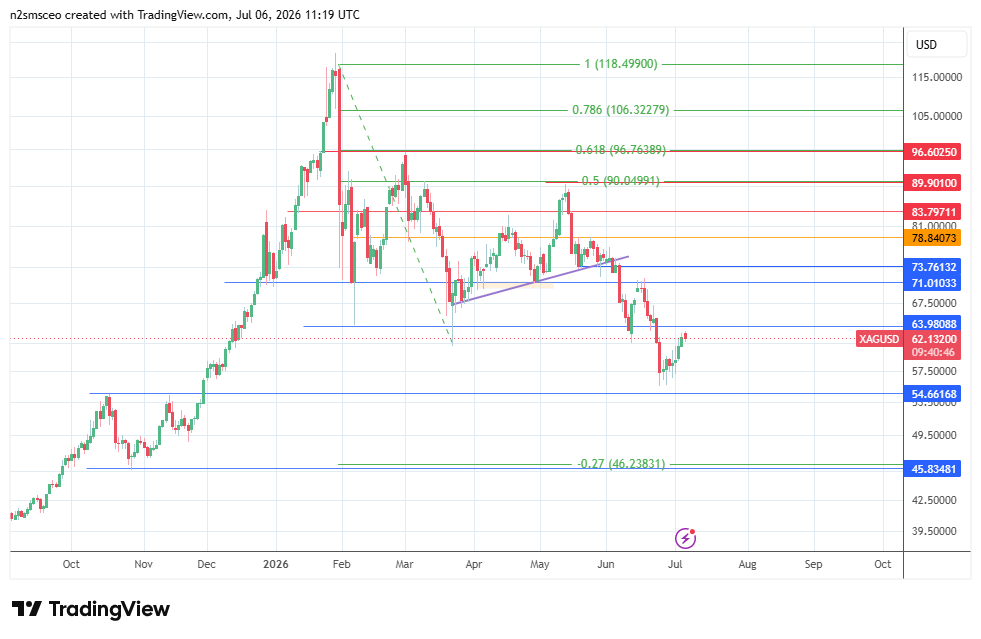
Conversely, if the bulls manage to uncap the 63.98 resistance, a further push north towards the 15 June high at 71.01 could be on the cards. 78.84 is the next upside target if the 71.01 resistance is uncapped, with subsequent upside targets at 89.90 (13 May high) and 96.60 (2 March high) entering the mix on a further recovery.