



Current Setup and Live Chart
The EUR/PLN is currently trading as a balancing act between the evolving monetary policy of the European Central Bank (ECB) and Poland’s relatively resilient economic outlook, which has kept the National Bank of Poland (NBP) cautious in its interest-rate approach. This is a classical playbook of the ECB versus a CEE proxy.
The Polish Zloty is one of the strongest of the Central European currencies. The Zloty has benefited from Poland’s stellar domestic growth, moderate inflation and an interest rate policy that attracts capital chasing higher yields relative to the single currency.
Therefore, the pair remains sensitive to both internal factors within Poland itself and external influences from the Eurozone, such as geopolitics, global risk sentiment and EU growth outlook. The EUR/PLN is currently trading at 4.2876, down by 0.02%.
EUR/PLN Macro Drivers
1) Cautious Stance of the National Bank of Poland
The Polish Central Bank’s policymakers remain cautious about a downward adjustment of interest rates despite the significant cooling of domestic inflation. Therefore, Poland’s domestic interest rates continue to support the Zloty. This attracts capital away from lower-interest developed economies and into Poland’s fixed-income markets that offer higher yields. Therefore, the sentiment around this lot remains constructive as long as inflation remains under control.
2) ECB Policy Expectations
The European Central Bank increased interest rates at its last policy meeting. However, recent commentary from ECB policymakers, including ECB Chair Christine Lagarde at the ECB Sintra meeting within the week, indicates that the European apex Bank wants to maintain a data-dependent approach to monetary policy decisions. This wait-and-see approach by the ECB looks set to cap near-term gains in the euro relative to the Zloty. The situation could put pressure on the pairing. On the euro side of things, the market will continue to focus on eurozone inflation, the growth outlook, and any other data the ECB considers important for achieving its inflation targets via monetary policy.
3) Improving Polish Fundamentals
Poland’s economy has shown signs of robustness and resilience, but household consumption remains strong. Industrial production is recovering, and this has led to stable market conditions and improved business confidence. These factors continue to underpin investor interest and confidence in Polish markets, including in the Zloty.
Price Catalysts (Near Term)

1. Eurozone Economic Data: The Eurozone may release data that will shape sentiment and the legal side of the period, including risk PMIs, industrial production growth, and economic data and location data. If these Eurozone data beat market expectations, this will be considered supportive for the Euro.
2. Inflation and other economic data from Poland: Domestic inflation data from Poland are considered especially important in the NDP’s assessment of the monetary policy outlook. Other data afloat include GDP data, employment, and retail sales. Stronger domestic data will be considered supportive of this outlook in the near term and medium term.
3. Global risk sentiment: Typically, the Zloty is a risk-owned currency that performs well when investor confidence improves. However, deterioration in global risk appetite tends to affect the Zloty more than the euro, because the euro is considered a safer-haven currency than the Zloty.
EUR/PLN Near-Term Forecast Scenarios
Base case: The pair is currently in consolidation, but the base case scenario is for a mildly bearish turn at the current resistance due to Poland’s relatively stronger macroeconomic fundamentals. The interest rate differential currently favors the Zloty, supporting this narrative as long as the global risk sentiment does not deteriorate.
Bull case: If Polish economic data starts to weaken and drives dovish NBP expectations, this could be a buy-case trigger. Stronger Eurozone economic growth will also reinforce this scenario. Under these conditions, markets will start to price in additional easing by the NBP, and the Euro will attract new demand, sending the pair higher.
Bear case: Stronger-than-expected Polish data on the back of resilient inflation and softer eurozone performance is likely to be very supportive of the pair. This will favor a breakout scenario that will see the pair hitting new highs for the year, even as Poland’s high interest rates attract capital away from the Eurozone.
Takeaway
The EUR/PLN continues to trade in balance between Poland’s improving domestic fundamentals and the Eurozone’s growth outlook. Interest rate differentials currently tilt towards the Zloty. However, a combination of deteriorating Polish data and improving Eurozone data will support the pair. But if inflation remains resilient in Poland and the EU growth outlook worsens, the pair could see a slump from current levels.
EUR/PLN Technical Outlook
The rejection at the 4.3067 resistance and prior highs of 8 April 2025 and 3 March 2026 keeps the pair in consolidation. The pair’s rejection is expected to dovetail into a further retracement to the opposing support levels at 4.2635 initially. A further breakdown of this pivot brings in the next support at 4.2271, which houses the lows of April-June 2026. Only if the bulls fail to defend this pivot will we see a further deterioration towards the 27 February 2025 low at 4.1296.
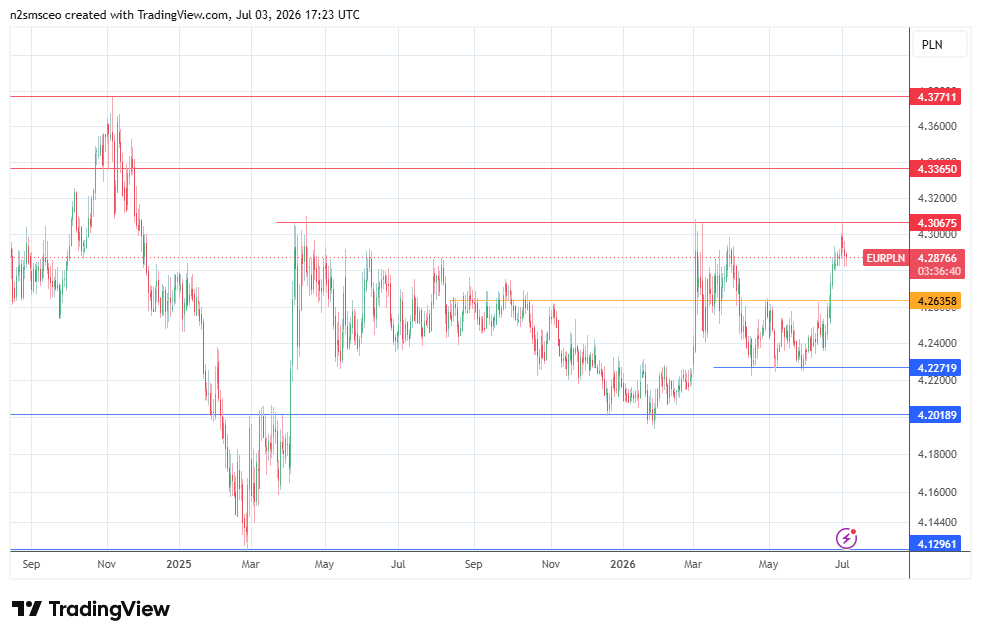
On the flip side, the uptrend returns on a break of the 4.3067 resistance. This uncapping action exposes the next resistance at 4.3365, before the 6 November 2024 high at 4.3771 becomes the next target in line for the bulls.