



- Traders are exercising caution on the USD/ZAR ahead of two high-profile risk events this week, even as a bullish chart pattern evolves.
Current Setup and Live Chart
The USD/ZAR is a classic showcase of a pairing between the US Dollar and an emerging-market FX currency that is highly sensitive to changing Fed interest rate expectations, global risk sentiment, and commodity prices. South Africa’s domestic fiscal and political outlook sometimes comes into the mix as an occasional macro driver.
Presently, the market is expecting the Fed Chair’s outing at an ECB event on Wednesday, which could stoke renewed Fed rate expectations. Furthermore, the Non-Farm Payrolls report will be indicative of US data that either validates current Fed rate expectations or forces an unwinding of these expectations.
The Rand is slightly higher vs the US Dollar today, trading 0.15% higher as markets await the market-moving events of Wednesday and Thursday, even as an interesting technical pattern forms on the daily chart.
USD/ZAR Macro Drivers
1) Global risk sentiment remains the primary driver
When markets are in risk-on mode, investors seek higher returns from higher-risk emerging-market assets. On the flip side, capital tends to flow out of these higher-risk emerging-market assets and into the safe-haven U.S.U.S. dollar when market uncertainty rises.
2) Fed Rate Expectations
Emerging-market FX currencies, such as the South African rand, are highly sensitive to changes in interest-rate expectations of the U.S. Federal Reserve. The rand typically gives a higher yield than the U.S.U.S. dollar because interest rates in South Africa are higher. In an environment where interest rate expectations for the U.S. Federal Reserve have turned hawkish, capital flows out of emerging-market currencies and towards the U.S. dollar. Similarly, when interest rate expectations for the U.S. turn dovish, capital leaves the lower-yield environment of the greenback for riskier, high-yielding emerging market currencies.
3) Domestic fiscal and political developments

Within South Africa itself, domestic fiscal and political developments could influence the value of the rand, but to a lesser degree than the previously discussed macro drivers. In this instance, traders will be studying the interest rates of the South African Reserve Bank, as well as structural economic reforms, the state of mineral exports, and investor confidence.
Near-term Price Catalysts for the USD/ZAR
US Economic Data: Two risk events will determine the near-term price direction of the USD/ZAR. The first is the outing of new Fed Chair Kevin Warsh at an ECB policy event in Portugal. The markets will seek clues on the future of the Fed’s policy direction. The second is the May release of the Non-Farm Payrolls data, which gets released with the Average Hourly Earnings data (wage inflation). The NFP will indicate whether the US economy, via its labor market, remains as robust as it has been in recent months.
Global risk sentiment: A second price catalyst concerns how it impacts emerging market capital flows. The demand for South African bonds and equities is a short-term price driver for the rand. This is usually the case when markets are in a risk-on mood, with improving global risk sentiment. However, a return of risk aversion, as we saw during the oil shock risk premium, will boost safe-haven markets and drag capital towards the US dollar.
USD/ZAR Forecast Scenarios
Base case: This scenario calls for the currency pair to be moderately bullish in the near term, as a resilient USD and more cautious global risk sentiment should keep it supported, even though a boost in commodity prices may limit the upside.
Bull case: the scenario will be triggered by stronger-than-expected U.S. data and hawkish comments from the Fed Chair at tomorrow’s ECB event. The combination of a stronger dollar and hawkish Fed rate-hike expectations will raise U.S. bond yields and trigger a decline in commodity prices. In this scenario, we will see capital outflow from U.S. market currencies towards the U.S. dollar and USD-denominated assets. Demand for the U.S. dollar will also increase, allowing the USD/ZAR to recover from recent retracements.
Bear case: The triggers for the bear case scenario are improvements in global risk estimates, stronger commodity prices and softer U.S. economic data. Furthermore, any comments by the Fed Chair that walk back recent hawkish expectations for the U.S. Federal Reserve’s interest rate policy are likely to boost the rand’s value as well. These conditions would drive capital away from the U.S. dollar and into higher-yielding emerging-market FX assets, thereby creating a situation in which the pair extends its downside retracement.
Takeaway
The USD/ZAR continues to be one of the most globally sensitive emerging market currency pairs. The pair trades within a regime characterized by the interplay among U.S. monetary policy, global sentiment, and commodity pricing. However, the main triggers for United price action this week will have to lie with U.S. data and the risk events due on Wednesday and Thursday.
USD/ZAR Technical Outlook
The evolving falling wedge pattern is a retracement of the upside move from the 29 January/26 February double bottom pattern that peaked at 17.1502. Upside continuation only follows the break of the upper wedge border and the 16.6616 resistance (8 June and 24 June highs). This will unlock the pathway that gives the bulls clear skies to reclaim the 17.1502 resistance and the 31 March high.
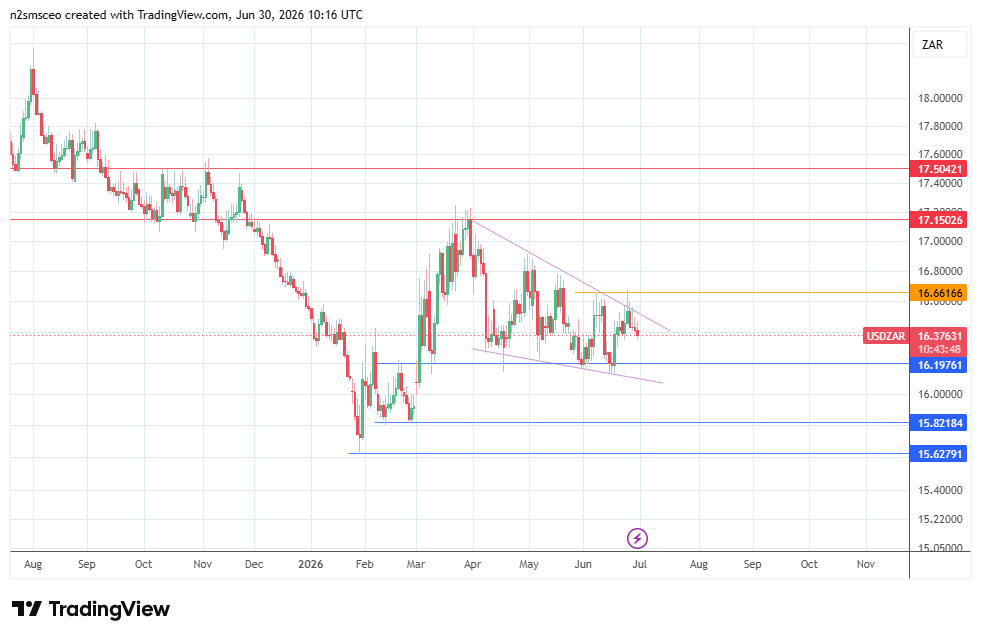
However, a decline below the 16.1976 support (Q2 2026 low) and the lower wedge border invalidates the upside continuation, and instead points to a further decline that retests the higher bottom at 15.8218. The lower of the two troughs constituting the double bottom at 15.6279 forms the next downside barrier.