



- The USD/JPY remains in intervention territory above 160.00. and two risk events have the potential of testing the BoJ's will in this regard.
Current Setup and Live Chart
The USD/JPY continues to trade within the interest rate differential regime. The pair remains supported above the 162.00 mark by relatively high US Treasury yields, with the potential for a rate hike by the Fed in late 2026 priced in by markets. This support is also underpinned by the accommodative monetary policy of the Bank of Japan, which keeps the Yen weaker relative to the USD.
However, the pair is now at levels where the last intervention by Japanese financial authorities occurred. A test of this will could happen today, as the new Fed Chair, Kevin Warsh, is due to speak on monetary policy at an ECB event in Portugal. If the Fed Chair doubles down on the recent hawkish tilt of the Fed, this could send USD/JPY into uncharted territory, where Japanese financial officials will have to determine whether to act or stay put. If he signals a change in the Fed’s approach to a data-dependent pathway, this could be bearish for the pair. The pair is currently trading at 162.62, marginally higher by 0.07% as of writing.
USD/JPY Macro Drivers
1) US Treasury yields
US bond yields are currently the primary driver of USD/JPY, making this pair one of the assets most strongly correlated with US long-term bond yields. When bond yields rise relative to Japanese Government Bonds (JGBs), this increases the attractiveness of US bonds and other dollar-denominated assets, thereby promoting capital flows into the US dollar. On the other hand, lower US bond yields make USD-denominated assets less attractive and will lead to a strengthening of the Yen relative to the US Dollar.
2) Bank of Japan Policy Normalization
The BOJ is normalizing policy, but at a relatively slow pace, keeping current interest rates low compared with other G10 peers. The market expectation is for the BoJ to maintain this path, despite recent data showing the Tokyo CPI heating up. If the BoJ maintains a measured, data-dependent tightening path, this could limit support for the Yen.
3) Intervention Risk at Current Price Levels

The USD/JPY is now at levels at which Japanese authorities last intervened. The risk event of today has already been mentioned, and after that comes Thursday’s Non-Farm Payrolls report. These two risk events will test the will of the Bank of Japan to allow any further weakness in the Yen towards the 165.00-170.00 levels. If these events lead to further depreciation of the Yen, markets will expect some response, either verbal intervention or more direct currency intervention, in which the BoJ will sell dollars to force a supply-driven depreciation of the pair.
USD/JPY Weekly Forecast Scenarios
Base case: the scenario is bullish as long as the market fundamentals continue to drive US bond yields higher. Even in the face of occasional interventions, USD/JPY should remain supported, as such interventions have historically provided new re-entry opportunities at lower prices.
Bull case: upbeat US economic data and hawkish Fedspeak push US Treasury yields higher. This will strengthen demand for the USD as investment flows pour into dollar-denominated assets. In this context, a push towards 165.00 Yen may not be ruled out.
Bear case: weaker-than-expected US data or a faster pace of BOJ tightening supports the Yen. This would then favor a push below 160.00, targeting the nearest support levels below this psychological barrier.
Takeaway
USD/JPY is trading within the regime of interest differentials between the Fed and the BoJ. The current trend is upward, as Fed expectations are hawkish and BoJ normalization continues to drag. Unless US bond yields decline sharply due to a more dovish Fed or an acceleration in the Bank of Japan’s policy normalization, the broader trend will remain bullish. Any intervention at this point will be seen more as a retracement and not a bearish reversal.
USD/JPY Technical Outlook
The pair has stalled at the 162.67 resistance mark, which is the 27% Fibonacci extension of the 12 February – 30 April upswing. The daily candle is forming a pinbar, which could favor a retracement towards the 160.53 support. A further push below this support brings downside targets into view: 157.64 initially, and the 61.8% Fibonacci retracement level at 155.60 on a deeper retracement.
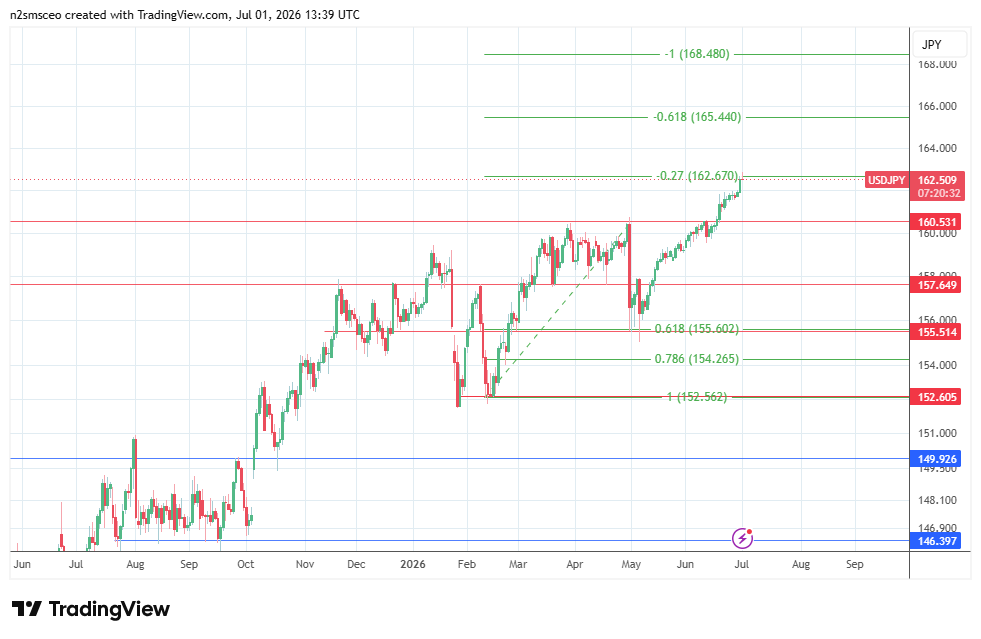
However, if bullish pressure breaks above 162.67, the next logical barrier is 165.44, the 61.8% Fibonacci extension level. Above this mark, the 168.48 resistance formed by the 100% Fibonacci extension becomes another upside target.