


- The USD/JPY remains in a strong uptrend, as it surges past the 161 Yen mark vs the US Dollar. However, intervention threats now loom.
Current Setup and Live Chart
The recent strength of the U.S. Dollar, stemming from last week’s hawkish stance by the U.S. Federal Reserve, has carried over into the new week. The last two days have showcased the greenback in a very strong upward trend against most of its peers. This has left USD/JPY among the strongest-trending major currency pairs, as it is currently trading near 40-year highs at ¥161,70 per dollar.
Behind the pair’s strong trend lies the continued interest-rate differential between the two currencies, as the Fed’s tilt towards tightening contrasts with the BoJ’s continued reluctance to push interest rates further north. But the higher USD/JPY goes, the more likely Japanese financial authorities are to intervene, especially since the pair has already crossed the ¥160 threshold that sparked last month’s intervention.
USD/JPY Macro Drivers
1. Bullish Rate Differentials Story
Despite two interest rate hikes by the BoJ, the Japanese apex bank’s policy remains largely accommodative. The bank has not matched market expectations for aggressive rate hikes to counter the impact of unprecedented wage increases over the last 2 years. This accommodative policy contrasts with the Fed’s, which is tilting towards greater restriction. U.S. bond yields have surged, making USD-denominated assets more attractive and sustaining dollar demand versus the Yen.
2. Rising Intervention Risk
A contrasting macro driver is the risk of BoJ intervention, as the Yen has weakened beyond the threshold set by last month’s intervention. With the Yen now trading at ¥162 per dollar, the pair is now teetering dangerously close to the BoJ’s elastic limit of tolerance. Officials have recently voiced concerns about what they term excessive weakness in the Yen, raising the likelihood of intervention at any time.
3. Japanese inflation is Heating Up
Today’s Tokyo June core CPI data showed an acceleration from 1.3% to 1.6%, as expected. This further reinforces expectations of a BoJ rate hike, with Q4 2026 as the expected timing. Some institutions have set their BoJ hiking timing for October.
Near-term Price Catalysts for the USD/JPY
1. Commentary from Japan’s Ministry of Finance

It is typical for officials at the Japanese Finance Ministry to make comments akin to a verbal intervention before the BoJ actually delivers its decision. So the playbook is that markets sometimes act on these comments rather than waiting for the actual BoJ move. If this happens, a sharp short-term correction could occur within the context of the longer-term uptrend.
2. U.S. Treasury Yield Picture: The correlation between U.S. bond yields and the USD/JPY remains strong, especially for 10-year Treasury yields. If these bond yields cool, this could trigger a near-term retracement in the pair.
3. Fed Rate Expectations: The expectations of the Federal Reserve’s next policy action are tilted towards the hawkish end of the spectrum. If there is renewed expectation of more tightening, the USD/JPY could breach the 40-year price cap and hit new record highs. The reverse expectation would also yield the opposite result.
USD/JPY Weekly Forecast Scenarios
Base Case: The pair is expected to remain bullish, but the threat of intervention could provoke a short-term correction. So we are now at a point where the bulls may have started to show some caution. Any retracements are expected to be met by renewed buying, as the fundamental picture for the pair is one of support from the current policy divergence.
Bull Case: the pair could hit new record highs if U.S. data beat expectations, if Fed speak remains hawkish, and if U.S. bond yields keep tilting northwards. From the Japanese side, a gradual tightening of the BoJ’s rate-hike regime may only slow, not reverse, the upside bias.
Bear Case: The immediate trigger would be currency intervention. Other bear case triggers include falling U.S. bond yields, soft U.S. data, or more aggressive tightening actions or rhetoric from the BoJ. These developments could trigger a rapid correction, as speculative long-dollar positioning remains elevated.
Takeaway
The USD/JPY pair is about the clearest manifestation of a rate policy divergence of all the major currency pairs. The Fed-BoJ divergence is driving the uptrend, but the current push toward the 161-162 range looks a bit overextended, with the threat of intervention lingering. Traders should expect greater volatility but should be very cautious as the threat of the BoJ hammer has increased.
USD/JPY Technical Outlook
The pair has breached the 160.53 resistance formed by the prior highs of 30 March and 30 April 2026. This has set the pair on the path towards the 27% Fibonacci extension level of the 13 February -30 April upswing at 162.70. Barring an intervention, this is the next logical price target for the bulls. Beyond this point, the 61.8% Fibonacci extension at 165.44 becomes the next price mark for the bulls.
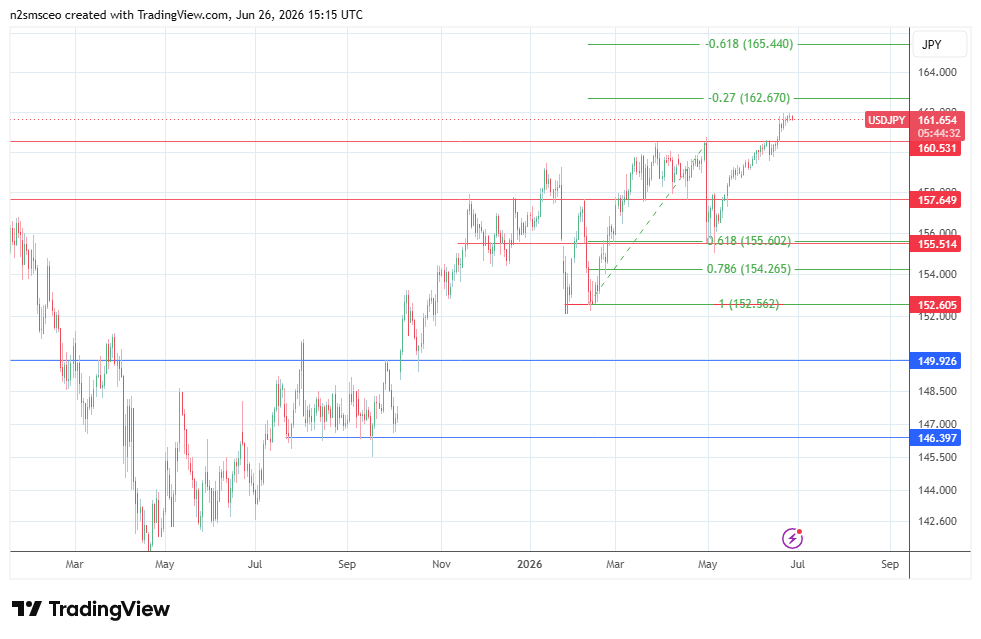
On the flip side, a push below 160.53 makes a case for a touchdown at the 157.64 support formed by the prior lows of 20 March and 17 April 2026. If the bulls fail to defend this price level, the 155.51 support and the 1 May 2026 low (61.8% Fibonacci retracement level) become the next available support.