



- The USD/INR has resumed its uptick, but the pair is now challenging a resistance after completing the double bottom's upside move.
Current Setup and Live Chart
The Indian Rupee has begun the new week on a negative note, down 0.24% against the U.S. dollar. Last week was not a particularly good week for the greenback. Still, the currency appears to have shaken off the dismal Non-farm payrolls report and is now back in control against several currencies, including the Rupee. However, the Reserve Bank of India’s management of the ongoing currency volatility has served to cap any gains in the USD/INR pair.
At the ECB Sintra forum on Wednesday, 1 July, new Fed Chair Kevin Walsh indicated that the Fed would adopt a more cautious approach to monetary policy and move away from forward guidance toward a data-dependent policy path. The market interpreted his comments as dovish and repriced the chances of a rate hike later in the year lower.
Furthermore, the U.S. Non-farm payrolls report came in lower than expected, with labor market participation declining, while average hourly earnings remained stagnant at 0.3%. The data set was enough to put the dollar on the back foot ahead of the U.S. Independence Day holiday weekend. However, a slight escalation in geopolitical risk has raised oil prices, which has so far supported the uptick.
USD/INR Macro Drivers
1) Higher US Bond Yields
U.S. Interest rates are still deemed restrictive at current levels. This is deemed to be USD-supportive. Today, the U.S. 10-year note is up 0.14% as of writing, which will continue to support demand for the U.S. dollar against emerging-market currencies like the rupee.
2) Oil Prices: the Rupee’s Biggest Risk
Oil prices remain above US$71 per barrel despite a slight decline on the day. However, there is still a threat of an escalation of geopolitical risk after the burial of former Supreme Leader Ayatollah Khamenei in Iran, with many in the crowd chanting and calling for some form of retribution against the U.S.
As a net oil importer and indeed the third-largest importer of crude oil in the world, any escalation in oil prices stemming from geopolitical risk remains the biggest risk for the rupee in the near term. This is because high energy prices increase the cost of imports, leading to greater demand for the U.S. dollar and a wider current account deficit. In addition, high energy prices also tend to exert inflationary pressures on the local scene.
3) RBI Intervention: Managed Depreciation

The Reserve Bank of India recently rolled out several measures meant to support the rupee. The apex Bank currently maintains a high level of activity in market operations and liquidity management, which has helped stem sharp fluctuations in the USD/INR pairing. Even in periods when the dollar is very strong, it tends to modulate the pair’s price movements.
Price Catalysts for the Week
1) U.S. inflation data: The next major US data release is on 14 July: the US CPI. With the Fed now shifting to a data-dependent model for determining monetary policy, upcoming U.S. data will help shape U.S. bond yields, which will impact the U.S. Dollar.
2) Brent crude prices: Oil price direction will continue to bear on the rupee. Geopolitical risk is the current major catalyst for oil prices. Therefore, expect the markets to view USD/INR through the prism of geopolitics, as it affects oil prices and the risk environment.
3) Foreign portfolio flows: The RBI’s recent support stimulus is expected to bring in billions of dollars in foreign portfolio investment. These foreign inflows into Indian equities and bonds remain an important prop for these markets, and net inflows are rupee-supportive, as any incoming foreign currency must be exchanged for the local currency to participate in the market.
USD/INR Weekly Forecast Scenarios
Base case: calls for the pair to be moderately bullish in the near term, supported by higher US bond yields and the potential for geopolitical risk to elevate energy prices. RBI intervention is likely to smooth the excess volatility.
Bull case: A reclaim of the all-time high is likely on stronger-than-expected US macroeconomic data, much higher Treasury yields, and elevated crude oil prices. This scenario will see an increase in dollar demand, rising oil price costs, and net capital outflows from the Indian market.
Bear case: a situation of lower oil prices, softer US inflation data and lower US bond yields, backed up by RBI intervention, will promote a retracement of the pair on the back of rupee strength.
USD/INR Technical Outlook
The short-term double bottom on the daily chart bounced off the ascending trendline, maintaining the uptrend. The upside move from this bounce is currently challenging the 95.24 resistance, where the prior high of 30 March 2026 resides. If the bulls manage to clear this barrier, the next target for the bulls comes in at the 96.96 high of 20 May.
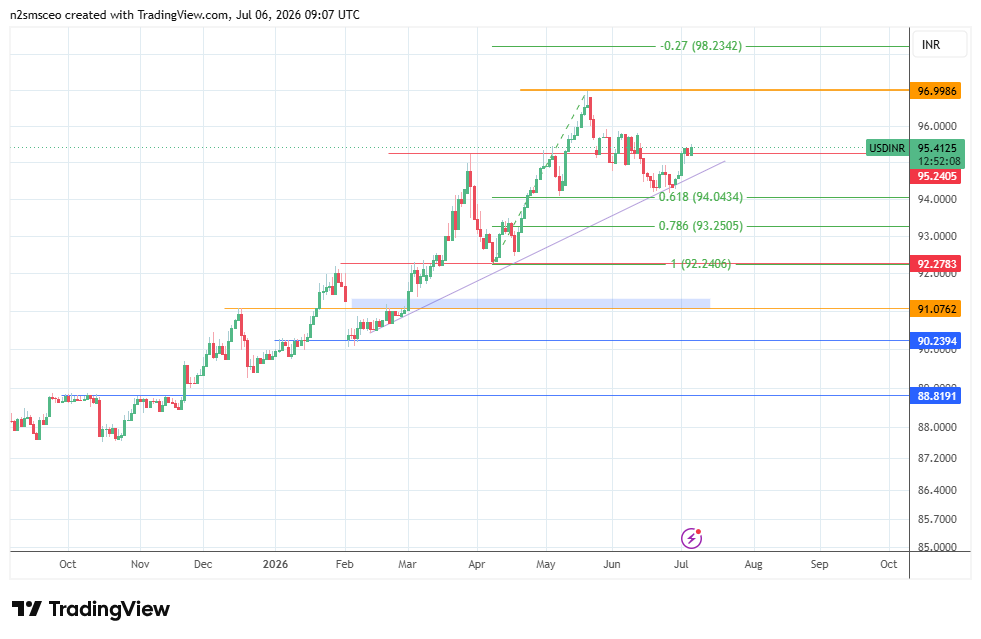
On the flip side, the bears need to reject the uptick at the current resistance and degrade the trendline, bringing the 94.04 support and the prior low of 7 May 2026 into the picture. This level is also the 61.8% Fibonacci retracement level of the 8 April – 20 May upswing. If the bulls fail to defend this price level, the next downside target is the 93.25 support, followed by the 8 April low, which forms the 92.24 support level.