


- The USD/INR has broken the recent downward streak as oil prices resume their climb following escalatory headlines from the Middle East.
Current Setup and Live Chart
After several days of gains versus the US Dollar, the Indian Rupee lost ground against the greenback in Tuesday’s trading session. This was due to a 1.12% gain in oil prices, which put the currency of the 3rd-largest oil importer on the back foot. What then is the USD/INR forecast ahead of the RBI’s next interest rate decision?
This price move once again brought USD/INR to the forefront as one of the pairs to watch, as long as the oil shock regime brought on by the US-Iran war continues to plague global markets.
The oil shock risk premium began to exert its effect in March 2026 after the US-Iran war and attendant blockade of the Strait of Hormuz shuttered oil shipments to Asian countries. India was affected by this closure, and the rupee has experienced significant volatility ever since. The currency has hit several record lows versus the US Dollar, and only the Reserve Bank of India’s (RBI) interventions have prevented disorderly depreciation.
The RBI continues to participate in the foreign exchange market actively and is expected to remain so to stabilize the rupee as long as the current geopolitical situation persists.
USD/INR Macro Drivers
1. Oil prices
As long as India remains a net oil importer, the rupee will continue to feel the heat from rising energy prices. The import dependency on crude oil and its energy derivatives raises import costs when prices head north, widening the trade deficit and weakening the rupee.
2. RBI intervention
The Reserve Bank of India’s active dollar selling has not halted the rupee’s decline. Rather, it has smoothed out the depreciation to prevent wild volatility. The interventions look set to continue as long as the war rages. A Reuters report quotes traders close to the situation as saying that the RBI has been selling U.S. dollars in nearly every trading session since the rupee first hit record lows against the greenback.
3. Interest rate outlook

Energy price spikes are starting to pile pressure on domestic economies, especially those dependent on imported crude oil and petroleum products. This situation has put the RBI on notice. It was shifted from the previous easing cycle to a more cautious stance amid the potential for rising inflation and ongoing geopolitical risks. Markets remain watchful to see whether the RBI will enter a full-fledged hiking cycle if inflationary fears materialize.
A May 22-29 Reuters poll indicates that 80% of polled economists believe the RBI’s monetary policy committee will keep the interest rate unchanged when it releases its high-stakes decision on Friday, 5 June.
USD/INR Weekly Forecast Scenarios
Base case: the pair is expected to remain range-bound, with mild rupee weakness supporting the pair on dips. The rupee is expected to continue struggling as long as geopolitical-driven energy price spikes persist. However, any upside moves within the consolidation are expected to be orderly as the RBI actively intervenes to prevent a wild depreciation of the rupee.
Bull case (USD/INR higher): if geopolitical tensions escalate significantly, energy prices are likely to rise above $100 again. This is a rupee-negative situation that could trigger new lows, driven by oil-induced pressure on the import-dependent Indian economy and by investor flight to the safety of the US Dollar. We could see the rupee hitting new record lows in this scenario.
Bear case (USD/INR lower): headlines of a breakthrough in the ongoing US-Iran talks, backed by continued RBI support, will support the rupee. A significant drop in oil prices below $90 will improve capital outflows and ease pressure on the rupee.
Takeaway
The USD/INR continues to trade within the oil price/RBI intervention narrative. The pair directly correlates with oil prices. While energy prices set the macro direction for the pair, the RBI’s interventions will set the pace of rupee depreciation if oil prices rise.
USD/INR Technical Outlook
The pair’s northern push is a retest of the recently-degraded support-turned-resistance at 95.24. If this resistance barrier holds firm, the corrective decline towards 94.04, the 61.8% Fibonacci retracement level, and 7 May low, will continue. Below this level, further support is seen at 93.25 and 92.24, the 8 April 2026 low.
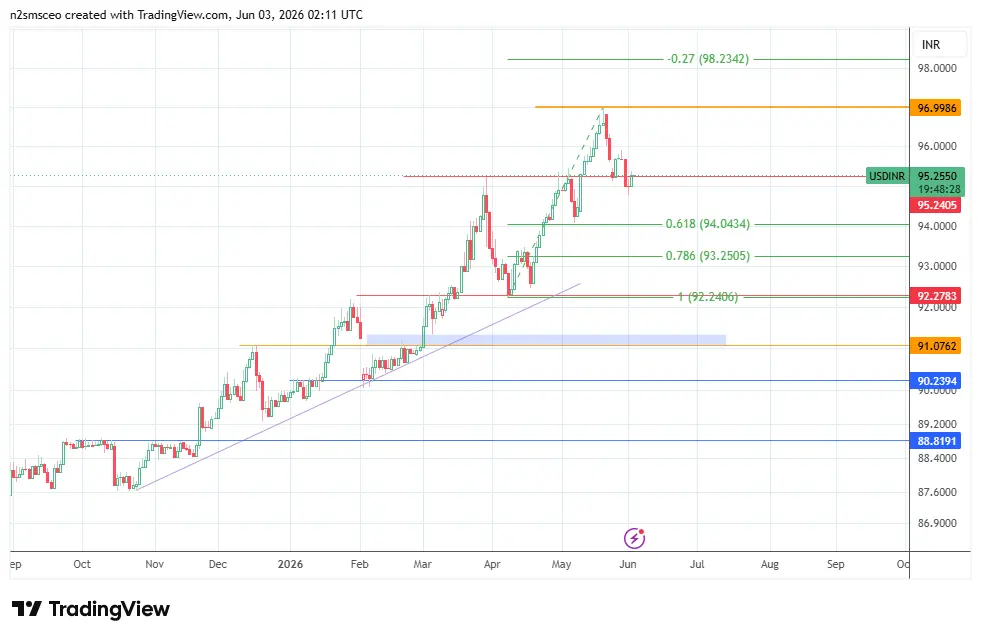
However, if the bulls manage to uncap the 95.24 barrier, a move to reclaim the all-time high at 96.96 cannot be ruled out. A break of this level forms new highs and re-establishes the uptrend. This will force a move towards the 27% Fibonacci extension of the 7 April -20 Mat price upswing at 98.23.