




- The USD/INR starts off the week on a modest bullish note as the markets await the outcome of this week's NFP data.
Current Setup and Live Chart
Last Thursday’s US data was largely positive, and despite Friday’s slight pullback on the greenback, the USD/INR enters the week in an uptrend. Currently, the US Dollar is poised to remain resilient, supported by data prints, higher US bond yields, and the overhang of uncertainty surrounding the US-Iran talks, as US President Trump’s comments continue to spook investors.
On the flip side, the Indian rupee has recently benefited from declining oil prices and the Reserve Bank of India’s (RBI) widespread measures to manage rupee volatility and bolster the local currency.
The pair is currently trading at 94.54, as the 0.08% upside has helped stem the 0.29% decline seen on Friday, 26 June. The markets remain balanced between Fed rate expectations, on the one hand, and energy prices/foreign portfolio flows into India’s markets, as the contrasting macro drivers. The rupee remains vulnerable to oil price volatility due to India’s status as a net oil importer.
USD/INR Macro Drivers
1) US dollar strength remains supportive
The US Core PCE Price Index rose 0.3%, matching the upward revision, while US GDP (Final) came in at 2.1%, well above the 1.6% consensus. Other data, such as Core Durable Goods Orders, Personal Spending, and Personal Income, all beat market expectations and helped support the US dollar, even as markets still hold on to the Fed’s hawkish stance from the previous week. Additional risk events this week include the US Non-Farm Payrolls on Thursday and the Fed Chair’s participation in a policy discussion at an ECB event on Wednesday. If these events push US bond yields higher, USD/INR will remain supported heading into the US Independence Day weekend.
2) Oil prices remain the biggest risk for the rupee
India is the 3rd largest crude oil importer. This exposes the rupee to the negative impact of oil price volatility that pushes Brent crude prices higher. Elevated oil prices lead to a higher import bill for India, necessitating more USD demand to pay for oil imports. Furthermore, there is higher inflationary pressure and foreign portfolio outflows from local markets, both of which are rupee-negative events.
3) RBI intervention
The recent supportive measures rolled out by the Reserve Bank of India have led to a modest relief rally rather than an outright reversal on the USD/INR. The RBI’s interventionist moves within a USD/INR uptrend tend to smooth the upside move, preventing outsized volatility. However, USD-supportive macro drivers have limited the impact of the RBI’s recent measures. The RBI implements its actions through increased dollar sales, liquidity management, and forward market operations.
Price Catalysts for the Week
1) Federal Reserve expectations and US Data
Fed Chair Kevin Warsh is to speak at a policy discussion event organized by the ECB. The market will look for cues in his comments that indicate the near-term Fed policy direction. This will be followed the next day by June’s Non-Farm Payrolls data. If these two risk events lead to heightened hawkish Fed rate expectations, the USD/INR could extend the upside recovery.

2) Brent crude prices
Crude oil prices remain the single most important external variable for the rupee. Higher crude prices weaken the rupee (explained above). Lower oil prices are rupee-supportive. The single most important driver of oil prices is geopolitics, with eyes on the ongoing US-Iran talks and commentary from the US President on the day-to-day proceedings.
3) Foreign portfolio flows
The Indian stock and bond markets have a heavy composition of capital from foreign institutional investments. Strong foreign portfolio inflows are rupee-supportive, as these dollar-denominated funds must convert to the local currency to purchase these assets, thereby creating rupee demand at the expense of the US Dollar. These inflows will depend on lower oil prices and a risk-on market sentiment. Once events create a risk-off situation, portfolio funds flee the markets and seek out the US Dollar or repatriation to other markets. This creates dollar demand at the expense of the rupee.
Weekly forecast scenarios
Base case: heading into the week’s key news events, USD/INR is expected to maintain a moderately bullish posture. Currently, markets have started the week on a muted note, preferring to cut risk while awaiting direction from Fed Chair Warsh’s comments and the NFP data.
Bull case: stronger US economic data this week could boost dollar demand and raise the cost of oil imports for India, a rupee-negative effect. In this scenario, USD/INR could retest its recent all-time highs near 97.00.
Bear case: softer US data or non-committal statements by the Fed Chair on the near-term outlook for US interest rates will be seen as a disappointment, allowing for a further retracement in USD/INR. Dovish Fed rate expectations are generally supportive of emerging-market FX, and the rupee stands to benefit from this scenario.
Takeaway
The USD/INR lies at the intersection of India’s energy import dependence and oil prices, on the one hand, and conditions that raise US bond yields (such as upbeat US data and hawkish Fed rate expectations), on the other. This is expected to be the scenario for the week, with two key events from the US and the US-Iran talks defining the pair’s near-term price direction.
USD/INR Technical Outlook
The trendline that has maintained the uptrend in USD/INR is being tested, along with the 94.04 support level, which houses the 61.8% Fibonacci retracement of the 9 February – 20 May upswing. The bulls have to defend these support levels to enable a bounce that eventually retests the 95.24 resistance. If this resistance is breached, the 96.99 all-time high comes into play.
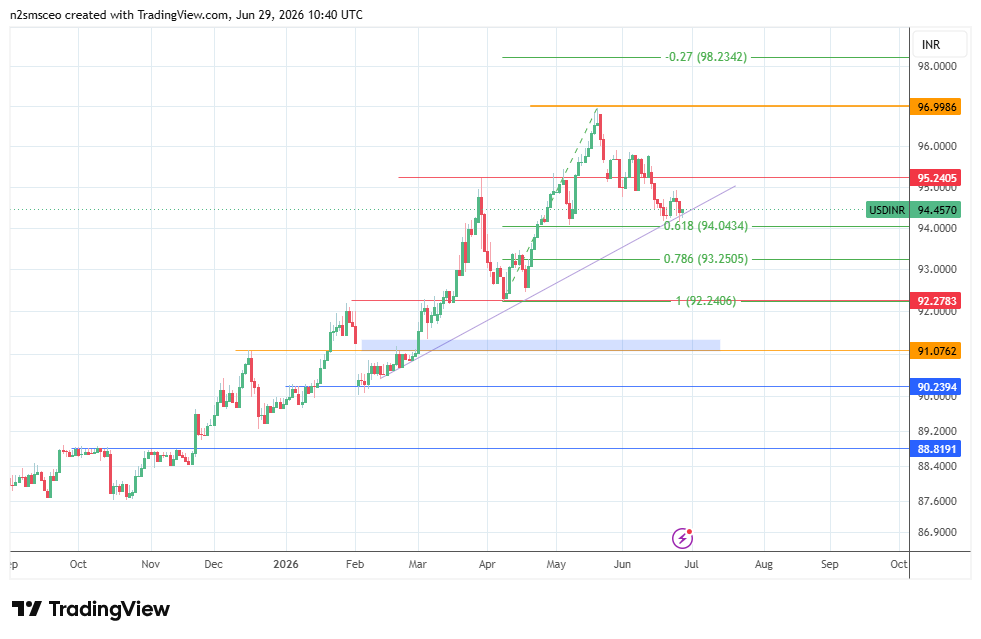
However, if these support levels are breached, the 93.25 support and the 78.6% Fibonacci retracement come into play as the next downside targets. A further decline will target the 92.24 support level, where the 9 April low is found.