



- The USD/INR reversed its gains after the RBI announced a huge stimulus package aimed at improving US Dollar inflows & strengthening the rupee.
The USD/INR is currently trading in an environment where two opposing forces are battling for the upper hand in directional pressure. The first is the latest US Non-Farm Payrolls report and the resultant rise in U.S. bond yields, which have exerted a USD-strengthening effect on the pair. On the other hand, we have the recent $40 billion worth of supportive measures rolled out by the Reserve Bank of India (RBI), which have helped bolster the rupee.
Immediate Impact of the NFP Report
Following the stronger-than-expected U.S. jobs print, which helped to reinforce the “higher for longer” Fed interest rate expectations, the following outcomes ensued:
- Broad-based USD strength as U.S. long-term bond yields surged.
- Reduction in expectations for near-term Fed easing.
- Emerging-market currencies buckled under pressure from less dovish Fed expectations.
Such a strong NFP print should have led to a huge rally in USD/INR. However, the RBI came to the rupee’s rescue with several supportive steps.
The RBI Alters the Outcome
The RBI had announced support measures directed at improving dollar liquidity in the Indian markets to attract foreign capital. These measures were announced before the NFP’s release.
The supportive measures included:
- Any new FCNR(B) deposits raised by banks will now receive full hedging support.
- Concessional forex swaps for state-owned companies that borrow from external sources.
- Broadening access to Indian government bonds to foreign investors.
- Other measures to increase foreign currency inflows.
The RBI’s hedging support for new FCNR deposits and external borrowing by state-owned enterprises is expected to lower the cost of importing foreign currency into India, thereby increasing USD inflows. Analysts estimate that these measures could bring in as much as $30 billion – $50 billion in foreign inflows.

Following the announcement, the rupee gained 0.88% against the U.S. dollar on the day of the NFP release. Goldman Sachs released a statement following the RBI’s action and indicated that it now saw the measures limiting the rupee’s depreciation. The bank subsequently shifted the outlook of its 97 rupee/USD forecast from 3 months to 12 months. MUFG has also revised its outlook for the pair, lowering its Q3 2026 price target for USD/INR from 95.80 to 94.00.
Oil Remains the Biggest Risk
Crude oil prices remain the biggest risk driver for the USD/INR. India is a net oil importer and saw its import capacity severely hampered by the blockade of the Strait of Hormuz and the weakening of the rupee. Elevated oil prices raise the country’s fuel import bill, widen the current account deficit, increase dollar demand, and eventually lead to a weaker rupee. The pressure on the rupee has been so great that the RBI has spent more than $110 billion in direct interventions to support it, according to a recent Bloomberg report.
Since the recent government measures, renewed strikes between Israel and Iran have occurred, raising oil prices once more and eroding a large portion of the rupee’s recent gains versus the US Dollar.
Takeaway
Despite the latest NFP numbers being supportive of the greenback, the Rupee received a shot in the arm from the RBI’s aggressive support package. The measures are expected to drive increased foreign capital inflows even as the apex bank’s regular interventions continue.
In the near term, the macro drivers for the USD/INR are likely to be as follows:
- US economic data: Will the CPI and other data prints be USD-supportive?
- The extent to which the new RBI measures attract foreign inflows.
- The direction of crude oil prices in response to geopolitical developments in the Middle East.
So while the US Dollar will continue to hang on to macroeconomic data as an anchor for US bond yields, the Rupee will rely on the RBI’s move and falling oil prices as its foundational support.
USD/INR Technical Outlook
The pair is still trading around the 95.24 price mark. The bulls would need a firm bounce from this level to push for a retest of recent all-time highs at 96.99, the high of 20 May 2026. A further move north brings in the 27% Fibonacci extension level at 98.23 into the mix.
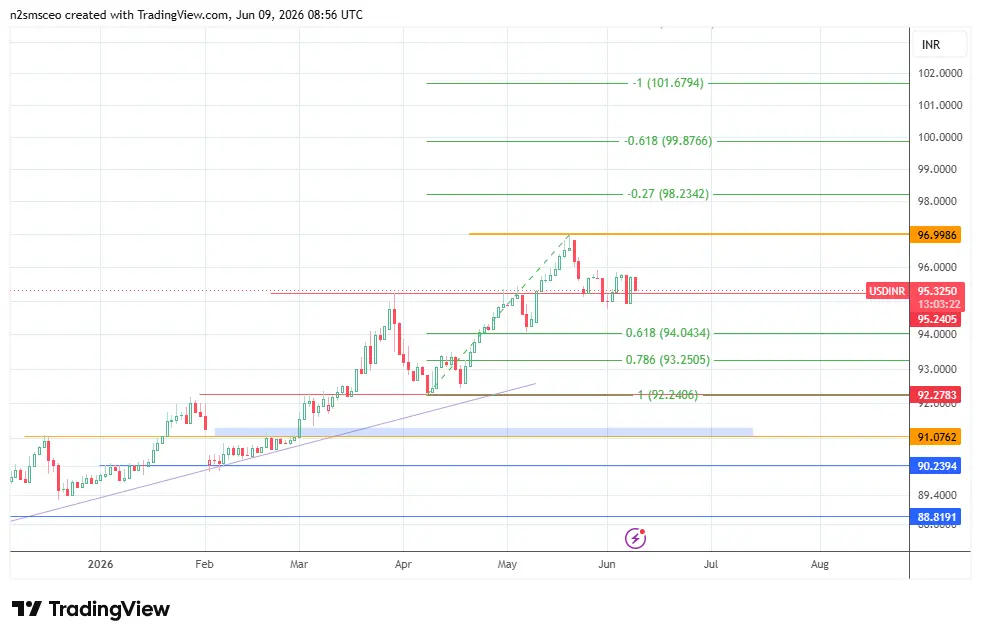
On the flip side, a breakdown of 95.24 ushers in a retest of the 7 May low and 61.8% Fibonacci retracement level at 94.04. A further decline tests the neckline of the double bottom at 93.25, before the 92.24 support formed by the double bottom low of 8 April comes into the mix.