



- This article examines the potential for Brent crude oil price forecasts to target prices below $70 as long positions get liquidated.
Current Setup and Live Chart
The collapse of the oil-shock risk premium following last week’s truce between the U.S. and Iran has led to a dramatic reversal in Brent crude oil prices. The asset has fallen from a price range of $97–110/bbl at the peak of geopolitical tensions to around $73/bbl today. The markets are also predicting a further dip in prices as the impact of the gradual reopening of oil shipping through the Strait of Hormuz filters through the supply chain.
In essence, the crude oil price narrative has shifted from an asset at the center of the war-risk premium environment to one undergoing supply normalization. As a result, the markets are currently seeing a heavy liquidation of accumulated long positions as the risk premium unwinds. Further adding to the supply normalization narrative is the improvement in crude availability from Iran, Russia, and Venezuela, even as shipping through the Strait of Hormuz slowly returns to pre-conflict levels.
Macro Drivers for Brent Crude
1) Strait of Hormuz Reopening
The blockade of oil shipping along the Strait of Hormuz was the greatest compounding factor driving the oil-shock risk premium. In like manner, the reopening of this oil conduit upon the signing of the truce and ongoing talks about unresolved issues, such as Iran’s nuclear future, is now the greatest driver of the recent crude oil price drop.
2) Improving Supply Outlook
The market focus is strictly turning towards supply recovery. Sanctions relief for Iran as part of the current negotiations will flood the market with millions of barrels worth of Iranian oil. Concurrently, output recovery in Venezuela and Russia is adding positivity to the supply-recovery narrative, and additional Reuters reports point to increased output from Iraq.
3) Demand Concerns
Risk-on sentiment typically drives global growth. However, the previous outlooks from the IEA and OPEC, which had pointed to weaker global demand for 2026, are back on the radar. This may be a factor that caps upside potential for crude oil prices in 2026.

Price Catalysts in the Near Term
Peace Negotiations: Now that the markets have settled into the easing momentum, there is always a chance that negotiations between the U.S. and Iran could stall or even collapse. U.S. President Trump casually remarked that the U.S. could resume bombings if things did not pan out well in the peace talks. A setback of this nature could bring back the oil-shock risk premium via port damages, Hormuz disruptions, etc.
U.S. Crude Oil Inventory Data: According to key U.S. officials, U.S. crude inventories are nearly exhausted and at multi-decade lows. This could support crude oil prices in the near term if demand remains resilient. The current market expectation is for further drops in crude oil inventories.
OPEC+ Quota: OPEC+ member states rarely complain when high energy prices fill their coffers. The complaints typically start when oil prices fall too low for comfort. If the current downside pressure on oil persists, we could see OPEC+ mount a response to stabilize prices.
Brent Crude Oil Price Forecast Scenarios (Near-Term)
Base Case: The bias is neutral to bearish, with price expected to remain within the $74-$80 consolidation range as markets further digest the supply normalization narrative amid ongoing negotiations and extended peace talks. Any rallies will likely attract renewed selling as long as oil shipping continues unhindered through the Strait of Hormuz.
Bull Case: A breakdown in negotiations could lead to renewed disruptions in the Strait of Hormuz. This will disrupt the supply-stabilization narrative, which could see Brent crude spike to $85-$90 as the geopolitical premium resumes.
Bear Case: A comprehensive peace deal that allows Iran to resume oil exports unhindered as part of a sanctions-removal package will boost the supply-recovery story. Weaker global demand reinforces the narrative, and we may see Brent crude hitting the pre-war levels below $70 per barrel.
Brent Crude Oil Price Forecast: Technical Outlook
The decline seen on the charts is a result of the technical double-top pattern. The breakdown of the 86.34 neckline support has led to a measured move that has attained completion at the 73.07 support. This support level remains under pressure, and a breakdown of this pivot brings in new downside targets at 65.61 initially (the 30 June and 18 August 2025 lows), with further extension to the south reclaiming the medium-term double-bottom support of April 2025 and December 2025 at 58.79.
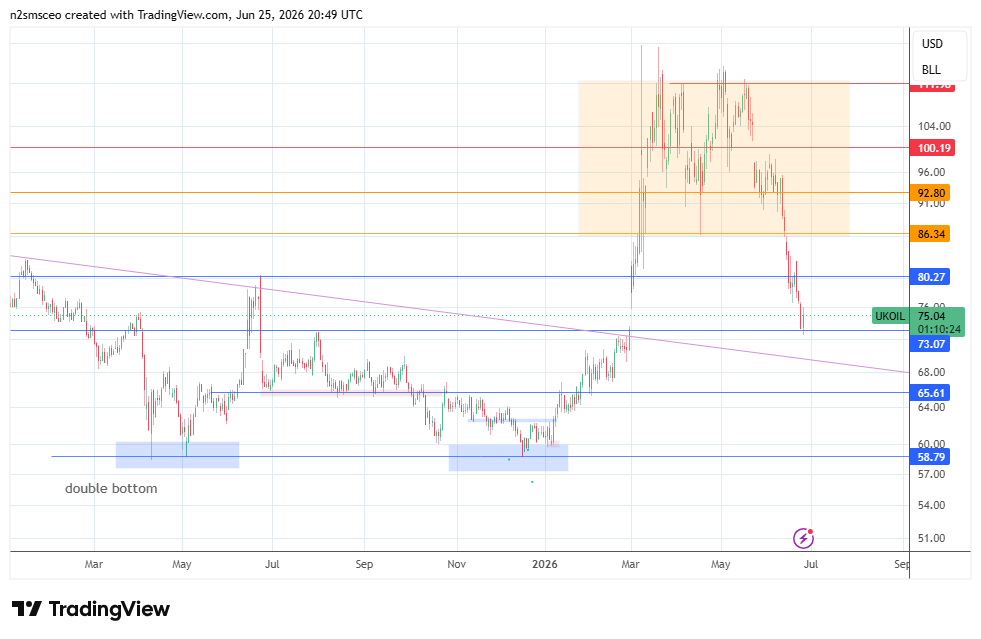
On the flip side, a bounce on the current support allows for a relief rally towards the 23 June 2025 high at 80.27. If this barrier is breached, the recovery move extends to the degraded neckline support at 86.34, which now acts as a resistance. Further targets to the north at 92.80 and 100.19 only come into focus if the 86.34 resistance is uncapped.