



Current Setup and Live Charts
Brent crude oil prices have risen sharply after a marked elevation in the Middle East geopolitical risk premium. The renewed confrontations between the US and Iran have led Iran to close the Strait of Hormuz. This has raised concerns about the return of the oil shock risk premium, which caused massive price volatility and distortions across several markets.
The situation has altered Brent crude oil pricing, and traders are now pricing in the possibility of supply shortages, tighter inventories, and higher shipping costs. Energy consumers are once more preparing for elevated energy prices. Brent crude has risen 5.02% this week and is now trading at $86 per barrel as of writing.
Brent Crude Oil Price: Macro Drivers
1)Renewed Closure of the Strait of Hormuz
The renewed blockade of the Strait of Hormuz is now the dominant macro driver for oil prices. If the dislocation caused by the Hormuz blockade is prolonged, the risk of reduced supplies from several major growth producers will filter into the markets and lead to further price volatility. This factor is responsible for the rapid increase in crude oil prices over the last two days, driven by the heightened geopolitical risk premium associated with the situation.
2) Additional Risk Premiums
Apart from the Hormuz blockade, markets are now facing additional risk premia due to supply losses. These include shipping delays, increased tanker freight rates, and higher maritime insurance costs. There is also the potential for increased volatility across several commodity markets. In addition, further military escalation could damage critical crude oil and LNG infrastructure in several neighboring countries, worsening the risk situation. So even without significant production outages and transportation disruptions, as well as additional risks from the factors mentioned above, they could tighten global supply with a heightened risk of inflationary pressures.
3) OPEC/IEA Mitigatory Actions

The OPEC+ cartel still has spare production capacity to offset production-level issues such as infrastructure damage. However, additional production will not offset the constraint that is caused by the blockade of shipping routes. Markets will continue to adjust to cost reductions in production volumes, as well as to the ability to transport any excess crude via alternative shipping routes, if the blockade of Hormuz is not lifted in the near term.
Brent Crude Oil Price Catalysts (Near Term)
1) Developments around the Strait of Hormuz: the markets will be looking out for any new military developments around the Strait of Hormuz, as this is now the most important near-term price catalyst. Specifically, any naval deployments, attacks (or lack thereof) on ships and energy infrastructure in surrounding countries, shipping activity, and the reopening of negotiations and the cessation of hostilities in the embattled waters are all factors that will cause shifts in the geopolitical risk premium.
2) Official OPEC+ communication: Any official communications from OPEC+ or the International Energy Agency (IEA) regarding any emergency production adjustments, alternative shipping routes, inventory releases, and any form of coordinated action to stabilize the market are factors that the investors also watch for as price catalysts.
3) US inventory data: Weekly US crude oil inventory reports have become very important after the US declared some weeks ago that its inventories were nearly exhausted following the initial conflict. Any further drawdowns in inventory at this time will raise concerns about global supply tightening. However, an unexpected buildup could provide temporary relief for oil prices.
Brent Crude Technical Outlook
Having completed the measured move from the double top at the long-term descending trendline, the bounce from there just below the 73.07 support has breached the resistance at 80.2 and is now challenging the the neckline at 86.34. Further targets that come into play if the neckline is uncapped are 92.80 and 100.19.
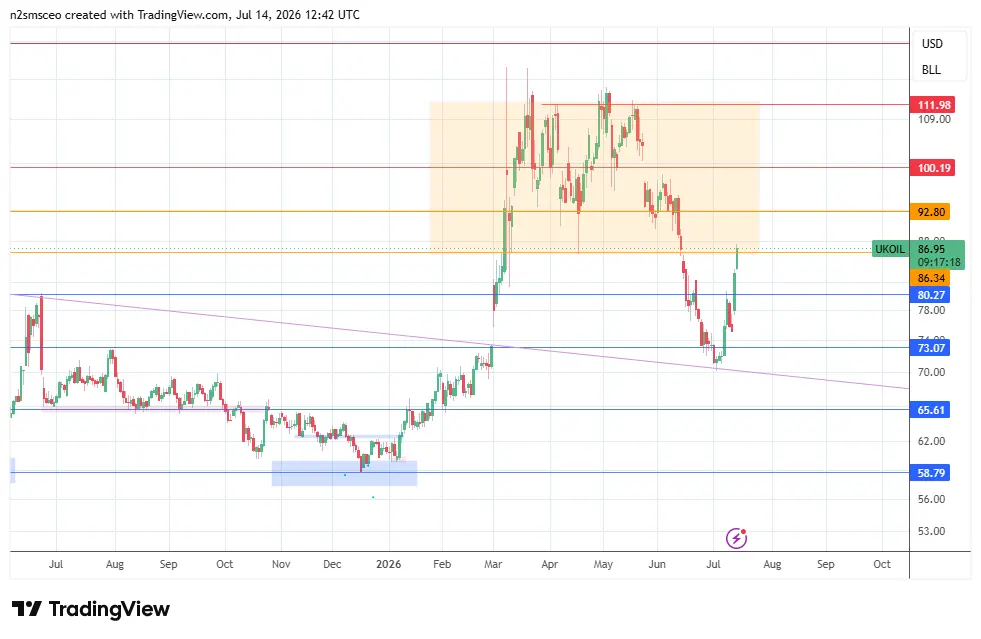
On the other hand, rejection at the current level brings the 73.07 support into the picture and the 5 September 2025 low at 65.61 into play if 73.07 is breached. The 58.79 support becomes the next target if the bears take out the 65.61 level.