



- The AUD/JPY seems set for a further correction as risk sentiment takes a hit amid hawish BoJ expectations ahead of its December meeting.
InvestingCube chart · Yahoo Finance data
Current setup
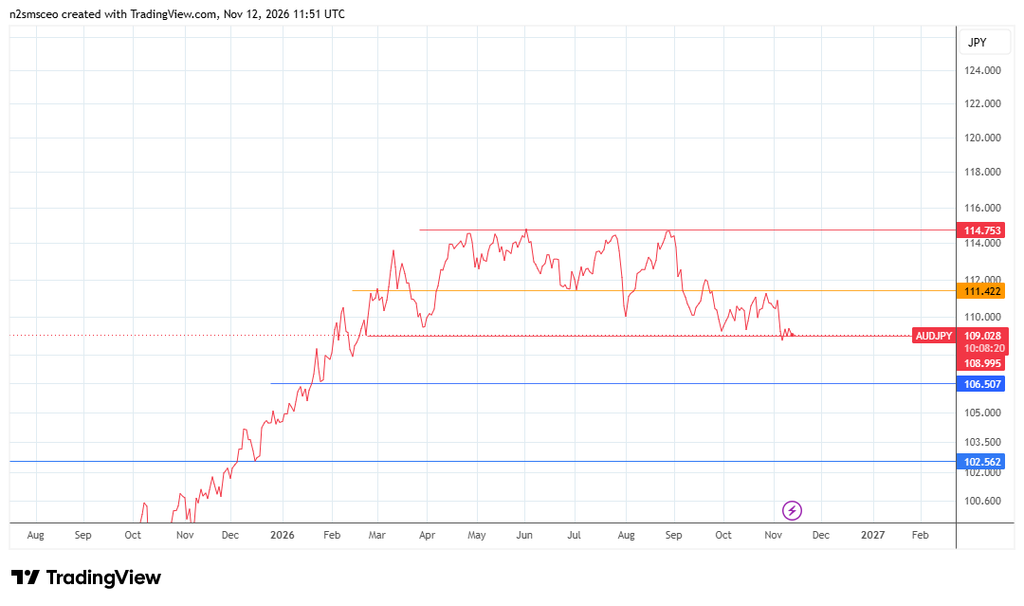
AUD/JPY currently trades at 109.02 as of this writing. The AUD/JPY continues to trade within this week’s consolidation, driven by competing influences. On one hand, higher Aussie interest rates provide support for the Aussie dollar; on the other, there is a flight to Yen safety as global sentiment deteriorates.
The RBA recently raised interest rates to 4.85%, as did the Bank of Japan, which raised rates to 1.25%. The interest rate differential between the two currencies gives the Australian dollar a substantial carry-trade advantage over the Japanese yen. However, the recent deterioration in global sentiment has seen risk-sensitive currencies trade into weakness, which has helped limit AUD/JPY’s upside.
The market’s focus has shifted to an assessment of the outlook for the BoJ’s monetary policy path. This comes as Japanese wholesale inflation data came in stronger than expected, driving renewed expectations of a December rate hike by the Bank of Japan.
Recall that in the last meeting, BOJ Governor Ueda strongly indicated that the Bank of Japan would most likely abandon the accommodative policy and become more aggressive in ensuring that inflationary risks are contained using monetary policy. The AUD/JPY therefore remains vulnerable to further correction, as investors are leaning more toward yen demand due to higher expectations of a BOJ rate hike and a flight to safety, rather than carry-trade benefits.
AUD/JPY: Key Macro Drivers
The AUD/JPY is currently trading as a balance between the carry trade support for the Aussie Dollar, and Yen-supportive BoJ rate hike expectations.
1. RBA-BoJ Interest-rate Differential
The current interest rate differential between the RBA’s policy rate and the Bank of Japan’s is 3.60 percentage points in favor of the Australian Dollar. This carry trade advantage supports the Aussie dollar, especially in a scenario of financial market stability and risk-on sentiment.
However, the RBA will need to maintain this restrictive stance to reinforce this tight relationship to the Australian dollar. If the RBA keeps interest rates steady and the BOJ delivers on its expected December rate hike, this will reduce the AUD’s carry-trade advantage and tilt the balance away from the currency towards the Yen. This outlook is especially true if Aussie inflation moderates or economic activity weakens.

2. BOJ Tightening Expectations
Renewed expectations of a BoJ rate hike in December have been boosted by October’s wholesale inflation numbers in Japan, which showed a 7.1% year-on-year increase. This blew market expectations of a 6.5% increase out of the water. As energy and raw material import costs rise in Japan, the BoJ could be forced to deliver another 25-basis-point hike, sending its monetary policy rate above 1.50%.
However, this is not a done-deal situation. Divisions still remain within the Bank of Japan’s board, as some policymakers argue that rapid rate hikes could stifle domestic consumption and growth. As mentioned earlier, a BoJ hike in December would cut the interest rate differential, currently 3.60 percentage points, and could provide a basis for a further correction in AUD/JPY.
3. Global Risk Sentiment
The two currencies in the pair are on opposite sides of risk sentiment. While the Aussie dollar is a risk-sensitive currency, the yen is the currency of preference in risk-off market scenarios.
The recent global technology stock sell-off, along with concerns about the sustainability of AI-related capex, has caused a pullback in risk-sensitive currencies. If volatility continues and investors continue to exit carry-trade positioning due to risk-off sentiment, Yen appreciation and a decline in the AUD are expected.
However, if market tone towards global equities improves, investors will shift towards capital appreciation, restoring AUD demand. Therefore, AUD/JPY is a perfect currency pair for trading global risk sentiment.
4. Chinese Demand and Commodity prices
China is Australia’s largest export market, which makes the Australian economy susceptible to Chinese economic activity. Stronger Chinese data on infrastructure investment, raw material imports (especially copper and iron ore), and industrial production supports Australia’s export outlook and boosts AUD sentiment.
However, a decline in commodity prices and weaker Chinese industrial production and growth could put pressure on the Aussie dollar. With the markets warming up to the prospect of further BOJ tightening, this scenario favors a decline in the AUD/JPY. However, stronger data from Chinese manufacturing, stimulus measures, or improved sentiment in China’s property sector are supportive of the pair.
Technical Outlook
The 109.00 support is being challenged. A breakdown of this price mark targets the 106.50 support level.
On the flip side, a bounce on this support keeps the pair within the range. Only if the bulls uncap the 111.42 resistance can we see a move towards the 114.75 resistance, which serves as the 2026 high.
What is your outlook on AUD/JPY?
Anonymous · no sign-up · results from the last 30 days · not investment advice