



- The USD/INR entered a second day of losses, as the rupee gained support from declining oil prices ahead of the US midterm elections.
Current setup
The USD/INR is currently trading at 94.90, marking the second day of losses following Friday’s 0.28% drop. The pair’s decline follows a 4.33% fall in Brent oil prices on Monday. Despite the rupee’s relief rally, the pair’s downside appears constrained by cautious sentiment across Asian markets and a resilient US dollar buoyed by rising bets of a Dec Fed rate hike and safe-haven demand.
This oil price retreat has come on the back of news that diplomatic progress is being made between the US and Iran, and the war is now in its 10th month.
Despite the intraday decline, oil prices remain well above $100 a barrel, and Monday’s marginal 0.04% close reflects this ongoing tension. The >$100 crude oil price levels continues to raise concerns about India’s foreign current account balance and the pressure elevated oil prices put on the country’s import bill.
The pair continues to trade within the context of the geopolitical dispute and the hawkish outlook for the U.S. Federal Reserve, amid the RBI’s supportive measures and the state of foreign portfolio fund flows.
USD/INR: Macro Drivers
1. Oil prices and India’s Import Exposure
Oil remains a major driver of the rupee because India is the world’s third-largest energy importer. To buy USD-priced oil, India needs to convert rupees into U.S. dollars. Higher oil prices indirectly require more U.S. Dollars to meet the higher energy import bill, which puts pressure on the rupee. Monday’s sharp pullback in oil prices provided near-term support to the rupee. However, a more sustained decline in oil prices will be needed to significantly reduce India’s oil import bill and lower demand for U.S. dollars from energy exporters. As long as Brent crude remains above $100, it will continue to put pressure on the rupee.
2. US Midterm elections
Tuesday, November 3 marks the U.S. midterm elections, which are emerging as an important near-term driver for USD/INR. Investors are currently reducing their exposure to dollar positions ahead of the elections. These U.S. dollar sales could weaken the USD, which could provide support for emerging market currencies, including the Indian rupee.
However, the USD/INR outlook remains uncertain and depends on the vote outcome. A Republican sweep of Congress keeps current market fundamentals in place, which could boost the U.S. dollar and pressure the Indian rupee. However, if Democrats win both legislative chambers, this could boost sentiment for a quicker end to the war and potentially weaken the USD vs emerging market FX. A mixed outcome for the Democrats could lead to choppiness in USD/INR this week.

3. Foreign Portfolio Flows
The recent selloff in US tech shares has spooked Asian markets, the primary source of semiconductor products for the US AI giants. This renewed volatility, driven by a move away from risk-associated stocks, puts emerging-market FX under renewed pressure.
If there is net foreign portfolio inflow, the additional dollar supply and rupee demand could cap USD/INR gains. However, net foreign portfolio outflows increase dollar demand, which supports the pair.
4. RBI Intervention
The Reserve Bank of India remains a source of interventions to stabilize the market and provide near-term rupee support. However, this support will not fully reverse USD/INR until the factors behind the surge toward the 97.00 mark are eliminated.
USD/INR Forecast Scenarios
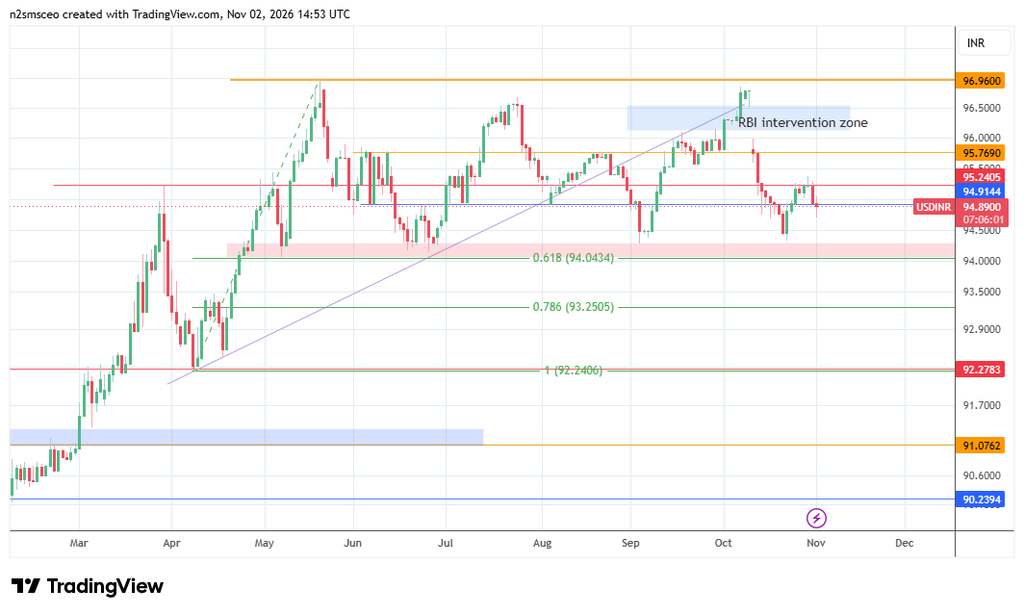
Bull case -> Recovery above 95.23: If oil prices push above $110 a barrel, along with rising U.S. bond yields and increasing import demand, this could support a recovery above 95.24. If so, the bearish outlook weakens, exposing potential moves to 95.50 and higher targets.
Base case-> Consolidation between 94.28 and 95.23: The market may wait out the outcome of the US midterm elections to see how this affects oil prices, stock markets, and foreign portfolio flows. This could favor a consolidation between 94.28 and 95.23.
Bear case-> Break below 94.28: More sustained weakness in oil prices, along with net improvements in foreign portfolio inflows and lower U.S. bond yields, would favor a decisive move down to 4.2 as a downside area. This would strengthen the case for a rupee recovery and unlock access to potential downside targets at 94.00 and below.