



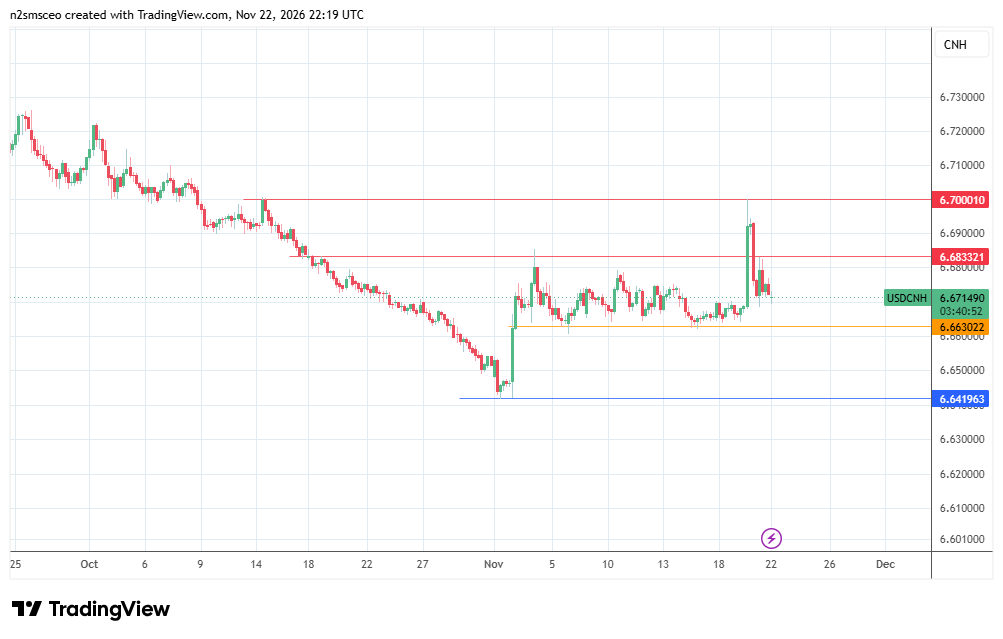
- The USD/CNH gave back most of its gains after the PBoC intervened to curb excess Yuan depreciation post-APEC.
InvestingCube chart · market data
Current setup
The USD/CNH surged on Thursday, 19 November, following the release of the FOMC minutes the evening before. The report’s hawkish tone led investors to unwind their long-Yuan positions as the US Dollar gained broadly. However, the subsequent recovery in the Yuan was due to actions by Chinese authorities to prevent undue depreciation. This allowed a pullback that forced the pair lower, losing 0.02% to close at 6.6708.
The People’s Bank of China set the daily reference rate at 6.7131 yuan per dollar, a marginal increase over the previous rate of 6.7128. The offshore yuan traded 0.3% weaker at this presentation decline.
The pair is trading in an environment facilitated by a stronger US dollar, hawkish Fed expectations, and offshore Yuan sales on the one hand, versus currency support initiatives by the PBOC and a strong Chinese trade surplus on the other.
USD/CNH: Macro Drivers
1. PBOC intervention and exchange-rate management
The PBOC operates a managed exchange-rate regime for the onshore Yuan, which sets the tone for the offshore Yuan’s exchange rate versus the US Dollar. The PBoC’s intervention and FX management regime remain the key influences on near-term yuan direction. The PBoC’s action is two-fold: FX liquidity manage prevents any outsized Yuan moves on both sides, while the setting of a daily reference rate provides exchange rate guidance for the onshore currency.
As part of FX management, the apex bank recently raised the FX reserve requirement ratio for financial institutions from 4% to 6% as a means of absorbing some of the available dollar liqudiity while stemming the Yuan’s rapid appreciation. This followed Yuan volatility following the recent Asian-Pacific Economic Cooperation (APEC) Summit. The near-term bias favours sharp intraday movements within the context of a two-way volatility-driven move within a consolidation.
2. Federal Reserve policy and US dollar strength
The FOMC minutes of 18 November point to a potential Fed rate hike in its December meeting. This has the potential to further widen the Fed-PBoC interest-rate differential, which puts more pressure on the offshore yuan. However, the PBOC’s managed exchange-rate framework means that an unrestrained surge in the USD/CNH is not likely to happen.
3. China’s trade surplus and export performance
Recent Chinese trade data indicated a substantial trade and current account surplus and this constitutes an important source of yuan support. Strong export data point to robust foreign currency inflows, allowing domestic companies to convert dollars into yuan and increasing demand for the Yuan. Resilient exports and China’s external surplus could provide gradual support for the Yuan well into 2027. However, this could be undone if there are tighter trade restrictions, weaker demand for Chinese exports and renewed geopolitical tensions that raise oil prices and make production more expensive.

4. APEC summit and geopolitical uncertainty
The recent APEC summit did not produce any material progress on key issues. This was a source of market uncertainty, which forced the unwinding of long-yuan positions that had been hopeful of more progress, especially on the US-China trade front. However, traders took solace in the PBoC’s actions and the Chinese trade data, offsetting some of the early Yuan selling pressure.
USD/CNH Forecast Scenarios
Base case: Consolidation between 6.6630 and 6.6800
FOMC minutes produced intense dollar strength, which will compete with Yuan stabilization efforts by the PBOC. A balance will favour consolidation between 6.63 and 6.68, the current boundaries of the range on the 4-hour chart.
Bull case: Break above 6.6800
Stronger USD demand that overwhelms the PBoC’s Yuan-stabilization efforts and rising US bond yields would make a case for a sustained move above 6.6800. Renewed geopolitical uncertainty and further unwinding of long-yuan positions would underpin this move. Upside targets could see the 6.7000 price high of 19 November come back into the mix.
Bear case: Break below 6.6630
If Fed policymakers walk back on the hawkish expectations for the December Fed meeting, with a decline in US bond yields and a supportive PBoC exchange rate fix, then a decisive move below 6.6500 becomes likely. Downside targets that could be exposed include the 6.6300 and potentially 6.6400.
What is your outlook on USD/CNH?
Anonymous · no sign-up · results from the last 30 days · not investment advice