



- Build your allocation based on what you want out of life, how long you plan to invest, and your willingness to lose money.
- Diversification among your investments is important; however, be aware of possible overlapping of those investments and the potential for market declines.
- Use a clearly defined rule to rebalance and modify the plan as your situation changes.
Markets are having a rough week that has been testing investment plans. Major U.S. indexes were down because of concerns about the valuation of Artificial Intelligence (AI). The S&P 500 lost approximately two percent on November 19th; more than ninety percent of the companies in the S&P 500 had decreased stock values. This sell-off serves as a reminder to investors that having too many shares in just a few companies can be detrimental to performance. While diversification does not necessarily protect against losses, it can decrease dependence on any single company or industry. See this for context. Reuters market report
This tutorial provides an explanation of what portfolio management is, how to allocate assets within your portfolio, why it’s important to diversify those assets and finally how to rebalance them. Your objective should be to develop a plan that will help you navigate through times of market volatility, rather than making predictions about where the market is headed.
What Is Portfolio Management?
Portfolio management is an on-going process that includes making decisions about which investment vehicles to use based on your financial goals (e.g., retirement, education, home purchase), time frame, current savings, ability to assume risk, and anticipated future needs. This is not just a list of assets you hold.
The first step is to assess your current financial status by evaluating your income, expenses, debts, savings, and other existing investments. You should have access to an emergency fund. It is likely better to pay off high-interest debt first rather than seeking potential higher returns. Only use funds for investing that are not necessary for meeting your daily living expenses.
Define the purpose of the money, as well as the length of time you will need it. Generally, if you are going to need the money in a short period of time, you should have less exposure to higher-risk investments. If you have a longer period of time until you will require the money, you may be able to take on more risk with the money; however, even though you have a longer period of time, losses will still affect your total amount of money. When there is a change in your situation, review your investment plan.
For a beginner’s step-by-step guide, read InvestingCube’s beginner investing guide
A good plan also identifies what you should track. Keep track of how much you are saving; assess if the portfolio continues to align with your objectives; and evaluate if expenses continue to be manageable. Do not judge success based upon the top performing investment in your portfolio. Your portfolio exists for the purpose of meeting your long-term financial goals, therefore, it is important that you judge its performance in relation to the goals and risk levels that you accepted.
Active vs. Passive Portfolio Management
Active portfolio management attempts to outperform a given market index. Portfolio managers analyse individual securities, and make adjustments to their positions when they believe market conditions warrant such actions. The ability to perform extensive analysis, and/or the ability to alter one’s position in response to changing market conditions, may result in adding value to the portfolio. However, the manager may also make poor investment decisions, trade at high cost, and charge higher fees than passive management.
Passive management follows an index (or benchmark) and doesn’t try to beat it. Passive managers make fewer trades than active managers do, and their expenses are typically lower than those of active managers. However, there is still risk associated with passive management; if the index goes down, then the fund will go down as well.
Fees and taxes should also be considered when comparing strategies.
Strategies that have high trading volumes will likely incur more expenses than those with lower trading volumes, as well as being less tax efficient if you use a taxable account. In addition, read the strategy’s mandate, benchmark, and reporting carefully. Learn about how decision-making occurs, how performance is evaluated, and what types of risk the strategy takes on. It is much easier to evaluate a clearly defined process for making investment decisions than it is to evaluate a promise to beat the market.
Neither of these options are inherently superior. Compare each option’s objectives, costs, holdings, and level of management required. Make your choice based upon your personal situation, not on what has happened over the past year.
Active strategies will likely have to be updated more frequently than passive ones. Therefore, investors should understand how each active strategy operates and why it might fail. Passive funds can typically be followed much easier than active ones; however, a passive fund’s benchmark can often be narrow (not representative of the entire universe), expensive to use in a given market, or heavily dominated by a few large companies. Investors should review the passive fund’s documentation to verify that it clearly defines its role in relation to the larger portfolio.
What Is Asset Allocation?
The way you divide up your money into different types of investments (like stock, bonds and cash) is called “asset allocation.” Stocks have the potential for higher returns; however, they can also lose value quickly. Bonds will usually give you a return on your investment in the form of interest payments, but bond values can decrease. Cash provides stability and is available when needed, yet inflation can decrease what you can buy with cash. There are many other types of investments that may be appropriate for certain objectives, based upon how much risk those investments carry.
Portfolio risk is shaped by allocation. Even if you have many individual stocks, you can still experience a decline in value during a broad-based market sell-off. The following examples are provided for illustrative purposes only, and are not intended as recommendations or projections of future performance.
| Sample profile | Equities | Bonds | Cash |
| Conservative | 25% | 60% | 15% |
| Balanced | 55% | 35% | 10% |
| Growth | 75% | 20% | 5% |
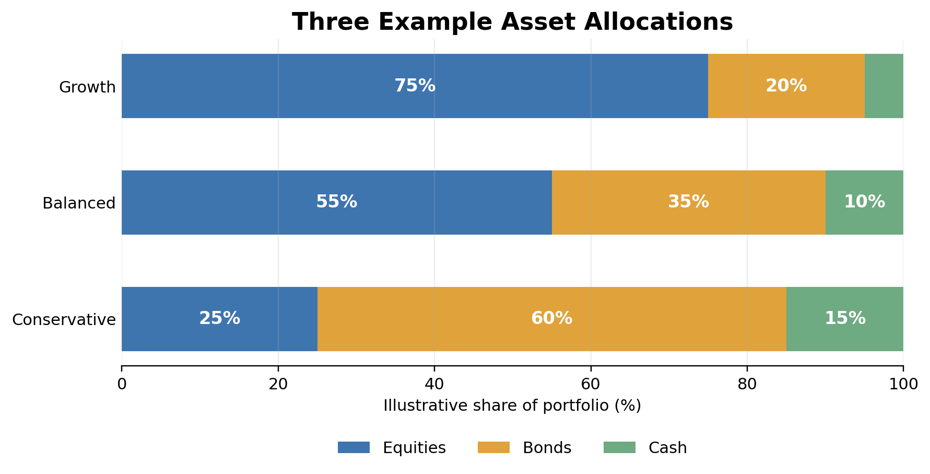
Figure 1. Illustrative allocation mixes. Actual portfolios may use other assets and percentages.
A “conservative” mix would hold more bonds and cash, and might be appropriate for investors with a shorter-term outlook or those who are more sensitive to risk.
A “balanced” mix would include more stock than the conservative mix but also maintain bond exposure. A “growth” mix would emphasize stocks and could result in significant losses. No guarantees apply to these labels; bonds can decline, cash can fail to keep pace with inflation, and stocks can remain depressed for extended periods of time.
Liquidity needs to be considered as part of an allocation. A large expense, for example, could require a cash or short-term reserve outside the long-term portfolio. That would allow you to avoid having to sell investments when there is a market downturn. The table only displays broad categories. Real portfolios may contain other asset types and will depend upon country, account type, and individual circumstances.
Asset Allocation by Age and Risk Tolerance
The age of an individual can be used to provide guidance on how to invest; however, it should never be considered a strict regulation. While a younger investor may be able to make up for losses in value due to declining markets, the amount of financial risk that a person can take on may be restricted by unstable income and/or high levels of personal debt. An individual who is approaching retirement age may need to continue to invest in growth-oriented assets, if they anticipate a long period of investment time ahead of them and their cost of living continues to rise.
Risk tolerance refers to the level of emotional stress caused by market fluctuations that you are willing to accept. Risk capacity refers to the amount of financial loss you can sustain before it begins to impact your lifestyle. Both are important because if a significant drop would cause you to panic and sell your investments, you should find an investment mix that will help you stay invested. If you have stable income, cash reserves, and a long-time frame for investing, you may be able to tolerate greater amounts of volatility in your investments.
Ask: At what time will you require the money? What amount of money lost would affect your future plans? Can you continue to invest when there is a significant decrease in value? After changing jobs, moving, having a child or retiring, re-evaluate your investment portfolio.

Diversification Investing: How to Spread Your Risk
Diversification of your investments involves spreading your money among different types of investments. While this may help reduce how much you lose when one specific company has trouble, it will not protect you from being impacted by the overall stock market falling. In fact, many of your investment choices could drop in value at the same time during a period of a large sell-off.
When you look at your portfolio’s contents, make sure to consider if there is an overlapping ownership of certain stocks. Multiple funds could be owning the same stock as another fund. You should examine the funds’ holdings to see how well they are diversified in terms of different types of assets, locations, industries and companies. During times of market turmoil, correlations among various investments can increase, while global investments will still have currency risks.
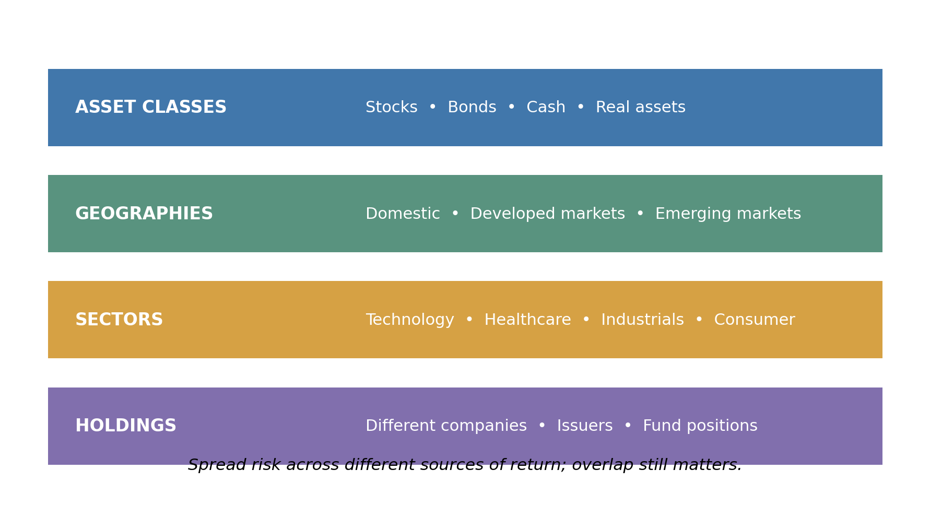
Figure 2. Diversification can be considered across several layers; the diagram is a framework, not a guarantee of protection.
Broad funds still may concentrate in some sectors or countries.
Check the index, top holdings, fees and currency risks. For more on ETFs and the costs to review, see InvestingCube’s ETF guide
A stock can lose a lot more than an entire portfolio during a sell-off when there is company specific news. Mixing up stocks can help prevent some of this loss; however, portfolios that are primarily made up of stocks will experience significant losses in a general market downturn. Try to diversify your investments among multiple companies, sectors and countries.
Diversification doesn’t guarantee you don’t take on some risks that are hard to see. Many companies are dependent upon the same customers, suppliers, interest rates or economic environment. While having many different company stocks in your portfolio does not mean you have many different types of risks in your portfolio. What factors would cause all of your investments to lose value simultaneously? Is your portfolio in balance appropriately for your specific financial circumstances?
How to Rebalance Your Portfolio
Rebalancing will adjust your holdings back to where you want them based on the allocation that you selected. Changes in the stock market can result in some shares taking up a larger or smaller portion of your total portfolio. Rebalancing is about managing this drift, and is not an attempt to forecast what type of share will perform better than others.
Choose either a review schedule or a point of action. A rule will prevent continuous adjustments. You should consider adding new funds to those assets that are under-weight rather than selling off other assets. Prior to making any decisions, you should review your tax implications and transaction costs.
Suppose you have a hypothetical $100,000 investment portfolio that comprises of 60% equities ($60,000) and 40% bonds ($40,000) (60/40). Over time, your equity portion increases to $84,000, while your bond portion decreases to $36,000. Your new portfolio value is $120,000 and the asset allocation has changed to 70% equities and 30% bonds. At this point, if you had stuck with your original 60/40 allocation, you would be holding 60% equities ($72,000) and 40% bonds ($48,000). To return to your original 60/40 allocation, you will need to transfer $12,000 from your equity portion to your bond portion. This example is for illustrative purposes only; it does not represent actual investment performance.
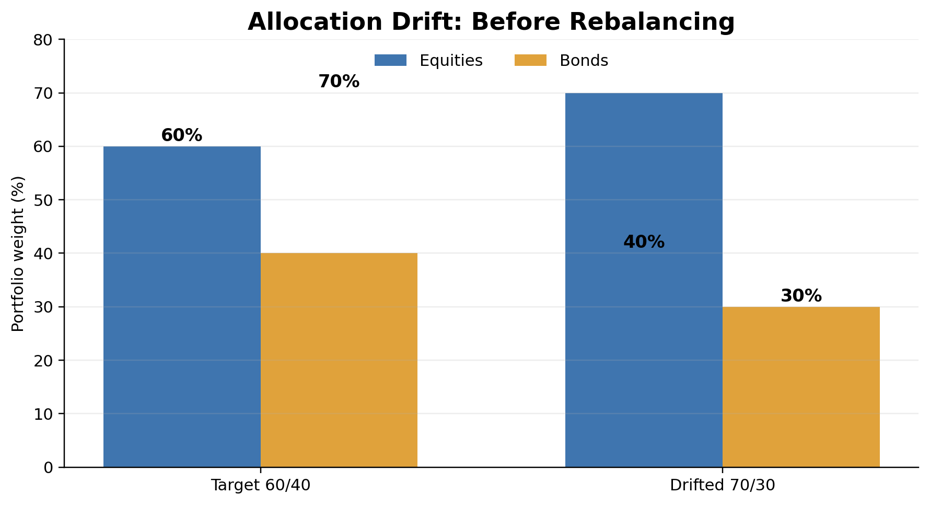
Figure 3. Allocation drift from a 60/40 target to 70/30; rebalancing would move the portfolio back toward its chosen mix.
Rebalancing trims the stronger performer and adds to the laggard to restore your target. But first check that the target still suits your goals and risk capacity. For a fund-comparison checklist, read InvestingCube’s ETF selection guide
Frequently Asked Questions About Portfolio Management
What is a good asset allocation for beginners?
There is no single “best” combination of assets. Your choice should depend on what you want to achieve, how long you plan to invest, how much money you will need in the near future and how willing you are to lose some of that money. This sample table is meant to educate you, but it should not be taken as advice on what to buy.
How many stocks do I need to be diversified?
No single number guarantees you will have achieved a diversified portfolio. Review your existing investments for overlaps among companies, sectors and funds. You may find that adding more of the same type of investment does not help to lower your overall risk.
How often should I rebalance my portfolio?
A twice-yearly review or threshold rule may assist in not responding to each change. When considering adjustments, remember to evaluate your fee and tax implications first.
Does diversification protect against a market crash?
It reduces concentration risk, but the prices of all the different assets in your portfolio could decline simultaneously during a major economic event. Therefore, it does not eliminate systemic risk (market risk) nor does it provide an assurance that you will realize a return on your investment.