



- A mutual fund pools money; a manager invests it.
- Costs matter: 1% versus 0.2% changes your result.
- Match the fund type to your goal and time frame.
A mutual fund is an investment option where a group of people put their money together, and then a person who manages that money uses the money to purchase stocks, bonds, or other types of investments. Every investor in the fund gets units, and the value of these units goes up or down depending on the performance of the investments in the fund. If you have ever wondered about mutual funds and how they work, this article can help. This article uses plain language. This article will teach you about the different kinds of mutual funds, how to get started investing in them, what it costs to invest in them, and the risks associated with investing in them. It will also show you how to select a mutual fund that meets your investment goals.
What Is a Mutual Fund and How Does It Work?
A mutual fund is like a common bucket. People put money into the bucket. The mutual fund company then purchases a variety of investments with the money in the bucket. Every person who puts money into the bucket receives “units” of the mutual fund. The cost of each unit is referred to as the “NAV” (net asset value). As the value of the investments inside the bucket increases, so will the value of the units. Similarly, if the value of the investments decreases, so will the value of the units. AMFI offers simple guides for new investors in India.
There are two types of mutual funds: open-ended funds and closed-ended funds. An open-ended fund allows you to purchase and/or redeem units on each business day. A closed-ended fund only issues units once when it launches, then those issued units can be traded on an exchange after that time. Most people who are new to investing tend to choose open-ended funds because they offer more flexibility and simplicity than closed-ended funds. Prior to purchasing any type of mutual fund, make sure you know what type of fund you are purchasing.
Why use a fund?
A manager researches the stocks and bonds that will go into the fund. Because your money is invested in multiple securities (stocks/bonds), if you make a poor choice with one security, it won’t affect you as much. You may be able to begin investing with a smaller amount of money than if you were to invest directly into individual securities. The graphic below illustrates how money flows through a fund.
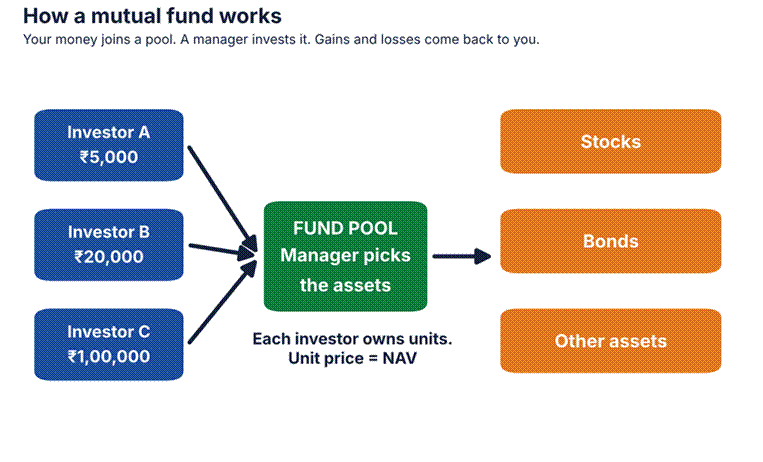
The first image shows a flowchart. There are three investors who contribute varying amounts to a single investment fund. A professional manager then uses that money to invest in stocks, bonds and other types of investments. Each investor receives units in exchange for their contribution. The value of each unit is determined by the NAV.
Types of Mutual Funds: Equity, Debt, Hybrid, and Index Funds
Funds have four main forms. Equity funds use most of their funds to buy stock. These funds provide greater potential for growth; however, they may experience larger swings than other forms of funds. Debt funds utilize most of their funds to purchase bond-like instruments. Hybrid funds combine both stocks and bonds into a single fund. Index funds do not attempt to outperform a specific index (such as the Nifty 50 or S&P 500) through active management; rather, they simply replicate that index. The Investor.gov guide to funds explains these ideas in plain words.
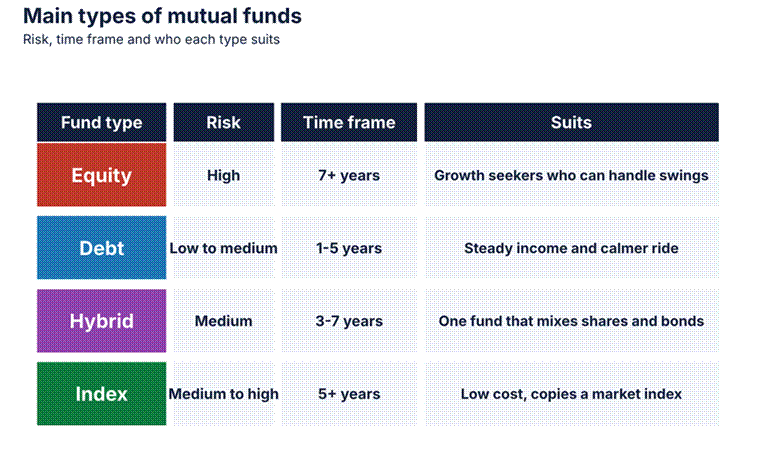
Image 2: An organized, color-coded chart that compares Equity, Debt, Hybrid, and Index Funds; this includes their typical risk level, recommended length of investment (time frame), and the type of investor they would suit.
Which one fits you? There’s a simple rule. Money needed within three years should be placed in safer investments. Money needed for ten or more years can have higher stock allocations. A hybrid fund will suit people that are looking for a single fund that has both sides of the equation. An index fund will suit people that are looking for a very inexpensive option and do not require a manager to guess which stocks are going to perform well. Don’t stress too much about choosing correctly. Most people begin by holding one equity fund and one debt fund, and then may add additional funds as time goes on. What is most important is that you know what each fund you hold represents.
How to Invest in Mutual Funds Step by Step
You can make investing in mutual funds stress free with these six steps:
1) Complete your KYC. KYC (Know Your Customer) is a onetime process where you verify who you are.
2) Determine what you want to achieve with your investments, as well as the length of time you plan to hold onto them.
3) Choose a type of mutual fund that will help you meet your goals and fit within the timeframe you have established.
4) Select a method for purchasing the fund(s). For example, you may use the fund company’s website, mobile application, a stockbroker, or your local bank.
5) Decide if you would like to invest a single amount at one time (lump sum), or if you would prefer to invest a smaller amount regularly (SIP).
6) Submit the purchase request, and then keep a record of the transaction. Finally, examine the status of your funds on an annual basis or every other year.
Before beginning the investment process, make sure that you have all of the required documents accessible. You must provide your Permanent Account Number (PAN), a document that serves as proof of residence, a bank account and a telephone number associated with your Aadhaar card. Typically, the Know Your Customer (KYC) procedure is completed on most platforms via the internet within minutes. Once you complete the investment, you will receive an account statement. Be sure to retain this document as it is needed during tax season and for verifying the return on investment.
A SIP is an investment method where a person makes regular monthly payments. To find out more about how a SIP works, please refer to our SIP Investing guide.
You’ll have to decide whether you want to go with a “direct” plan or a “regular” plan. Direct plans are less expensive than regular plans because they cut out the middleman (distributor) and avoid paying a commission. Regular plans do include the distributor’s commission and usually provide some form of financial guidance. Before making your final decision on which type of plan to use, be sure to compare the two. To start, pick a dollar amount that you know you won’t need for at least several years. Then, set up automated payments so you don’t miss any monthly contributions.
Mutual Fund Costs: Expense Ratio, Exit Load, and Fees
Costs take away from your profits, so understand what they are right away. The expense ratio is the annual fee that is represented by a percentage of the total amount of money you have invested. The fund will deduct this fee from its own assets; therefore, you will never receive an invoice. An exit load is a penalty that you pay if you withdraw your funds prior to a certain period of time (typically one year). In addition, there may be other costs such as entry fees, brokerage charges, or taxes associated with a particular fund.
For example, if you were to make an investment of $10,000 for 10 years, and the fund was able to earn 8% each year prior to expenses. If there is a 1% expense ratio, you will receive 7%. This means that after 10 years, your investment has grown to approximately $19,672. If there is a 0.2% expense ratio, you will receive 7.8%. Therefore, your investment has grown to approximately $21,193. The difference in growth over this time period due to fees is about $1,521.
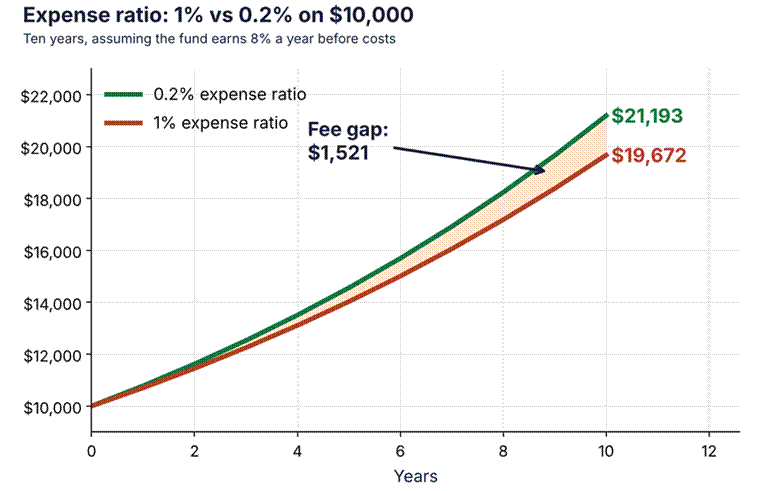
A line graph that illustrates how much an initial investment of $10,000 grows over a period of 10 years when invested in a mutual fund with a 1% expense ratio versus a 0.2% expense ratio. The lower-cost mutual fund would grow to approximately $21,193 while the higher-cost mutual fund would grow to approximately $19,672. The difference in growth, represented by the shaded region between the two lines, is approximately $1,521.
Small percentages add up over time. A 0.8% difference seems small in 12 months, but over 10 years, that adds up. Compare the costs of similar funds. For example, an index fund and an actively managed fund serve different purposes; therefore, compare similar types of funds. Evaluate if a higher cost is justified by the benefits of a manager’s skills. If not, consider other less expensive alternatives.

Watch out for taxes too. Capital gains from mutual funds may be taxable. The tax rate is based on the type of mutual fund, as well as the length of time it is held. Tax laws change, therefore, consult with a tax advisor about the current tax law prior to selling. A tax advisor will also assist you with planning your sale.
Pros and Cons of Mutual Fund Investment
The most significant advantage is simplicity. A professional manages your money, and you have the ability to invest small amounts. You will receive an immediate diversification of investments into numerous types of assets. Additionally, there are protective regulations that apply to you. SEBI (Securities and Exchange Board of India) establishes disclosure requirements for mutual funds operating in India. It is also simple to purchase and sell funds; furthermore, you can set up automatic payments.
There are also some negatives associated with investing in funds. Fund prices go up and down and therefore you could potentially lose money. Additionally, fees charged by fund managers will lower your overall return. Also, some funds perform worse than the index they are measured against. Finally, depending upon how long you hold the fund, there may be tax implications for any gain you make. Past returns do not promise future gains. Our look at India’s market and SIP flows shows that even steady buyers face rough patches.
Before making a purchase, ask yourself one question: “What is this money going to help me achieve?” If you are unable to explain the role that the money will play in your life in just one sentence, then you should consider waiting. Money works best when there is a specific goal for it (retirement, down payment on a home, emergency fund, etc.).
How to Choose the Right Fund
First, establish what you want to achieve, over what period of time and the level of risk you are willing to take. Next, find out about costs, if the fund is outperforming its benchmark, the experience of the fund manager and the size of the fund. Do not base your decision to invest in a fund solely on the previous year’s performance.
Our guide to the best mutual funds to invest in walks through these checks and common mistakes.
Also check how costly the market is. The P/E ratio compares price with earnings. A high market P/E can mean lower future returns.
After you invest, track your real return. Use XIRR when you add money at different dates.
After you invest, track your real return. Use XIRR when you add money at different dates.
Frequently Asked Questions About Mutual Funds
Are mutual funds safe?
There’s no such thing as a “risk-free” investment. Debt funds generally have less volatility than equity funds. While there are regulations that help safeguard your money against fraudulent activity, those same regulations will not shield you from losing money in the stock market. You should choose a fund based upon how much risk you can tolerate.
How much money do I need to start investing in mutual funds?
Many funds begin with an initial investment of either ₹500 or ₹1000 using the SIP method. In the United States, there are many funds that do not require an initial investment; however, some funds will require a minimum investment of $1000 or more. Review the fund’s requirements.
What is NAV in a mutual fund?
NAV is the value of each individual unit of the fund. It represents the total amount of money that the fund has available (its assets) minus all of the expenses associated with managing the fund, then divided by the total number of units in the fund. Investopedia explains it with examples.
Can I withdraw my money from a mutual fund at any time?
Most open-ended funds allow you to make a sale on any business day. There could be a fee for making a premature sale (an exit load). Certain types of funds like those used for tax savings may require that you keep the investment until a specific period has passed (lock-in period). Typically, the funds will arrive in your bank account within a few business days.
Your first fund should have a specific goal. Write it down, choose the type, and begin the process. The best fund for you is one that you can relate to and stick with even during difficult economic conditions.
Investopedia explains it with examples.
Can I withdraw my money from a mutual fund at any time?
Most open-ended funds allow you to withdraw your investment on any working day. An exit load may apply depending upon when you choose to withdraw your money. Some types of funds such as tax saving funds will have a period of time during which you cannot make withdrawals from the fund. Your funds should arrive in your bank account within a few working days.
What do you want to accomplish with your initial fund? Describe what you want to achieve, select the type of fund that fits your needs, and begin to work toward your first goal. The most appropriate fund for you is the one you know well and can maintain during difficult economic conditions. The purpose of this guide is education, not investment advice.