


- Patience is the hard part.
- Markets fall sometimes. In those moments, return to your goal and your time horizon.
- If they have not changed, your plan probably should not change either.
The initial investment process can seem daunting. There are many terms used in the world of investments that are difficult to understand. There are also graphs showing the ups and downs of prices. Many people believe they must have a lot of wealth to invest. However, this is not true. This guide will provide step-by-step instructions on how to invest using plain language. This guide was developed specifically for individuals who are just beginning their journey as investors. You will find out what to do first, what options are available for purchasing, how to assess the risks associated with investing and how money increases in value through compounding over time. We will not recommend specific products or advise you on which product(s) to purchase. Our goal is to prepare you to become a confident investor. Go at your own pace. Now, let’s get started.
How to Start Investing: What You Need Before You Begin
Before you begin investing, make sure your foundation is strong. Build an emergency fund. An emergency fund is money that can help cover unexpected expenses like losing your job or having a medical bill. Many financial professionals recommend that people have enough money in their emergency funds to last them three to six months’ worth of living expenses. The Consumer Financial Protection Bureau explains how to build one. Keep it in a safe account you can reach fast, not in the market.
The second step is to establish your objectives. What do you intend to use the money for? Will you buy a home within five years? Are you saving for retirement over thirty years? Are you paying for your children’s education? Every objective has its own time frame. Put them in writing.
Thirdly, determine what your time horizon is. The length of time that you can allow the money to sit there undisturbed is your time horizon. Any money you may require within the next three years should be placed in low-risk investments. Money that you do not plan on touching for at least ten years or longer can be invested in higher-risk investments. This is due to the fact that money can have time to recover from drops in value. If you would like to know how to begin investing, these three factors are more critical than any stock tip.
Another check: examine your debt. High-interest debt (e.g., credit card debt) can be more costly than investing will provide return. Therefore, pay off this type of debt prior to making an investment decision. This will allow for a more objective assessment when considering which type of investments to pursue.
Investing for Beginners: Stocks, Bonds, ETFs, and Funds Explained
Investing for dummies: in 1 minute. A stock represents a tiny portion of a business. Stock prices can fluctuate significantly; however, investors who are willing to wait for a while have historically been compensated by owning stocks. Our guide to growth and value stocks shows the main styles.
A bond is a loan you give to a company or a government. They pay you interest. Bonds usually move less than stocks, but they still carry risk.
Cash savings sit at the low-risk end. Cash is not exciting, but it is steady. Most people hold some cash alongside their investments.
An ETF is a basket of investments that trades on an exchange like a stock. Many ETFs track an index. Read our complete guide to ETFs for the basics.
A mutual fund also pools money from many people, and a manager buys the investments. Costs and rules vary. See our mutual funds guide for beginners for details.
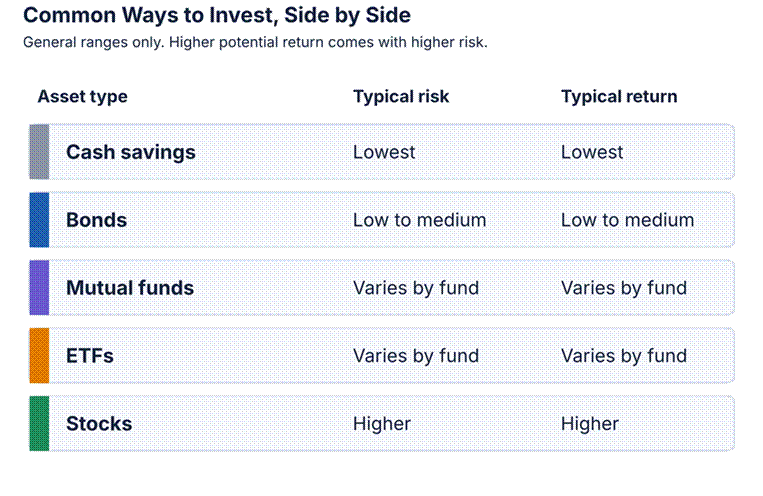
Image 1: A table compares cash savings, bonds, mutual funds, ETFs and stocks. Cash has the lowest typical risk and return, stocks have the highest, and the others sit in between.
How to Invest Your Money Step by Step
Invest your funds in six simple steps. Step 1: Establish your foundation. Create an emergency fund and pay down all high-rate debts. Then Step 2: Determine your objective(s) and the timeline for achieving those objectives. Later Step 3: Select the type of account that fits your needs (e.g., brokerage accounts, retirement accounts, or employer-sponsored plans). Following is Step 4: Invest in simple products such as broad-based mutual funds. Step 5: Decide on the amount you want to invest and how regularly you intend to make additional investments. Step 6: Review your portfolio at least annually.
Keep the fourth step simple. To begin with, a single broad-based mutual fund can provide an excellent way for a beginner to invest his/her money. Later on, you may wish to add other investments to your portfolio. It is important that you do not purchase anything that you are unable to explain using just one sentence.
The type of account you choose is based on the benefits and limitations of each. A brokerage account provides flexibility. A retirement account has the potential for tax advantages; however, it has restrictions regarding early withdrawals. A workplace plan can provide additional funds from an employer. Each country’s rules vary, therefore, review the local rules or consult with a qualified advisor.
How to Invest Money to Make Money: Risk vs. Return
People often inquire about the best way to utilize their funds to generate income. In reality, there is no magic formula. To realize profit, you must take on some degree of risk. Risk refers to the likelihood that the value of your chosen investment will decrease. Your return represents the amount of money you receive in exchange for assuming the aforementioned risk. Typically, the greater the potential return, the greater the associated risk. Unfortunately, there are no guarantees of profit. The basics page at investor.gov provides an excellent overview of the terminology used when discussing investments.
Risk is defined as “the possibility that an event will occur.” There are three types of risk that affect us. The first is market risk, which refers to the price of your investment dropping. The second is inflation risk, which refers to the purchasing power of your money decreasing. Finally, there is behavioural risk, which refers to making poor decisions based on fear and selling your investments at an inappropriate time. Behavioural risk is particularly harmful to new investors.
In addition, to spread the wealth of an individual investor by investing in several different companies and/or asset classes will lessen the impact of a loss if one of those investments fails. The amount of risk you take should be determined based upon the timeframe of your investment goals. Short-term goals require less risk while longer-term goals may allow for more risk.
And don’t forget the fees. Every year, fees can eat away at your investment return. If a fund has an annual fee of 1 percent, it will cost you significantly more than if you had invested in a fund with an annual fee of only 0.2 percent for thirty years. Also, tax consequences are important; find out how they apply in your state or country.
Investment Strategies for Beginners
You do not need to use a complicated investment plan. There are five basic investment plans that you can follow. The first one is called “Buy and Hold.” When you follow this type of plan, you invest in quality investments and then hold onto them for many years. This strategy helps to eliminate the need to trade frequently and can also reduce the overall cost of your investments.

Dollar-cost averaging is the second method. Dollar-cost averaging means that you will be buying shares at regular intervals (such as every month or every week) and you will be buying more shares when prices are lower and fewer when prices are higher. See Image 2 for an example of dollar-cost averaging. Our guide to SIP investing covers this monthly habit.
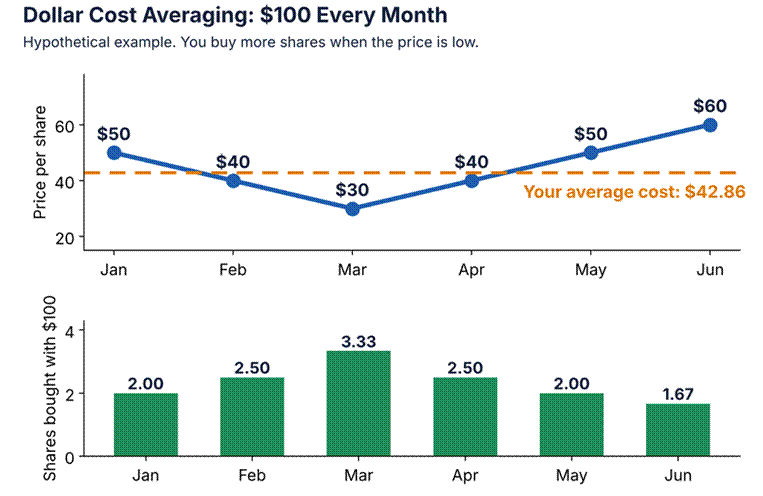
Image 2: Two charts show $100 invested each month for six months. The top chart shows the share price rising and falling. The bottom chart shows more shares bought when the price was low. The average cost is $42.86.
The third is index investing. You buy a fund that tracks a whole market, such as the S&P 500. It spreads risk and costs little. Read how to invest in the S&P 500 and index funds.
The fourth is diversification. You mix stocks, bonds and other assets so no single piece can sink you.
The fifth is dividend investing. You buy companies that share part of their profit with owners. Dividends can add steady income. Our dividend stocks guide explains yield and the risks.
Which one should you pick? Many beginners combine them. For example, you might use index investing with dollar cost averaging and hold for the long term. The best plan is the one you can follow when markets get rough.
How to Make Your Money Grow Over Time
Time does the heavy work. Compound growth means you earn returns on your earlier returns. It starts slowly, then speeds up. Image 3 shows $200 invested each month for 30 years. You put in $72,000. At a 4% yearly return, it grows to about $138,810. At 7%, it grows to about $243,994. These are examples, not promises. Try your own numbers with the Investor.gov compound interest calculator.
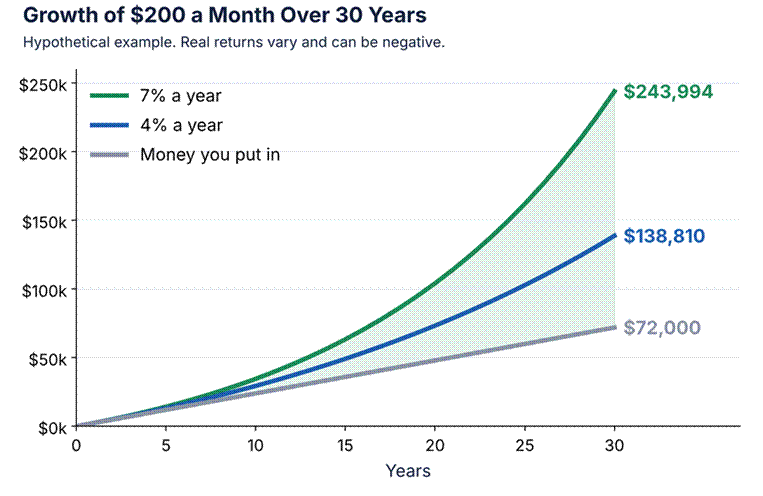
Image 3: A line chart shows $200 a month over 30 years. The grey line is money you put in, $72,000. The blue line at 4% reaches about $138,810, and the green line at 7% reaches about $243,994.
Start early (with a small amount), automate deposits, keep costs low, reinvest dividends, increase contributions with each pay raise, check your plan at least once/twice per year instead of daily.
Write a short note to your future self now, so you remember why you started.
Frequently Asked Questions About Investing
How much money do I need to start investing?
You may begin by spending a small amount of money on some platforms ($10 to $100) and purchase a portion of a share (fractional). After you have put aside enough for your emergency fund, then spend only those extra funds.
What is the safest way to invest money?
There are no safe investments. The least risky alternatives are bank accounts that have insurance protection and bonds from the government for a brief period of time. Typically, these provide lower returns. Select based upon what you intend to accomplish with the money and how much time you will allow yourself to achieve those goals.
Should I invest or pay off debt first?
The first step should be paying down your highest interest rate debt (credit card) because the interest on these types of debts is usually higher than what you would earn from investing. Your low interest rate debt can remain in place while you are investing. You should always have some form of an emergency fund available.
How long does it take to see returns?
The time is indefinite. Stocks may drop during the first year of ownership. Generally, long term investments require 5 to 10 years (or even longer) to realize profits. Instead of thinking about the market on a weekly basis, consider it in terms of years.
What will be your initial action? Create one objective for today. Select a day on which you would like to begin your savings program. The smaller actions we take can lead to larger accomplishments. The purpose of this manual is to provide educational information and does not constitute financial advice.