




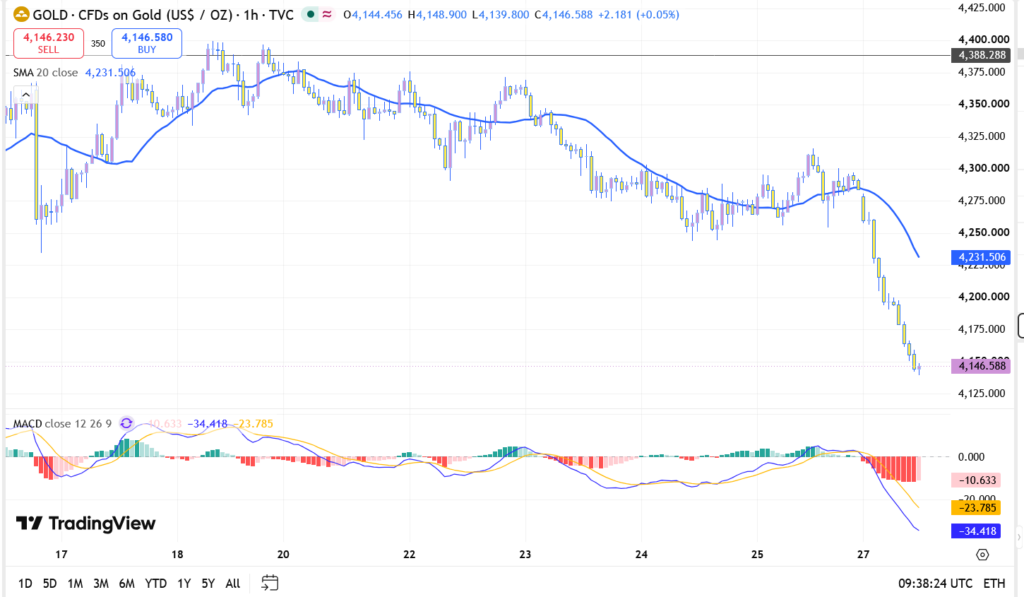
- Gold price today plunged about 3% below $4,200, with XAU/USD falling toward $4,140 and hitting its lowest level since August 5.
- Rising oil prices have revived US inflation fears and strengthened expectations for another Federal Reserve interest-rate hike in October.
- US PCE inflation and nonfarm payrolls are among this week's major catalysts as traders assess whether gold can stabilise after its sharpest recent selloff.
The gold price today extended its selloff on Monday, September 28, crashing below $4,200 as rising oil prices, higher Treasury yields and growing Federal Reserve rate-hike expectations triggered another wave of selling.
XAU/USD fell toward $4,140, extending losses to around 3% and reaching its lowest level in more than seven weeks. Reuters reported spot gold at $4,156.45 by 08:14 GMT, while December US gold futures dropped 3.1% to $4,188.80.
The decline extends last week’s loss of more than 2% and represents a decisive break below the $4,200 level. Gold had traded above $4,300 as recently as last week but has come under increasingly heavy pressure as markets reprice the US interest-rate outlook.
Why Is Gold Price Falling Today?
The latest gold price crash is being driven by an unusual combination of rising geopolitical tensions and higher interest-rate expectations. Oil prices rebounded after US President Donald Trump rejected Iran’s proposal aimed at ending the conflict and reopening the Strait of Hormuz. Brent crude moved higher as uncertainty surrounding one of the world’s most important energy routes returned to focus.
Normally, geopolitical uncertainty can support safe-haven demand for gold. This time, however, markets are concentrating on the inflationary consequences of expensive energy. Higher oil prices can increase transport, production and consumer costs, potentially keeping US inflation elevated. That makes it more difficult for the Federal Reserve to ease monetary policy and strengthens the argument for further tightening.
Fed Rate-Hike Bets Push XAU/USD Below $4,200
The shift in Federal Reserve interest-rate expectations has become one of the biggest headwinds for XAU/USD. Markets now assign roughly a 70% probability to another Fed rate increase in October, according to CME FedWatch data cited by Reuters. The Fed already raised its benchmark rate by 25 basis points earlier this month.
Cleveland Fed President Beth Hammack added to the hawkish backdrop on Friday, warning about the risk that persistently elevated inflation could become embedded in public expectations. Higher rate expectations have helped keep both the US Dollar and Treasury yields elevated. That combination is particularly difficult for gold because higher yields increase the opportunity cost of holding a non-interest-bearing asset.
Silver has been hit even harder, falling nearly 5% to around $61.17, while platinum and palladium also recorded steep losses on Monday.

Gold Price Forecast: US PCE and Nonfarm Payrolls in Focus
Attention now turns to a packed US economic calendar that could determine the next move in the gold price forecast. This week’s releases include US job openings, ADP employment data, the Personal Consumption Expenditures (PCE) Price Index and nonfarm payrolls.
The PCE report will be particularly important because it is the Federal Reserve’s preferred inflation measure. Strong inflation or employment numbers could reinforce expectations for an October rate increase, potentially maintaining pressure on gold.
Softer data, however, could challenge the recent rise in rate-hike expectations and provide some relief for XAU/USD.
Gold Price Outlook After the $4,200 Breakdown
The gold price outlook has weakened considerably following Monday’s breakdown. Gold is now trading well below its 20-hour moving average near $4,231, while momentum remains negative. The immediate area to watch is around $4,140, Monday’s latest low, followed by the psychological $4,100 level.
For buyers, $4,200 has changed from support into the first important recovery level. A stronger rebound would need to push XAU/USD back toward $4,230-$4,250 to begin reversing the damage from Monday’s decline.
Until then, the combination of rising oil prices, elevated Treasury yields and stronger Fed rate-hike expectations leaves the near-term gold price forecast under pressure.
Gold is falling as higher oil prices fuel US inflation concerns and increase expectations for another Federal Reserve rate hike. Higher Treasury yields and a firm US Dollar are adding pressure on XAU/USD.
Gold’s next move could depend heavily on US PCE inflation and nonfarm payrolls data. Stronger inflation or employment readings could support further Fed tightening expectations, while weaker data could reduce rate-hike bets and help gold stabilise.
The immediate gold price forecast remains under pressure below $4,200. The $4,140-$4,100 area is the next downside region to watch, while a recovery above $4,200 and then $4,230-$4,250 would improve the short-term picture.