



- The Reliance Industries share price retains its bearish structure below the Rs 1250 price barrier, as sentiment on Indian equities weakens.
Current setup:
Bias: Bearish
Reliance Industries share price closed the week at ₹1,226.00, down 0.03%. This followed a sharp sell-off on 24 September that pushed the stock to its lowest level in 17 months. The Reliance Industries share price has lost 22% of its value in 2026, making it one of the NSE’s largest underperformers. The stock is currently underperforming the Sensex index, which is down 13% this year.
The stock is at an important inflection point, even as the immediate structure remains bearish. This bearish structure remains valid below ₹1,250. However, higher refining margins and stronger-than-expected spreads in its petrochemical business continue to support its O2C earnings story. Its spinoff division (Jio) also retains a value unlocking narrative, which is an additional support stream. But ultimately, the major story is the prolonged Middle East disruption that continues to keep the oil-shock risk premium active, creating an environment dominated by fuel-supply risks and higher energy prices that add cost implications and Indian equities.
Reliance Share Price Drivers
1. Weak Sentiment on Indian Equities
Thursday’s sell-off in Indian equities shows how vulnerable Indian stock indices are to the energy market risk premium. The sell-off coincided with a spike in crude prices and US bond yields towards 5.15% (20-year highs). This also caused heavy foreign portfolio fund selling. Reliance Industries’ share price carries a heavy weighting in Indian indices, so weakening sentiment across the Indian board makes the stock particularly vulnerable to institutional investors.
2. Improving Oil-to-Chemicals (O2C) Fundamentals
This is the most important counter-macro driver for Reliance Industries. An analysis by institutional research outfit Jefferies indicates that the geopolitical situation in the Middle East has led to a nearly 4% loss in global refinery throughput. The company’s O2C margins are being supported by tighter refining and petrochemical markets, even as petrochemical spreads have also strengthened.
3. Jio remains the major structural growth story
Jio Platforms is Reliance’s digital business subsidiary. Jio is in the middle of a value-unlocking restructuring that could bring loads of value to Reliance Industries, especially after the proposed Initial Public Offering. However, this is a long-term investment case which will have little impact on the near-term weight posed by the oil shock risk premium and weak sentiment.

4. Jio-bp is facing supply-chain pressure
The West Asia disruption has impacted the company’s fuel-retailing operations. Jio-bp has been forced to ration sales to just 50 liters of diesel per transaction amid this latest disruption.
Reliance Industries Share Price: Forecast Scenarios
Base case→ Volatile Consolidation: the ₹1,200–₹1,280 price zone around the 17-month lows appears to be the consolidation area of choice as investors balance the stronger O2C margins against the geopolitical risk weight and weak sentiment around Indian equities.
Bull case: Any developments that point to a sustainable de-escalation and resumption of Hormuz shipping could favor a return above ₹1,250. This move unlocks ₹1,280 as the next target, followed by ₹1,300 if the sentiment turns more positive with the return of foreign portfolio funds.
Bear case→ Further Sentiment Deterioration: A further deterioration in sentiment could push the Reliance Industries share price below ₹1,225. This clears the path to ₹1,200, with ₹1,180 becoming visible on a further downside push.
Technical Outlook
The 17 April/18 September lows at ₹1,225 are the next key technical support. If the bulls hold this line, it could provide a basis for a potential recovery toward ₹1,250. A sustained recovery above ₹1,250 would indicate easing selling pressure and open the way to ₹1,280. Above ₹1,280, the technical picture improves further, with ₹1,300 becoming the next major resistance.
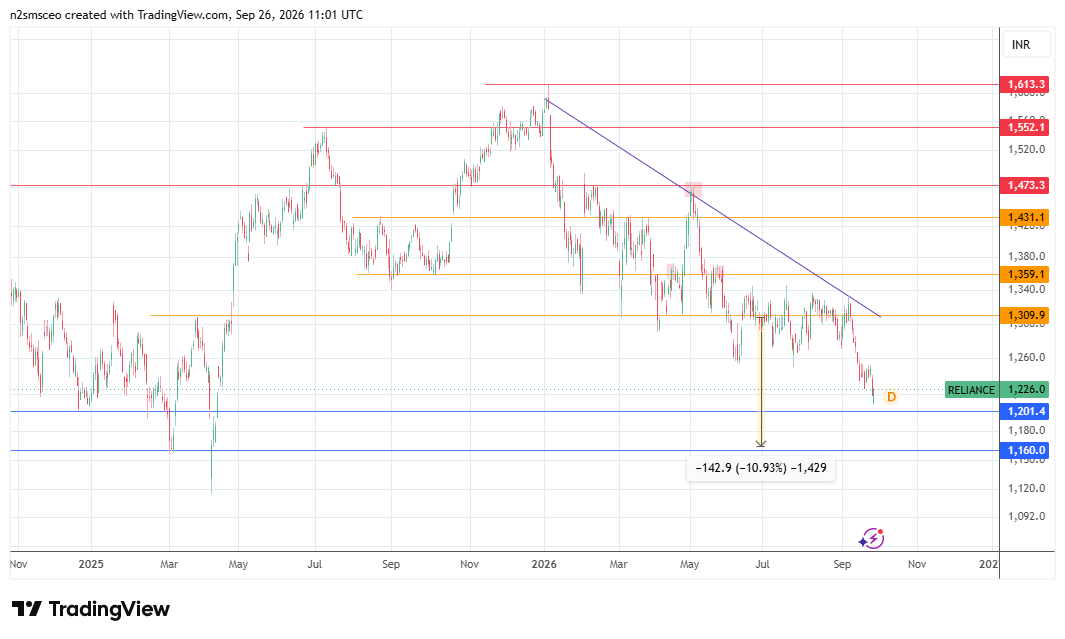
Conversely, a decisive break below ₹1,225 would shift attention toward ₹1,200 (20 December 2024 low). Below ₹1,200, the pathway towards the 4 March 2025 low at ₹1,160 becomes clearer.