




- The Nifty 50 index sold off heavily on 24 September 2026. Here is the forecast for the index following this selloff.
Current setup:
Bias: bearish below 23,000
Nifty 50 fell steeply in Thursday’s trading session, closing 1.64% lower at 23,063 in its biggest one-day drop since 9 March. The index had a relatively uneventful start to the last trading day of the week, trading flat to negative around 23,080–23,130 as traders recalibrate positions ahead of the next trading week.
The Nifty’s current bias is to remain bearish as long as price stays below 23,300. Higher oil prices (Brent > $105), US 10Y > 5.00%, and renewed foreign institutional investor selling provide a difficult environment for bulls to thrive at the moment.
The decline has also led to consolidation in the bearish rising wedge pattern; short-term structure has therefore shifted from consolidation to bearishness below 23,300. 23,000 is the line in the sand. A technical rebound above this changes the course northwards. Below it, downside momentum toward 22,700 picks up.
Key Drivers: Nifty 50 Index
1. Crude oil: the primary macro headwind
Brent crude has dipped to $98, but the geopolitical risk remains as the war spreads to the Saudi front. For Indian equities, elevated crude pushes input costs higher. For the wider Indian economy, higher oil prices raise the nation’s import bill, add inflation pressure, and weaken the rupee. Any sustained move towards the $110 Sept highs brings the pressure back on.
2. US Treasury yields
Higher US bond yields reflect tighter financial conditions. The US 10-year yield has risen to around 5.15%, its highest level since June 2007. Higher US yields mean investors can earn more on US bonds, making relatively lower-risk US Treasuries more attractive than high-riskemerging markets. This situation leads to the third driver discussed next: foreign portfolio fund outflows.
3. Foreign Institutional Investor Fund Flows

Foreign institutional investors pushed their funds out of India by selling ₹5,027 crore on 24 September 24. Domestic institutions only bought ₹4,301 crore. Total foreign portfolio fund outflows hit roughly ₹12,609 crore in September, directly contributing to the Nifty 50’s downside move.
4. Geopolitical Uncertainty Persists
The geopolitical situation in the Middle East remains unresolved despite the fall in oil prices below $100. As long as this risk-off event persists, it keeps the oil risk premium and its Nifty-negative events in place. If de-escalation is sustained, it will unwind this risk premium, and the Nifty 50 will recover.
Nifty 50: Forecast Scenarios
Base case→ Volatile Consolidation: The focus is on the 23,000–23,300 price zone as the potential region of volatile consolidation following Thursday’s sharp sell-off. Price direction to be determined by Brent crude prices, foreign portfolio flows, and US bond yields.
Bull case: -> Geopolitical De-escalation: this is the scenario that will aid a recovery above 23,300. Above this mark, a further recovery towards 23,500 and possibly 23,700 cannot be ruled out.
Bear case→Breakdown continuation: Rising US bond yields, higher oil prices and foreign portfolio fund outflows could drive the Nifty 50 lower, continuing the bearish breakdown. Below 23,000, new downside targets appear at 22,800 → 22,500.
Technical Outlook
The 23,270–23,500 zone is now the key recovery area. If the price pushes above this zone, it indicates new demand following Thursday’s selloff. This unlocks access to the 23,850 barrier as the initial recovery target. A further advance that uncaps this resistance brings in 24,450 as the next upside target.
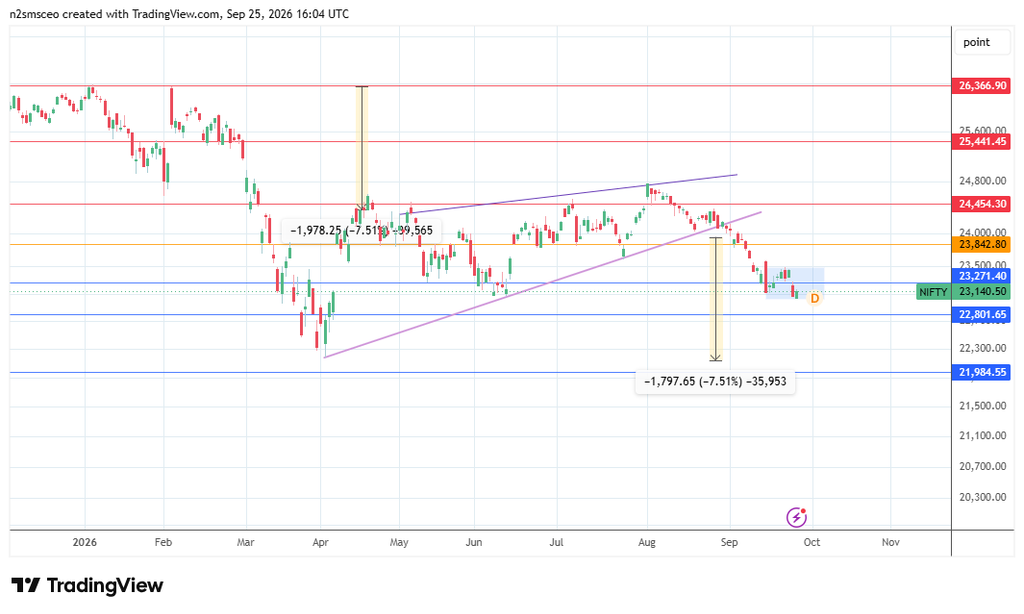
Conversely, a decisive break below 23,000-22,800 exposes the 2 April low at 22,200 as the next downside target. This completes the breakdown of the rising wedge that began on 31 August.