



- Gold price traded around $4,274 on Friday, attempting to stabilise after falling more than 2% this week as the US Dollar and Treasury yields strengthened.
- XAU/USD remains below $4,300, with expectations of further Federal Reserve tightening limiting demand for the non-yielding metal.
- Gold's near-term outlook remains under pressure, although $4,200 is emerging as an important support area, while longer-term forecasts remain supported by central-bank demand and fiscal risks.
The gold price steadied near $4,275 during Friday’s Asian session, but remained on course for a weekly decline as elevated US Treasury yields and a stronger Dollar continued to weigh on bullion.
XAU/USD traded around $4,274, recovering from an earlier session low near $4,256. Gold remains down more than 2% this week and well below the $4,400 area tested earlier in September. The decline comes as US borrowing costs remain elevated following the Federal Reserve’s September rate increase. Higher Treasury yields and a firmer US Dollar have created a difficult backdrop for non-yielding gold.
Why Is Gold Price Falling This Week?
The main pressure on the gold price this week has come from a rapid repricing of US interest-rate expectations. The Federal Reserve’s September rate increase was followed by stronger US economic data and hawkish comments from policymakers, strengthening expectations that interest rates could remain elevated or rise further.
Higher Treasury yields increase the opportunity cost of holding gold because bullion does not pay interest. A stronger Dollar adds another headwind by making dollar-denominated gold more expensive for buyers using other currencies.
Those forces have outweighed some of the geopolitical support traditionally associated with gold. Earlier this week, rising expectations for further Fed tightening had already pushed spot gold lower while supporting the Dollar.
Why Is Gold Price Falling This Week?
The main pressure on the gold price this week has come from a rapid repricing of US interest-rate expectations. The Federal Reserve’s September rate increase was followed by stronger US economic data and hawkish comments from policymakers, strengthening expectations that interest rates could remain elevated or rise further.
Higher Treasury yields increase the opportunity cost of holding gold because bullion does not pay interest. A stronger Dollar adds another headwind by making dollar-denominated gold more expensive for buyers using other currencies.
Those forces have outweighed some of the geopolitical support traditionally associated with gold. Earlier this week, rising expectations for further Fed tightening had already pushed spot gold lower while supporting the Dollar.
Gold Price Today Struggles Below $4,300
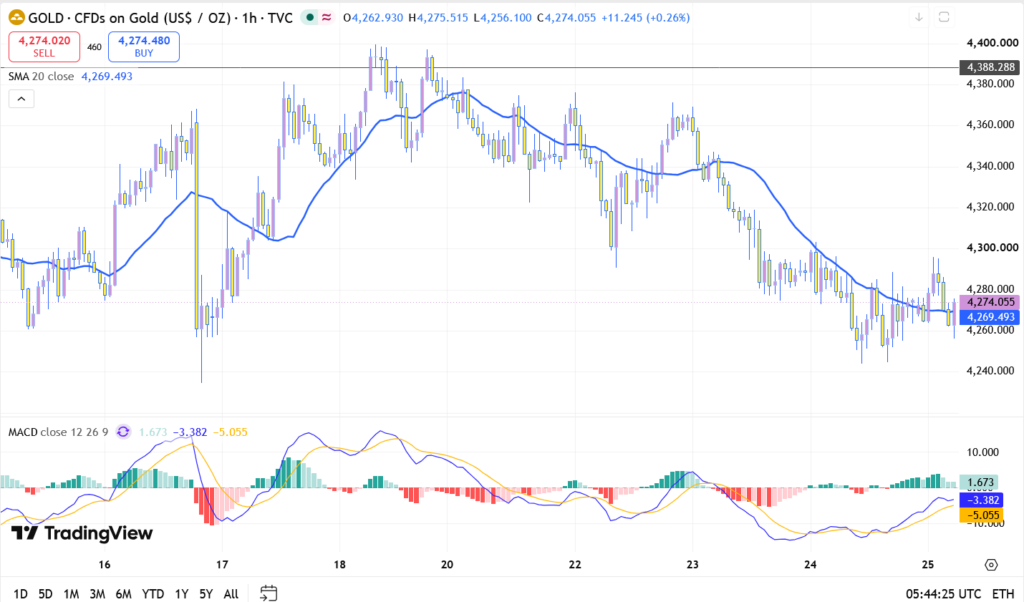
Friday’s price action shows gold attempting to find support after its latest decline.
The hourly chart puts XAU/USD near $4,274, slightly above its 20-hour simple moving average around $4,269. Gold has recovered from an intraday low near $4,256, but the broader short-term structure remains weaker after the decline from above $4,380.
Momentum is showing tentative improvement. The MACD histogram has moved back into positive territory, suggesting selling pressure is easing, although this has yet to produce a decisive recovery.

For the gold price today, $4,300 is the first major psychological level bulls need to reclaim. Until that happens, rebounds may struggle to reverse the broader weekly decline.
Trump-Xi Talks Add Another Variable for Gold
The US-China relationship is also back in focus after President Donald Trump and Chinese President Xi Jinping met in Washington this week.
Markets entered the summit looking for progress on trade, tariffs and other areas of economic tension. Expectations of reduced US-China friction can reduce some safe-haven demand for gold, although the impact is competing with developments in the Middle East and monetary policy.
The summit followed months of negotiations between Washington and Beijing and came as the Chinese yuan strengthened to multi-year highs ahead of the talks.
For gold, however, US rates and the Dollar remain the more immediate drivers heading into the end of September.
Gold Price Forecast: Can XAU/USD Recover Above $4,300?
The gold price forecast remains cautious as a stronger US Dollar, elevated Treasury yields and expectations for further Federal Reserve tightening continue to pressure XAU/USD. Gold needs to reclaim $4,300 to strengthen the near-term outlook, while $4,250 and $4,200 remain important downside levels. A sustained move above $4,300 could bring the $4,400 region back into focus.
Beyond the near term, the gold price outlook for 2026 remains more supportive. Elara Capital forecasts gold between $4,200 and $4,700 for the remainder of 2026, while projecting prices could reach $5,000-$5,200 by the end of 2027, supported by central-bank demand, reserve diversification and US fiscal risks.
Elara Capital forecasts gold trading between $4,200 and $4,700 per ounce for the remainder of 2026. The range reflects a combination of near-term pressure from rates and the Dollar and longer-term support from central-bank demand.
The $5,000 gold price remains a major long-term target in current market forecasts. Some analysts expect gold to revisit or exceed $5,000 as central-bank demand, reserve diversification and fiscal concerns provide longer-term support, although elevated real yields remain a near-term obstacle.
Gold is priced primarily in US Dollars, so a stronger Dollar can make gold more expensive for buyers using other currencies. Dollar strength often weighs on XAU/USD, particularly when it occurs alongside rising Treasury yields.