



- Gold and silver prices have resumed the downward move following Monday's modest recovery, as Fed rate hike bets rise further.
Gold and silver start the new month on a defensive note after Fed Chair Kevin Warsh’s Jackson Hole speech caused a hawkish repricing of the Fed’s monetary policy. The highlight of the speech was a warning that further tightening may be necessary to curtail inflation. Warsh reaffirmed the Fed’s 2% PCE inflation objective. This target has not been met in 65 months now and counting.
Gold and silver prices declined sharply following the speech, with silver posting a larger drop as traders unwound positions that had been amassed in anticipation of further easing.
Gold’s Immediate Reaction to Jackson Hole
Gold prices entered Friday’s Jackson Hole session on a position of strength, well above the $4,600/oz price level shortly before Warsh’s speech. Once Warsh’s comments hit the newswires on a hawkish note, gold began to unravel, falling by about $150 from the start of Warsh’s speech to $4,495 within four hours. The classic monetary-policy transmission playbook played out in support of the US Dollar at the detriment of precious metals.
Warsh’s concerns regarding persistent inflation (hawkish) → higher rate expectations → higher US Treasury yields → higher USD appeal → investment flows away from non-yielding gold towards USD-denominated assets.
The market had been bracing for an easing in monetary policy. However, Warsh’s comments noted that inflation remained materially above the Fed’s target. The discussion has now shifted toward the possibility of a September rate hike, with these bests rising sharply to 66% by September 1, according to information from Reuters. That repricing was highly negative for gold.
Gold Price Action Today (1 September 2026)
The initial Jackson Hole selloff was followed by an upward retrace as traders banked profits from the sharp strengthening of the US Dollar on Monday. The selloff in gold has resumed and spot gold is down more than 1% in overnight trading. Gold now trades at $4375/oz as of writing, as US Treasury yields have jumped to 9-month highs. The key question is whether this decline is a case of a deep correction in a bull market (long-term trend still bullish), or whether a significant trend reversal is now in play.
The Technical Outlook for Gold
Technically speaking, XAU/USD has deteriorated significantly. However, the longer-term bullish structure remains intact. The decline from he 4449 intraday resistance of 31 August is now testing the 4361 support, where the 200-day moving average lies.
A sustained recovery from this level, targeting 4584 and 4697, suggests the recent decline was a pullback within the uptrend and offers a dip-buying opportunity.
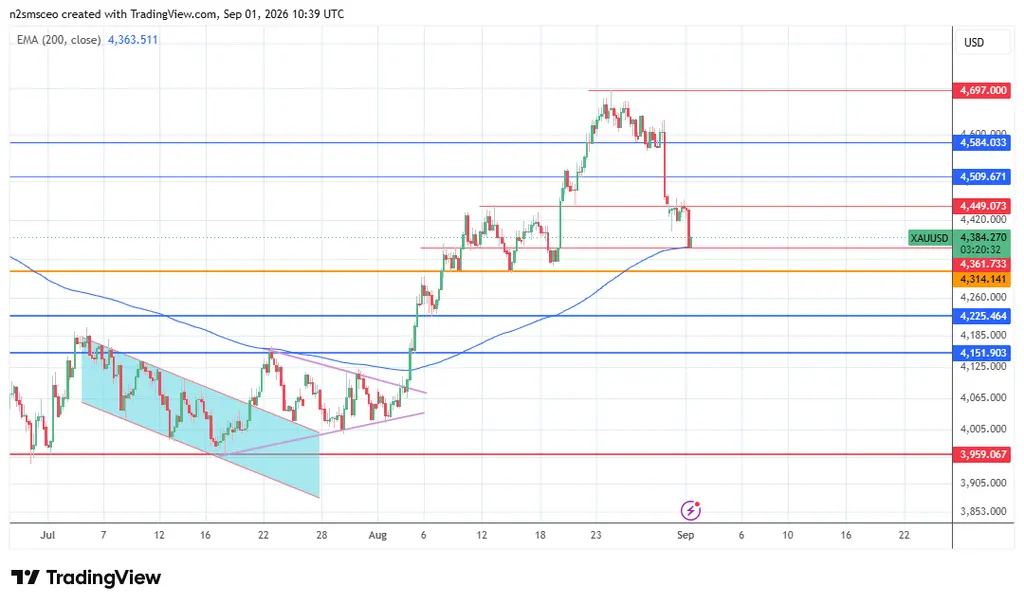
Conversely, a decline below the 200-day EMA at 44361 suggests vulnerability to another leg lower, with 4314 (10 August and 13 August lows) and 4225 (6 August low) as the nearest downside targets.
Silver Price: Technical Outlook
The trendline and the 200-day EMA are the immediate support levels for silver. A bounce from here preserves the higher lows and aims for the 66.78 resistance. If this level is uncapped, the 70.73 resistance becomes the next target, after which the uptrend continues towards the 77.49 price mark formed by the 26 May and 2 June 2026 highs.

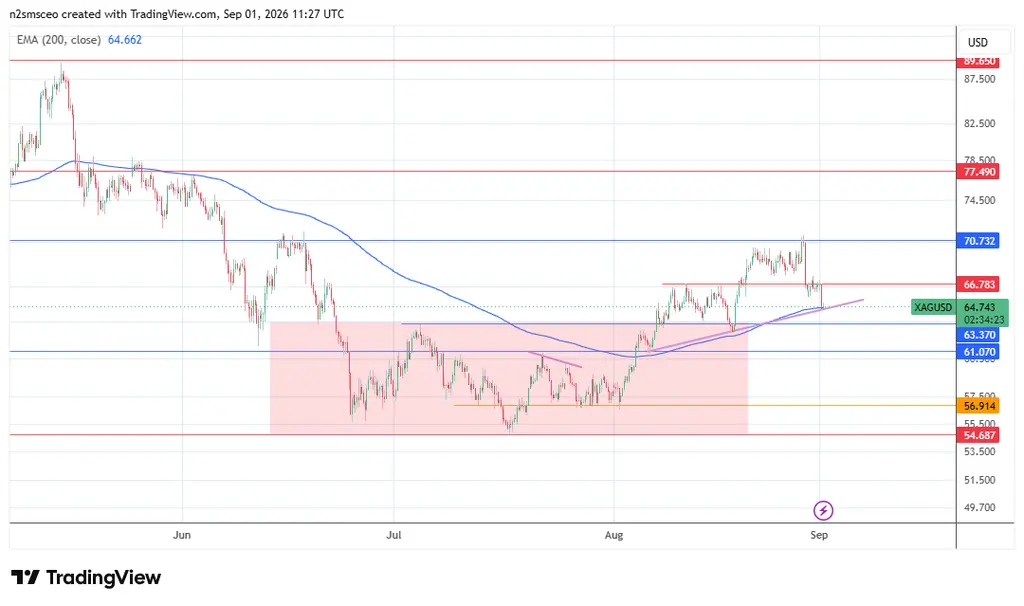
Conversely, a breakdown of the trendline and the 200-EMA exposes the 63.37 low of 14 August. Below this level, additional support is seen at 61.07, the 6 August low.
Silver Took a Harder Hit
Silver’s negative reaction to Warsh’s Jackson Hole comments was considerably more aggressive. Silver prices had been trading above $71/oz (a two-month high) heading into the event. After Warsh’s speech, the white metal reversed sharply, falling 4% that day and approaching the mid-$66 area.
This morning (September 1), spot silver fell another 1.2% to about $64.98/oz. This move puts the attempted $70 breakout on hold, potentially damaging the bullish breakout structure.
Why Was Silver’s Decline More Aggressive Than Gold?
Silver’s dual-purpose nature as a precious metal and an industrial commodity means it is sensitive not only to bond yields and Fed rate expectations. It is also sensitive to global manufacturing, industrial production, and demand by renewable energy and AI infrastructure industries.
A repricing of Fed rate expectations in a more restrictive direction usually leads to a larger liquidation in silver. AI stocks are risk-associated and typically take a hit as higher interest rates reduce their future valuations. Margin compression in these companies usually leads to lower silver demand, which is negative for silver prices. Furthermore, manufacturing companies also face margin compression from higher interest rates, which could reduce industrial production as higher costs pressure margins. This is also a silver-negative scenario.
1 September: The Gold/Silver Market Showing Signs of Stabilization
Gold’s decline has hit support at the 200-day EMA, and the 4-hr candle indicates that buyers have begun to enter the fray. This suggests a market shifting toward data dependence as the initial knee-jerk reaction to the Jackson-Hole speech wears off. Data dependence means treating US Employment and Inflation numbers as the data that dictates the Fed’s data-dependent stance.
With Warsh also reaffirming the Fed’s shift from forward guidance to data dependence in interest rate decision-making, the next US Non-Farm Payrolls numbers scheduled for 4 September have grown more important. This report also includes wage growth data and the unemployment rate, with labor participation also a closely watched metric.
A strong USD NFP report reinforces the hawkish Fed narrative, driving US bond yields higher and supporting the USD at the expense of gold and silver prices.
A weak labour market report produces a reverse result: USD weaker → lower US bond yields → rate-hike probability falls → gold/silver rebound.