


Archived Article This article was published more than 5 months ago. The market data, prices, forecasts, and analysis were accurate at the time of publication but may have changed since then. Please use this article for historical reference only and refer to our latest content for current market information.
- Nifty 50 index starts the week on a lower note after oil prices rose to $108 per barrel on the back of geopolitical escalation.
Current Setup and Live Chart
Indian shares. including stocks of companies listed on the Nifty 50 index, started the week on a weaker footing following a slide to record lows by the Rupee in early Monday trading. This occurred as oil prices climbed once more following increased tensions in the Middle East. A reported drone strike on a UAE nuclear power plant and the U.S. President Donald Trump’s comments stating that “the clock is ticking” for Iran, reignited the geopolitical tensions.
The Nifty 50 index fell by 1.26% initially to 23,347. However, bargain hunters appear to have entered the fray, bringing in some demand that has enabled the index to recover most of the initial losses. The Nifty 50 index is now down 0.01%.
Oil prices hit as high as $108.86 barrels on Monday, before retreating to $107.20, sending global bond yields soaring. The Rupee is now at record lows versus the US Dollar, now at 96.3325 as the oil shock risk premium continues to pressure the Indian currency and stock markets. A similar situation is also playing out in the rupee’s pairing with other currencies, as the GBP/INR is currently trading 0.67% higher, even if not at record levels.
The situation leaves Indian assets starting the week within a regime of a variety of macro stress factors: higher oil prices, a record-weak rupee and rising global bond yields.
A Reuters report also indicates that shipping across blockaded Strait of Hormuz is virtually non-existent, which continues to keep the oil risk premium going. This is a negative for Indian equities in a country which is a net oil importer, as inflation expectations remain heightened and foreign portfolio outflows continue.
Nifty 50 Index: Macro Drivers
1. Rupee Stress and Inflation Risks
The pressure on Indian equities comes from elevated inflationary expectations, driven by higher energy prices. Under these conditions, the Reserve Bank of India (RBI) will tighten domestic financial conditions. Rupee weakness also adds to the risks to the Nifty 50 from the oil shock. India is an oil-import-dependent economy whose currency weakens with higher oil prices. When this happens and there is a market selloff, foreign portfolio funds exit the market. These funds must exchange rupees for US Dollars as they head to new destinations, and the large volumes that increase rupee supply and USD demand further depreciate the rupee, triggering a cascade of foreign outflows to prevent value loss from exchange rate depreciation.
2. Oil Shock
Elevated oil prices for a net oil importer like India widen the trade deficit by making imports much more expensive than the national government originally budgeted. This “tax” on the Indian economy is a Nifty-negative situation.

3. FII outflows + higher yields
Higher bond yields pull investment flows out of stocks and into bonds. For foreign portfolio funds, the exit takes them out of the domestic market entirely and into safe havens or better investment destinations, such as US Treasuries, where yields are guaranteed. There was a record $12 billion in foreign portfolio outflows in March 2026, when the oil shock risk premium set in. The Nifty 50 index remains sensitive to broader global risk-off market sentiment.
Nifty 50 Index: Forecast Scenarios This Week
Base case: The stock is expected to remain in a choppy consolidation, with a downside skew, as long as oil prices remain elevated and the rupee remains under pressure. The pattern on the charts also supports this narrative. The bias for the stock is to sell on rallies, based on any relevant negative headlines.
Bull case: The base case for a relief bounce is a cooling of oil prices, which, in itself, is a factor in the de-escalation of the geopolitical situation. This will also drive INR stabilization, with added support from the RBI’s interventionist measures. Upbeat Purchasing Managers Index (PMI) data will also prove supportive for a market that is presently searching for any positive headlines on which a relief bounce can occur.
Bear case: Higher oil prices will put more pressure on the rupee and the Nifty 50 index. If we see a USD/INR exchange rate that is able to hit the 97–97.50 price range and bond yields continue to rise, we could see the technical pattern quickly move to completion with a downside push.
Takeaway: The Nifty 50 index remains a proxy for oil prices and the rupee’s valuation. The major risk events for the week are:
- India Flash PMI, May 21 (Thu) — this gives a look into the business conditions around manufacturing and services activities.
- US Flash PMI data and Initial/Continuous Jobless Claims, May 21 (Thu): These provide a barometer for risk sentiment and global yields.
- University of Michigan Consumer Sentiment, May 22 (Fri)
Nifty 50 Index Technical Outlook
The double top pattern on the daily chart, which was confirmed by the breakdown of the 23842 neckline resulted in a downward push that completed the measured move at 23271. However, the bulls forced a bounce on this support which has so far, not uncapped the 23842 neckline that now acts as a resistance.
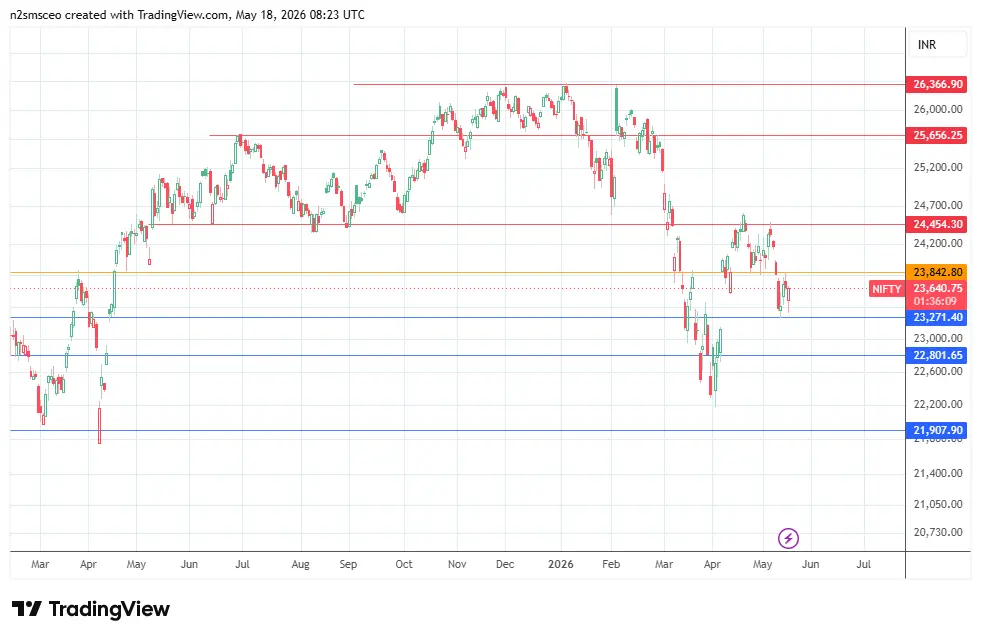
As long as the price action trades between these two price points, the consolidation will continue. If the floor price at 23271 is degraded, a further push to the downside resumes, targeting the 22801 support formed by the prior low of 27 January 2025.
On the flip side, a retest of the topping price at 24454 will be on the cards if the bulls uncap the current price ceiling at 23842. A further push to the north will depend on the break of 24454, which gives the bulls clear skies to aim for the 25656 resistance and prior high of 30 June 2025.