



- The recent Trump-Xi summit and resilient tech earnings have been the primary catalysts for this rally, offsetting the “hawkish” pressure from the hotter-than-expected 3.8% CPI print.
Yesterday, May 14, the S&P 500 hit a new record high, driven by a massive rally in semiconductors and AI infrastructure. NVIDIA jumped nearly 4%, reaching a market cap of $5.7 trillion, and Cisco surged 14% after its earnings report.
The market was optimistic as the bosses of Nvidia, Tesla, and Apple accompanied President Trump on his trip to China. The cooperation raised investor hopes for a summit with Chinese President Xi Jinping that could yield new trade deals focused on the semiconductor industry.
The rally took place despite the release of the U.S. producer price index for April, which indicated a significant resurgence in inflation. The figures show that the final demand PPI increased by 1.4% each month and by 6.0% annually. The figures were the largest year-over-year increase in more than three years and exceeded economists’ expectations.
But the yield on the 10-year Treasury note jumped to its highest level in 10 months at 4.50% after core inflation data came in hotter than expected with a 5.2% annual increase. As such, investors are weighing the chances that the Federal Reserve will keep interest rates high for longer.
Risk-On Rally Fueled by Summit Breakthroughs:
- Markets were still in a good mood as investors reacted to ongoing talks between Donald Trump and Xi Jinping, hoping for progress on trade and tariffs and the wider geopolitical mess revolving around Iran and Taiwan.
- Both the US and China agreed that the Strait of Hormuz must remain open, easing fears of deeper disruptions to global energy supplies. Oil traders probably felt some relief.
- Markets love stability nearly as much as they love AI. If there is less geopolitical uncertainty, it gives investors more confidence to be aggressive on risk assets like equities, especially tech stocks.

S&P 500 Technical Outlook:
The S&P 500 chart reflects a strong bullish recovery following the sharp selloff seen in March and early April. After breaking out from the descending channel highlighted in red, the index established a clear reversal structure near the 6,474 support zone. In this zone, buyers aggressively stepped back into the market. The circle areas on the chart highlight key transition points where bearish momentum faded and bullish control gradually strengthened, eventually triggering the current upward trend.
Once the index successfully broke out above the long-term moving average near the 6,900 region, it marked an important shift in market sentiment. Since then, the price has remained firmly above all major moving averages. Even the short-term averages crossing above the longer-term trend indicators in a bullish alignment.
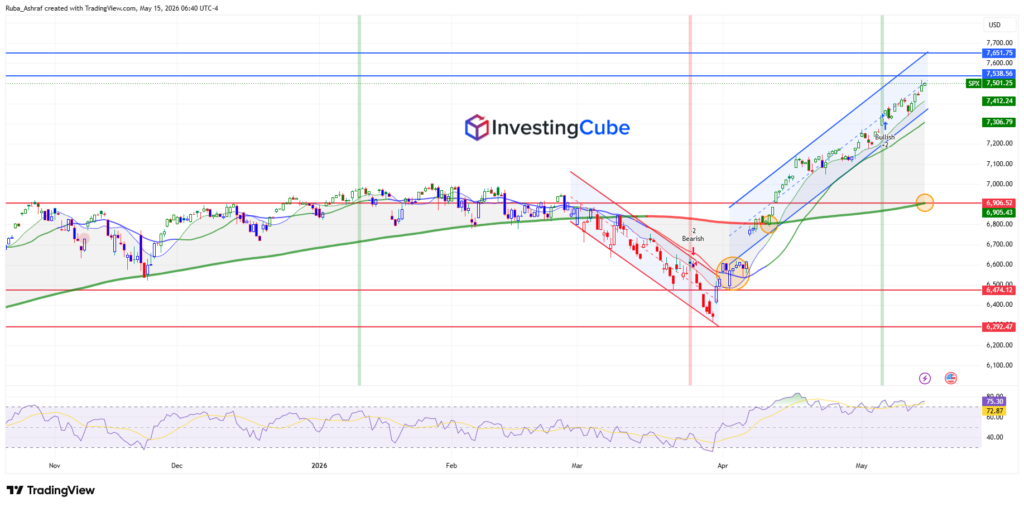
The ascending blue channel currently reflects a strong trend continuation structure, supported by higher highs and lower lows. This suggests buyers remain in control despite the steep rally. From a momentum perspective, the RSI is trading above the 70 level, signaling overbought conditions after an aggressive upside move. This could suggest that the market may enter a temporary consolidation or corrective pullback before extending higher.
The index is now approaching a major resistance level between 7,538 and 7,651. This area acts as a significant technical barrier where profit-taking pressure could intensify. At the same time, the lower boundary of the blue ascending channel and the 7,306-7412 support region remain key areas for bulls to defend in order to preserve the current trend structure.
Potential Scenario for the S&P 500’s Next Move:
- Bullish Scenario:
If the index manages to maintain stability above the lower trendline of the ascending channel, the bullish scenario would likely remain dominant. A decisive breakout above the 7,538 resistance could pave the way toward the 7,651. After that, it’s potentially possible to reach fresh record highs beyond that level. - Bearish Scenario:
Failure to break above resistance, coupled with weakening momentum, could spark a short-term pullback. A breakdown below the lower channel support could see profit-taking pressure towards 7,306 and perhaps the 6,905 region, which now acts as an important medium-term support zone. However, unless the price trades back below this wider support area, the overall structure remains biased towards the buyers in the medium term.