



Archived Article This article was published more than 5 months ago. The market data, prices, forecasts, and analysis were accurate at the time of publication but may have changed since then. Please use this article for historical reference only and refer to our latest content for current market information.
- Lululemon Athletica (LULU) shares plummeted nearly 12% on Thursday, hitting their lowest level since early 2020 after the company named former Nike executive Heidi O’Neill as its next CEO.
- While the board praised O'Neill as a "growth agent," analysts expressed concerns that she is too closely linked to the "ill-fated Donahoe era" at Nike.
- O’Neill will start at Lululemon in September and has addressed her future staff in a letter, stating that she has a lot to learn and will ask a lot of questions.
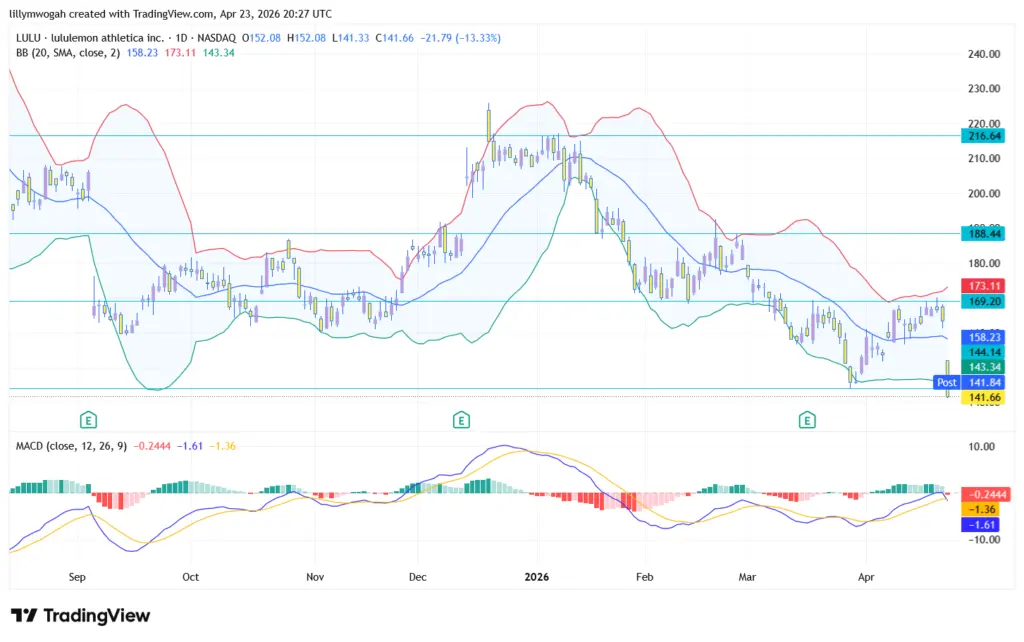
Lululemon Athletica Inc.’s share price gapped down significantly on Thursday, opening at $152.08 before sliding further to settle near $141.66, a staggering 13.3% single-day decline. The selloff followed Wednesday’s announcement that the board had unanimously selected Heidi O’Neill, a 28-year Nike veteran, to succeed former CEO Calvin McDonald.
Why Investors are Skeptical: The “Uh-Oh’Neill” Sentiment
O’Neill, 61, spent more than two decades at Nike. She was closely associated with former Nike CEO John Donahoe, who led a controversial push to sell more products through Nike’s own stores and websites. That strategy ended up isolating key retail partners like Foot Locker, while cutting ties with Zappos and Amazon. Rivals like Hoka, On, Brooks and Salomon took over the coveted shelf space Nike had abandoned.
The Donahoe era ended in 2024 amid falling sales and declining market share. His successor, Elliott Hill, has undone many of those moves, but Nike’s revenue is still expected to fall again in the current quarter to its lowest level in five years.
As reported by Bloomberg, O’Neill’s history at Nike is raising questions among investors, who are concerned about her association with former Nike CEO John Donahoe and his strategies. The Bloomberg article also noted that O’Neill was once considered an internal candidate for Nike’s top job, but the board ultimately hired Hill out of retirement.
Why Lululemon Is Losing Market Share to Alo and Vuori
The timing of this leadership change is sensitive. Lululemon has lost significant market share to emerging competitors like Alo and Vuori. The core North American market is cooling. Net revenue in the Americas decreased 4% in the most recent quarter.
The financial health of the company is also showing cracks. Gross margins dropped 550 basis points to 54.9%. This decline was driven by increased markdowns as the company struggled to move inventory without the “buzz” that once defined its releases.
While China remains a bright spot with 24% growth, it is not enough to offset the domestic slump. Activist investors, including Elliott Management, have already built billion-dollar stakes to demand radical changes in how the company addresses its falling price.

Lululemon Faces Leadership Gap Until September as New CEO Waits to Start
Adding to the unease is O’Neill’s delayed start date. Due to her prior agreement with Nike, she cannot join Lululemon until September 8. This leaves the company under interim co-CEOs during the high-stakes summer season.
O’Neill was absent from the company’s recent all-hands meeting. However, she addressed her future staff in a letter reviewed by Bloomberg. She acknowledged the weight of the task ahead.
You’ve built something special, and I don’t take that lightly. I’ll ask a lot of questions, and I have a lot to learn.”
said O’Niel in a letter to Lululemon employees
Lululemon key technical levels to watch
- Lululemon is currently trading at $141.66, down 13.33% on the day.
- The stock hit a low of $141.33, its lowest level since early 2020.
- The 20 period Bollinger Band (SMA, close, 2) shows the lower band at $143.34, which has been breached to the downside, a classic oversold signal but also a sign of severe weakness.
- Support now sits at the recent low of $141.33. A break below that could open the door to $130 and then $120.
- Resistance sits at $143.34 and then $152.08 (today’s high).
- The negative histogram at -0.2444 indicates that downside momentum remains intact.
Conclusion
Lululemon is at a crossroads. The company is transitioning from a high-growth darling to a legacy brand that must defend its territory. Hiring O’Neill is a high-risk bet that her Nike experience can be salvaged and applied to Lululemon’s specific culture.
For now, the market is choosing to wait on the sidelines. The massive share price drop suggests that investors are not yet convinced she can restore the “lustre” that made Lululemon a global fashion leader.
Lululemon shares crashed 12% after the company named former Nike executive Heidi O’Neill as its next CEO. Investors are concerned about her association with former Nike CEO John Donahoe, whose direct to consumer strategy alienated retail partners and led to falling sales.
She will join the company on September 8, 2026, after completing a non-compete period with Nike.
While the company remains profitable, its gross margins have recently decreased due to higher markdowns and increased competition.