



Archived Article This article was published more than 5 months ago. The market data, prices, forecasts, and analysis were accurate at the time of publication but may have changed since then. Please use this article for historical reference only and refer to our latest content for current market information.
- IREDA share price is up by 20% in the last month, driven by an impressive Q4 FY26 business update
- A recent JPY 28 billion financing from Sumitomo Mitsui Banking Corporation is a vote of confidence on the corporation's growth outlook
- Valuation is a concern as the state-backed corporation has a debt-to-equity ratio of 5.41 and P/E ratio of 20x
After a somewhat subdued start to the year, IREDA stock has shown renewed vigor in April 2026, advancing roughly 25% over the initial three weeks. At the time of this writing, the share price hovers around the ₹137 mark, having briefly touched an intraday high of ₹142.94.
This recent rally appears to be underpinned by solid fundamental factors. However, determining if this represents a true turning point or merely a temporary rebound within a broader, still-challenged trend warrants a more critical evaluation than current optimistic views often provide.
What Sparked the Rally
The immediate catalyst was IREDA’s provisional Q4 FY26 business update, which landed on April 1 and contained numbers that were hard to argue with. The state-owned renewable energy financier reported its highest-ever annual loan sanctions of ₹51,883 crore and disbursements of ₹34,946 crore for FY26.
By March 31, 2026, its total loans had grown by 22%, reaching ₹93,075 crore compared to ₹76,282 crore the previous year. A surge in lending approvals and fund releases at this state-backed green finance institution hints at faster execution of projects ahead. This is precisely what investors needed to see after a prolonged period of stock underperformance. Despite past struggles, signs now point toward momentum picking up where it once stalled.
Another key factor contributing to this momentum was a substantial funding success. IREDA successfully secured a JPY 28 billion External Commercial Borrowing facility from Sumitomo Mitsui Banking Corporation. That an arrangement notably includes a JPY 12 billion green shoe option.
Accessing international capital on this scale not only broadens the company’s funding avenues but also suggests that global institutional investors maintain confidence in IREDA’s credit standing.

The Valuation Trap
The market consensus is currently overwhelmingly bullish, with many retail investors chasing the momentum in hopes of a quick return to previous highs. However, while the growth metrics are stellar, we must look at the Debt-to-Equity ratio, which currently sits at a heavy 5.41.
The stock’s Price-to-Earnings (P/E) ratio has moved up to roughly 20x. Although this figure might appear justifiable for a growth-oriented company, it does notably exceed that of larger, comparable entities such as PFC and REC. Should interest rates persist at elevated levels for an extended period, IREDA’s considerable leverage could potentially pressure its margins, causing the present valuation to appear somewhat elevated when benchmarked against the broader financial sector.
IREDA Stock Forecast
IREDA stock pivots at ₹140.12. The RSI is trending high at 66 but remains below the overbought zone of 70, suggesting there is still some room to run before the momentum becomes exhausted. The most critical hurdle is at ₹143. The second barrier will likely be at ₹147.55, and a sustained breakout above that level would be the technical green light for a move toward ₹150. Immediate support has shifted upward to the ₹136–₹133 range.
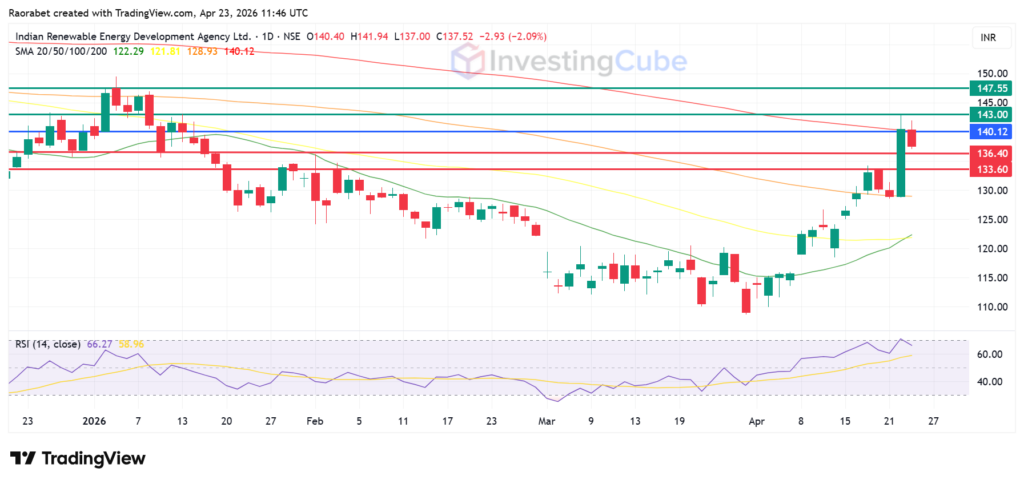
IREDA stock on April 23, 2026 with the key levels of support and resistance. Created on TradingView
The rally was sparked by a strong FY26 business update showing a 22% growth in the loan book and a 16% increase in disbursements, reflecting robust demand for renewable energy financing in India.
With current momentum, a retest of ₹150 is possible in the near term if the stock maintains a daily close above the ₹140 resistance.
The primary risks include a high debt-to-equity ratio of 5.41 and potential margin compression if borrowing costs rise. Additionally, any delay in government-backed renewable projects could impact its disbursement targets.