



- EUR/USD is under mild pressure as safe-haven demand keeps the US dollar supported.
- Delayed Fed rate cut expectations are reinforcing the dollar's near-term advantage.
- Eurozone PMI data shows growth is still positive, but momentum remains fragile.
- Softer US services data may help slow the downside in EUR/USD.
- The 1.1700 area is the key short-term level to watch today.
Dollar Strength Keeps EUR/USD Under Pressure, While Softer U.S. Services Data May Slow The Downside
Fundamental Backdrop
EUR/USD came into the session today under pressure with safe haven support for the dollar. The overall tone in markets is still a bit cautious as geopolitical risks out of the Middle East are affecting oil prices, inflation expectations, and hence also overall risk appetite.
The dollar was little changed as investors continued to digest events in the US and Iran. A Reuters headline from April 23, 2026, noted the dollar holding near a 1.5-week high. Why that matters for EUR/USD is simply due to the fact that in times of uncertainty, the dollar usually wins by way of defensive positioning ahead of any internal Euro problem.
Interest rate repricing is another reason the dollar continues to attract support. Economist expectations for the Federal Reserve to delay cuts longer than previously imagined were cited recently in a Reuters report (April 22, 2026), referring to anticipated inflation risks from war. This message to buyers of the dollar suggests holding their horses, adding that the cutting has possibly been pushed back.
This helps to keep US yields fairly anchored and will be a limit on how far EUR/USD can rally before it goes back down again. In layman’s terms, expectations that the Fed will keep rates higher for longer make the dollar more attractive relative to the Euro.
Eurozone Growth is Holding, but Only Just
With the latest PMI readings on the Euro side of things suggesting only a narrow escape from contraction for the Eurozone economy. An April flash composite PMI for the Euro area came in at 50.7, where manufacturing rose to 51.6 and services printed at 50.2 (Data source: Trading Economics, April 23, 2026). While these numbers do not indicate a failure, they may instead indicate a mild recovery.
The fragile tone conforms to a wider trend Reuters had already mentioned earlier this month. It reported earlier that growth in the Eurozone slowed to a nine-month low last month (April 7, 2026) as war-related energy shocks and uncertainty weighed on activity. Input cost inflation also quickened markedly, the same report showed, a sign the Eurozone is grappling with a nasty combination of softer growth but renewed price pressures. That makes for a poor backdrop to the Euro, as it stops the market from being able to build an obvious bull story around the region.
ECB Policy Dilemma Limits Euro Support
This puts the European Central Bank in a bind. Recently, ECB President Christine Lagarde cautioned that the hostilities could harm growth while pushing inflation higher than previously expected. Lagarde said in comments cited by Reuters (April 17, 2026) that inflation risk was higher than forecast. Normally, stronger inflation would support the Euro due to higher expectations of weaker monetary policy. But when inflation is due to energy supply shocks rather than strong demand, the ECB has less space to sound aggressively hawkish.
There is a real reason that stretches as far as the Euro cannot get much support based on inflation solely. The world knows that the ECB will not be able to simply tighten into an environment of weak growth. Hence Europe is not falling to pieces but also does not have a broad macro base strong enough under it to keep EUR/USD convincingly higher.

US Data Adds a More Balanced Twist
However, today’s US data was not enough to back a strong bearish position in EUR/USD. The US April flash manufacturing PMI, despite holding at 52.3, saw services slip to 49.8, and the composite PMI came out at 50.3 (Trading Economics, April 23, 2026). This is crucial, as it indicates the health of the US economy is not ironclad overall. Manufacturing remains solid, whereas services are showing signs of softening. It makes the near-term outlook more even for the pair.
The dollar is supported by two factors: safe haven flows and delayed Fed easing. Conversely, if the momentum in US services continues to lose steam, then dollar bulls may start playing it a bit closer to the vest. That makes EUR/USD likely to remain under some pressure, but the downside should be more gradual and uneven compared to a straightforward risk-off move.
EUR/USD Price Outlook
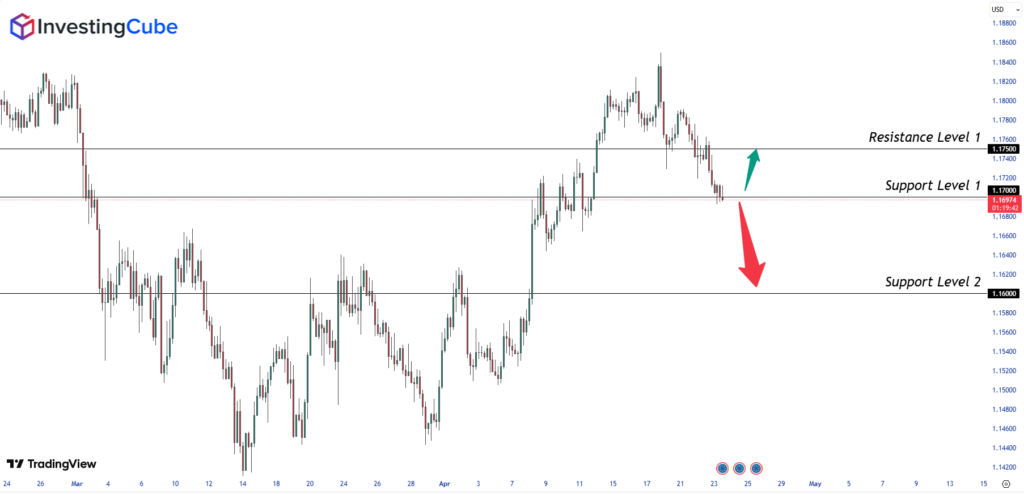
In the short term, the 1.1700 level has emerged as the first obvious key price action pivot point. Earlier today, EUR/USD traded about 1.1699 (Reuters, April 23, 2026), while ECB reference data showed the previous fixing at 1.1733 (ECB, April 22, 2026). This indicates that the pair has fallen through a recent balance zone and is now testing whether sellers can keep that psychological handle beneath water.
The following week, EUR/USD could be more susceptible to further weakness towards the mid-1.16 region. There are some slightly lower targets that could be considered. The lower boundary of the 1.16 region becomes achievable should risk sentiment remain fragile, and we see a retention and additional firmness from oil prices. Conversely, a return back above the 1.1730-1.1750 zone would make today’s fall feel more like a short-term pullback in the dollar, rather than an early-stage reversal to reclaim broader bearish bias.
Final View
The bias for today is slightly bearish on EUR/USD. Geopolitical tension, high oil prices, and Fed cuts slow to come are all dollar supportive, so the market still favors the greenback. That said, the worst US services print argues against a one-way EUR/USD collapse. In this respect, the pair is being overwhelmed externally by strength in the dollar as much as it is internally by weakness in the Euro. The bias is marginally soft while markets are focused on safety and rate differentials. However, if the dollar rally runs out of steam later in the session, it could catalyze a sharp EUR/USD break.
EUR/USD is slipping mainly because the US dollar is stronger. Investors are leaning toward the dollar as a safer asset, while expectations that the Fed may keep rates higher for longer are also giving the greenback extra support.
Because the Eurozone economy is expanding only slightly, not strongly, the PMI data shows growth is still there, but momentum is weak; it is not enough on its own to push the Euro much higher.
The 1.1700 area is the main short-term pivot. If price stays below it, EUR/USD may remain under pressure. If it moves back above the 1.1730-1.1750 zone, the pair may stabilize and recover.