



The GBP/INR cross has seen its fair share of volatility due to the ongoing conflict in Iran and the attendant issues that have led to an oil shock. India is the world’s third-largest oil importer. As such, it is subject to the ongoing oil shock arising from the US-Iran war and the disruption of shipping flows across the Strait of Hormuz. It is against this backdrop that we discuss the GBP to INR forecasts as the second quarter kicks off.
GBP/INR Current Setup & Live Chart
The GBP/INR pair is now trading primarily under the influence of the oil shock and the stress it has brought to the Indian Rupee. Most of the fundamental drivers are coming from the INR side, as the UK end has been relatively quiet. So what is currently happening?
- The oil shock has caused a downfall in the Indian stock markets. The Indian markets have witnessed a record volume of outflows from foreign portfolio funds, as investors seek to protect their investments amid falling markets and a rapidly depreciating Rupee. The Rupee has weakened sharply, hitting its second-lowest level of 126.30 against the Pound in late March. This came amid record outflows of $12.14bn from Indian equity and bond markets, according to a Reuters report.
- As foreign portfolio funds leave the Indian market, they would look to sell their Rupee-based investments for foreign currencies, typically the US Dollar and the Pound. The Pound bid/Rupee offer created a cascade that further weakened the Rupee.
- The current oil-shocked environment has pushed the GBP/INR higher.
GBP-to-INR exchange rates are primarily in an INR-plus-oil trade regime. The Rupee remains pressured if oil prices are higher, with RBI intervention only helping to smooth the Rupee’s decline rather than reverse it.
The RBI has shown it will intervene aggressively to support the Rupee and prevent further overextension. On the other hand, the Sterling is relatively stable and is only reacting on the basis of whether the oil shock will produce local inflation, which then changes the BoE expectations as far as rate cuts are concerned.
Price Catalysts for the GBP to INR Rate
1.Oil direction: this remains the major swing factor for the pair, and acts mostly on the INR side of the equation.
2.RBI action intensity: the degree to which the RBI will go to defend the Rupee in the spot, forwards and options market is a key catalyst for price action.

3.Rate expectations: As for interest rate expectations, anything on the GBP side is secondary to the catalysts for the Rupee.
GBP-to-INR Forecast Scenarios
Base case: the pair will remain in a choppy consolidation, albeit with mild upside bias if upside risks to energy prices remain. This state keeps the Rupee fragile, even as the RBI smooths any decline in the Rupee.
Bull case (GBP/INR higher): a renewed oil spike spooks risk aversion and weakens the RBI, with GBP/INR pushing higher once more in a more sustained fashion.
Bear case (GBP/INR lower): cooling of the geopolitical situation will lower oil prices and stabilize the INR. We will then see a retracement in the pair, but maybe not a full reversal.
GBP-to-INR Rates: Technical Outlook
The bounce from the 61.8% Fibonacci retracement and the support base from 6 February to date at 122.07 broke past the 11 February high and is currently seeking to reclaim the all-time high at 127.38. If this level is breached, the bulls will have clear skies to aim for the 27% Fibonacci extension at 128.72.
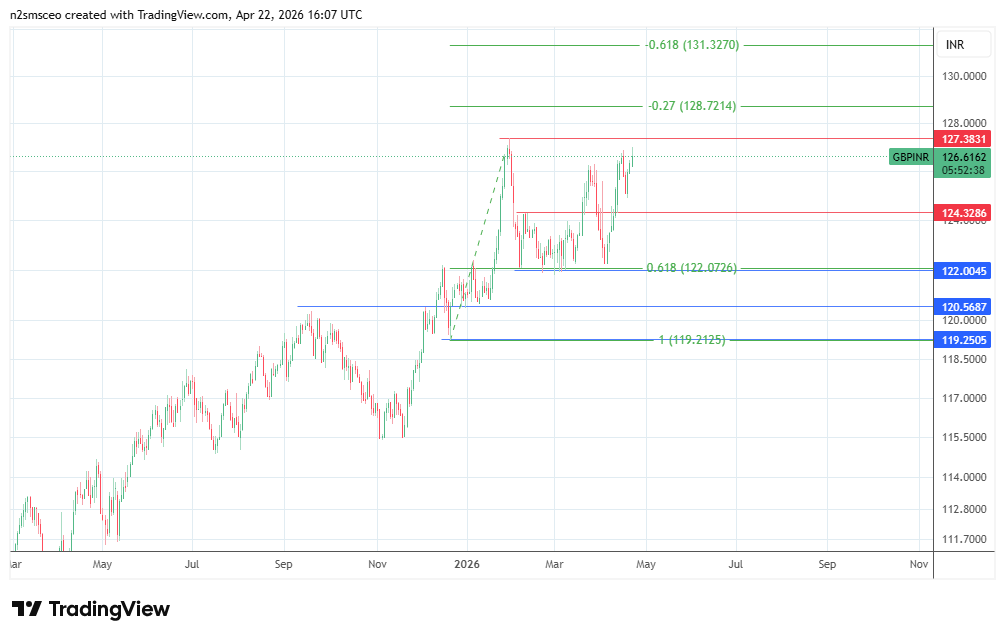
On the other hand, failure to break above 127.38 to establish new highs could lead to a pullback that then retests the 124.32 support. If this support breaks down, the 122.07 pivot and the 61.8% Fibonacci retracement level come into play. Only if this pivot fails to withstand the bears can we see an additional pullback to 120.56.