



Archived Article This article was published more than 5 months ago. The market data, prices, forecasts, and analysis were accurate at the time of publication but may have changed since then. Please use this article for historical reference only and refer to our latest content for current market information.
- GBP/INR remains mildly bullish in the near term.
- UK inflation risks are helping support the pound.
- Higher oil prices are weighing on the Indian rupee.
- Middle East headlines remain a key short-term driver.
- A drop in oil prices could trigger a pullback in the cross.
GBP/INR is tilted to the upside in the near term, supported by a sticky UK inflation risk and a relatively cautious BOE outlook, along with renewed weakness on the Indian rupee from rising oil prices and tensions in the Middle East.
Risks in the near term, such as spiraling crude prices and global inflation, are still relatively more favorable for sterling compared to the rupee, unless there is material improvement in geopolitical conditions and a retreating crude recovery.
Fundamental Backdrop
The pound’s strength is driven mainly by the inflationary consequences of the latest conflict in the Middle East. At its March meeting, the Bank of England kept the bank rate at 3.75% and indicated that it is monitoring the inflationary effects from disruptions to transportation routes for oil and gas (Bank of England).
This matters for Sterling because a new energy shock lowers the markets’ belief that UK rate cuts are coming anytime soon. That is to say, if imported energy makes inflation stickier, the Bank of England might not be able to reach an accommodative stance as quickly, which tends to protect the pound.
Recent reporting has reaffirmed that perspective. Rising energy prices are darkening the outlook for inflation in Britain and have already caused markets to scale back some of their previous expectations for interest rate cuts in 2026, according to Reuters.
That does not make Sterling aggressively bullish in its own right, but it does leave an important cushion underneath the currency, one you may expect against currencies that are historically much more sensitive to oil shocks.
On the Indian side, a more direct macro challenge for the rupee exists. India is a large net importer of crude oil, so any persistent increase in energy prices typically weighs on the currency via a larger import bill, inflationary pressure, and concerns about external balances.
In April, the Reserve Bank of India (RBI) held the repo at 5.25%, recognizing a tougher growth-inflation trade-off as fighting in Iran disrupts the worldwide energy backdrop. This is significant because it indicates that the RBI is navigating a less friendly zone where the ability to bolster growth and tame inflation simultaneously is becoming increasingly difficult.
India’s March CPI was also at 3.4% year-on-year, up from 3.1% according to Reuters. Though that inflation reading was not out of the ordinary, it does highlight early pass-through effects from higher energy prices. If crude stays high, the markets could start factoring in wider pressure on India’s inflation trajectory, which would tend to keep the rupee under pressure.
Why Oil Matters So Much for GBP/INR
Oil is perhaps one of the most straightforward macro transmission channels for this cross. An environment of high oil is not a good thing for the UK, but it tends to be a larger direct negative to India. This means that very often when crude prices shoot up on geopolitics, INR will tumble faster than GBP. Consequently, GBP/INR grinds higher.
The rupee, which recently slipped sharply as oil prices surged after tensions with the United States and Iran flared up again, was at one point down to 93.3750 per dollar, according to Reuters. This was its biggest single day drop in two weeks.
That is a useful signal for GBP/INR traders because it suggests the rupee has reverted to trading more in line with oil and capital flow dynamics. If that relationship reasserts itself, headline-driven moves in energy markets can be quickly fed back into the cross.
Technical and Market Positioning View
Market linking is directing GBP/INR to still be trading at a firm ground, focusing on a cross. Public chart references suggested it was near 125.5 during recent trade, above the 125.00 figure and with a decent short-term profile.

Broader technical sketches have also favored a bullish daily structure, lending support to the current macro narrative. Sterling is relatively supported by “higher for longer” UK rate expectations, while the Rupee remains on the back foot amid important inflation and risk aversion.
That said, this is not a one-sided market:
- The GBP/INR is very responsive to fast-moving headlines out of geopolitics.
- Given the recent premium in the cross has been in large come about new war-fueled oil fears, any sign of de-escalation could spark a swift pullback.
GBP/INR Price Prediction
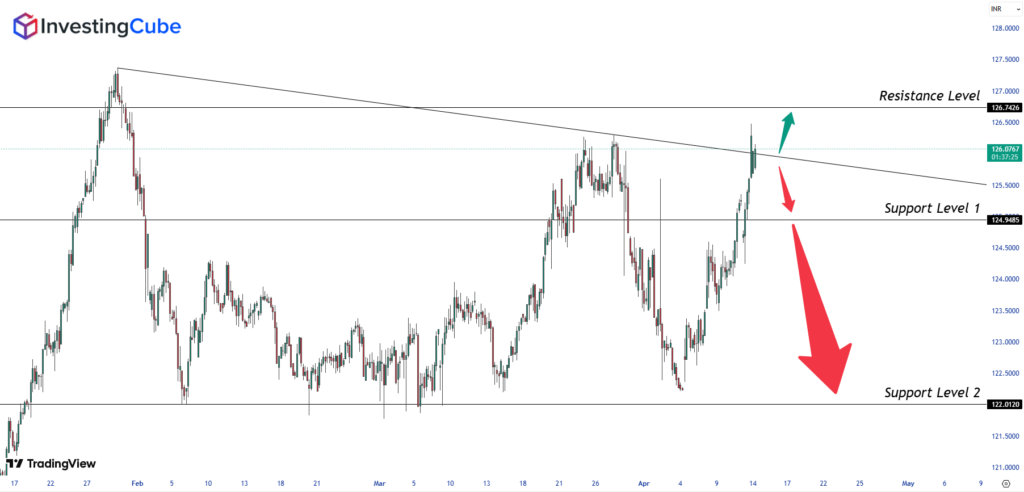
The near-term view might be mildly bullish. As those tensions last and crude is higher, GBP/INR can stay supported on dips. This is relatively simple stuff at heart: the pound rallies on a more hawkish repricing of UK rates and increased future growth prospects, while the rupee gets whacked on higher imported energy prices. In this context, the cross can still retain levels above 125.00 and try another leg higher toward recent highs.
If oil peace-freighters extend their gains, or if the markets are even more convinced that the Bank of England (BOE) lays low on easing as renewed inflation pressure builds, the bullish scenario will be strengthened. In that configuration, sterling ought to be fairly stable, with weakness in INR likely to become the major driver for the pair.
In a neutral scenario, GBP/INR consolidates within a wide range near these levels. This would be likely if traders take a break for new catalysts and with oil either stabilizing or not surging again. For now, though, the cross is supported but needs a fresh geopolitical or macro-impulsive direction to print strongly higher.
A bearish scenario for the GBP/INR would therefore only come into play if we see:
- Real de-escalation in US-Iran tensions
- A significant and sustainable decline in crude
- A more global recovery of risk appetite
That would probably enable the rupee to bounce more than the pound, meaning a steeper retracement lowering in the cross. Real rupee strength earlier in the sessions on temporary de-escalation reminders reminds that GBP/INR can reverse quickly when the market starts to flush the war premium.
Conclusion
Currently, GBP/INR is a geopolitically sensible, oil-sensitive, bullish leading cross. Sterling is supported by the risk that UK inflation could remain hotter for longer. While the rupee is weighed down by India’s vulnerability to higher energy prices, for now, it keeps the balance tipped towards the upside.
But traders need to remain on alert: should the diplomatic headlines improve and crude gives back some of its gains, GBP/INR could turn from a nice low grind higher into a sub-corrective move lower.
Frequently Asked Questions
Because the pound is supported by expectations that UK interest rates may stay higher for longer, while the rupee is under pressure from rising oil prices and Middle East tensions.
India imports a large amount of crude oil, so higher oil prices can hurt the rupee more directly by lifting inflation and import costs.
If geopolitical tensions ease and oil prices drop, the rupee could recover faster, which may push GBP/INR lower.