




- This week's Jackson-Hole symposium and the US Treasury's bond buyback program are the defining factors for this week's EUR/USD forecasts.
Current Setup and Live Chart
The EUR/USD enters the new week with a moderately bullish bias due to last week’s developments in the US Treasury market.
The previous week began with US long-term Treasury yields spiking to levels not seen in decades. The 30-year Treasury Note hit a 19-year high, and the 10-year Treasury Note also topped 4.24%, a high not seen in a long while. The sharp spike in bond yields caused an accelerated selloff in the US bond market, forcing the US Treasury Department to double its bond-buying program to $4 billion per operation to stabilize the market. The corresponding drop in bond yields reduced the appeal of the US Dollar and USD-denominated assets, weighing on the greenback vs. its peers.
The FX implication of doubling the bond-buying program is that the US Treasury is trying to set a floor under the bond market. This is creating an unusual dynamic:
Treasury buys long-term (10-yr and 30-yr) bonds → drop in long-term yields → Narrowing of US yield advantage → USD loses appeal → EUR/USD gains.
Simultaneously, geopolitical developments in the Middle East remain relevant to price action on USD pairs. Uncertainty around the Strait of Hormuz and the prospect of stiffer US sanctions against Iran keep geopolitical risks elevated. This means that oil prices will remain high, which brings on inflationary pressures. This is a risk-off event that generates some USD safe-haven appeal. This is the factor limiting the upside in the EUR/USD.
EUR/USD is therefore trading amid the interaction of US fiscal policy (Treasury-market intervention), geopolitics, and central bank expectations, which will come back under the spotlight at this week’s annual Jackson-Hole Symposium.
Macro Drivers for EUR/USD Forecasts
1) The Treasury Buyback Program
The US Treasury announced last Tuesday that it will double the maximum size of its long-end liquidity support operations from two billion dollars to at least four billion dollars per operational cycle. This bond buyback program will cover the 10- to 20-year and 20- to 30-year bond yields. The program is due to commence on 9th of September. However, this is not the same as quantitative easing by the US Federal Reserve. This distinction matters because Treasury buybacks primarily aim to boost liquidity by removing less-liquid bonds from the market. In other words, the Treasury is effectively redefining the maturity profile of US government debt and is not creating new money. The US Treasury documentation describing this new initiative explicitly calls them liquidity-support buybacks. For FX market traders, the policy is clear: It aims to contain long-term borrowing costs and reduce the US Dollar’s yield advantage, making USD and USD-dominated assets less appealing. The move has sent the US dollar lower, where it is now trading at multi-month lows versus the euro and many of its other G10 currency pairs.
2) US Fiscal Concerns

Concerns about the US fiscal position are growing. The US Treasury’s intervention reflects these concerns. The surge in the 30-year Treasury yield above 5% indicates investors want higher premiums to buy and hold US government debt for longer. The sentiment is that investors increasingly see attempts to suppress long-term yields as artificial, which indicates that the US government is now uncomfortable with rising borrowing costs. The latter sentiment reduces fiscal credibility and ultimately scares investors away from US government bonds to other destinations. The decline in the US Dollar is evidence of this sentiment currently.
3) Geopolitical Risk Premium Still Generates USD Appeal
The US-Iran conflict is a risk-off event that still generates demand for the USD via safe-haven appeal. If there is severe geopolitical escalation beyond the current situation, safe-haven demand for the dollar will rise, curtailing EUR/USD upside. Furthermore, the Eurozone is an energy-import-dependent region. Higher oil prices will create imported Eurozone inflation, which could stifle Eurozone growth (a key ECB concern). The ECB is likely to turn dovish if Eurozone growth is suppressed.
EUR/USD Price Catalysts This Week
1) Jackson Hole and Fed expectations: This week’s annual Jackson-Hole Symposium is the most important catalyst for price action this week on monetary policy. The market will look for clues on the direction of Fed policy and how ECB policymakers handle the battle between imported inflation and growth.
2) Treasury yields: the intervention of the US Treasury in the bond market has made the direction of the 10-year and 30-year bond yields of prime importance. Typically, rising bond yields are USD-supportive, while falling bond yields are USD-negative, which favors a EUR/USD upside.
3) US-Iran developments and oil prices: A further deterioration in the conflict raises the geopolitical premium and introduces risk-off sentiment, which favors the USD via safe-haven appeal. However, US fiscal concerns and lower US bond yields will reduce USD demand and further weaken the USD. The energy shock also introduces Eurozone inflationary pressures and stifles growth prospects, limiting the Euro’s upside. View the geopolitical situation as fluid, as the dominant factor will determine which way the pair swings.
EUR/USD Technical Outlook
The presence of the two pinbar candles at the 1.1671 resistance is indicative of a stall in the uptrend. If the price declines from this resistance, the 15 June high at 1.1621 becomes the immediate downside pivot. If this pivot fails to hold, 1.1577 (19 January and 21 May lows) forms the next downside target. Further below, the double bottom’s neckline at 1.1506 assumes importance.
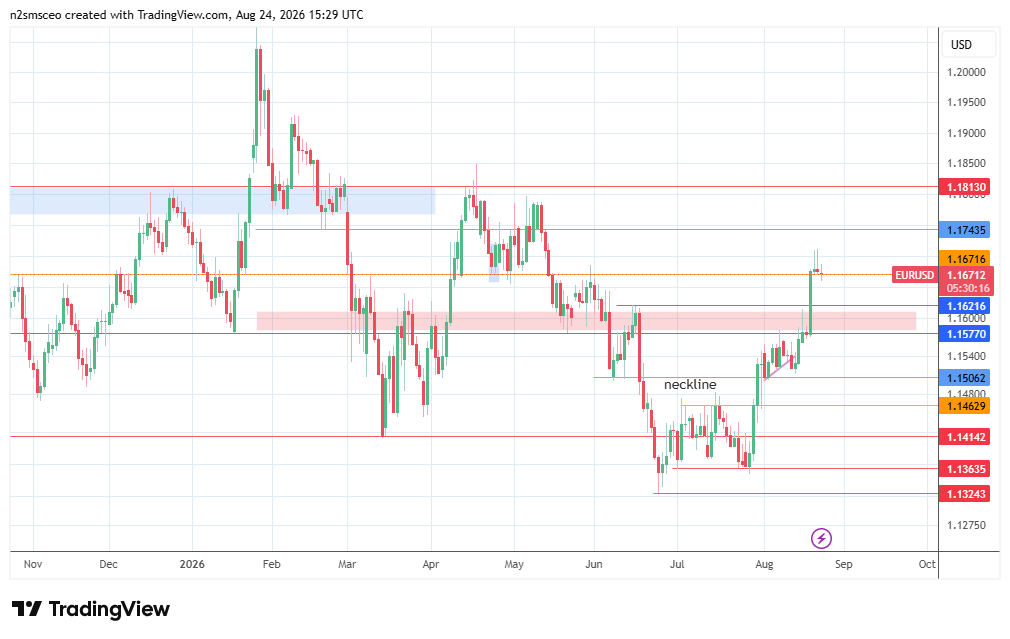
On the flip side, if 1.1671 holds firm against downward pressure, we could see a bounce targeting 1.1813 resistance as the major upside target. Before then, there is the potential for a pit stop at 1.1743, which served as the 19 February support level.