


- An option gives the right, not the duty, to buy or sell.
- Calls gain when price rises; puts gain when price falls.
- Buyers can lose the premium; sellers can lose much more.
- Time value fades, so know your expiry date.
- In the UK, use an FCA-regulated broker.
What is options trading? This is the simple definition. An option is a financial agreement that provides the purchaser with the opportunity (but not the requirement) to purchase or dispose of an item at a specified cost on or prior to a predetermined time. There is a nominal charge associated with acquiring this privilege. You then determine if you wish to exercise your privilege. It would be helpful to keep this image in mind when reading further.
This article contains easy to understand language and actual data. There is an example of both a call option and a put option. In addition, there are two graphs that illustrate potential profits/losses (payoffs) from these types of investments. Finally, you will find out how much risk is associated with investing in options; options may result in rapid loss of capital.
What Is Options Trading and How Does It Work?
Another common question people ask is “how does options trading operate in the real world?” To explain this, imagine making a down payment on a home. When you make a down payment on a home, you are paying a small amount of money upfront so that you can purchase the home at a fixed price.
If the home increases in value after you make your down payment, then you will have won. On the other hand, if the home decreases in value after you make your down payment, then you have only lost the down payment. This same basic principle applies to options trading. In options trading, the fee for entering into an option contract is called the premium. The fixed price at which you agree to buy/sell the underlying asset is called the strike price. Lastly, the date by which you must exercise your option contract is known as the expiration date.
Why do people buy and sell options? One reason is to gamble on whether something will go up or down using less capital. Another is to protect the stock that someone already owns. There is risk involved in both. Neither can guarantee success.. Most stock options cover 100 shares. The Options Clearing Corporation publishes a full risk document. Every new trader should read it. Our guide on what options trading is gives a short overview.
Call Options and Put Options: What They Are and How They Work
What is a call option? It gives you the right to buy at the strike price. You buy a call when you think the price will rise. Here is an example. A stock trades at 98. You buy one call with a strike of 100 for a premium of 4.00. That costs 400, because one contract covers 100 shares. Your break-even is 104. That is the strike plus the premium.
At expiry, three things can happen. If the stock is at 110, the call is worth 10. You make 6 per share, or 600. If the stock is at 104, you break even. If the stock is at 99 or lower, the call expires worthless. You lose the 400 premia. Notice the most you can lose is the 400.
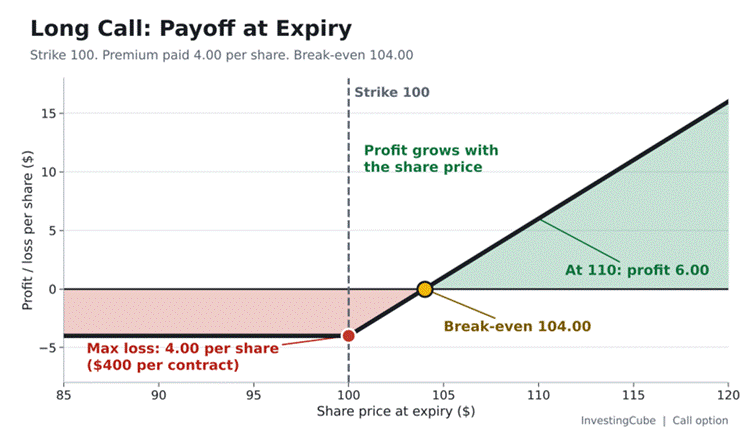
Image 1: The call payoff. The red zone shows the loss, which stops at 4.00 per share. The green zone shows profit above the 104 break-even, and it keeps growing as the stock rises.
The put option definition. A put allows you to sell the underlying asset (e.g., stock) at the strike price. You would buy a put if you believed the price of that underlying asset would drop. Let’s see what a put option looks like in real life. A stock trades at 102. You purchase one put with a strike price of 100 for 3.00. You spend $300. Your breakeven is 97. The breakeven is the strike price less the cost of the option (premium).
The stock falls to 90. The put option is worth 10. Your profit will be 7 per share for a total of 700. If the stock remains above 100, the put option will expire worthless. You will lose 300. As stated previously, the maximum amount you can lose is 300. Now, how do we distinguish between a call option and a put option? A call option is used to profit from rising stock prices. A put option is used to profit from falling stock prices.
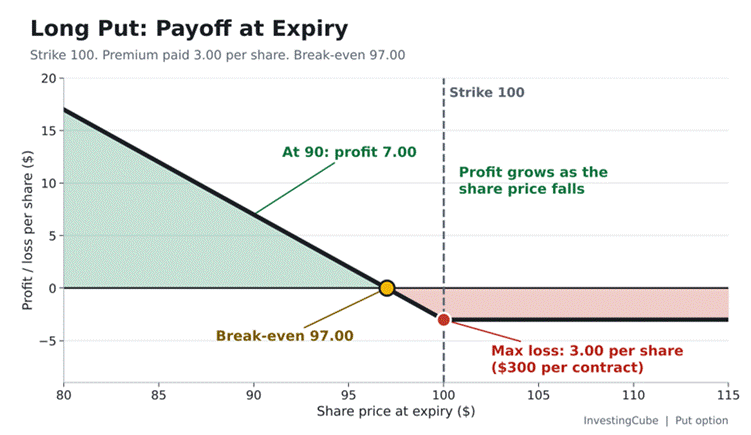
Image 2: The put payoff. The line slopes down. Profit grows as the stock falls below the 97 break-even, and the loss is capped at the 3.00 premium.
Options Premium: What Determines the Price of an Option?
The options premium has two parts. The first is intrinsic value. That is how far the option is in the money. The second is time value. That is extra price for the chance that things improve before expiry. A stock at 105 with a 100 call has 5 of intrinsic value. If the call costs 7, then 2 is time value.
Investopedia shows the same split. Four things move the premium. More time to expiry raises it. Higher expected volatility raises it. A price close to the strike raises it. Interest rates and dividends play a small part. Time value shrinks every day. Do not pay for time you will not use. That is why options lose value near expiry. Our option chain guide explains implied volatility and open interest in plain words.
In the Money, Out of the Money, and Deep in the Money Options
These words tell you where the share price sits next to the strike. In the money call options have a strike below the share price. Out of the money call options have a strike above it. Deep in the money call options have a strike far below it. They cost more, but they move closer to the stock itself. Use the table to compare them.
| Term | Call option | Put option |
| In the money | Share price above strike | Share price below strike |
| At the money | Share price near strike | Share price near strike |
| Out of the money | Share price below strike | Share price above strike |
| Deep in the money | Share price far above strike | Share price far below strike |
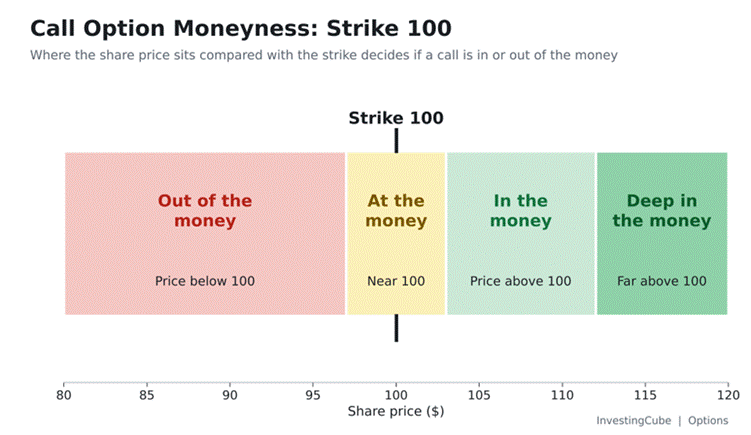
Image 3: Moneyness for a call with a strike of 100. Below 100 the call is out of the money. Near 100 it is at the money. Above 100 it is in the money, and far above 100 it is deep in the money.
Most beginners start with options that are at the money or in the money. They cost more than out of the money options. But they are less likely to expire worthless.

Options Expiration: What Happens When an Option Expires?
Options expire on the final day of the option’s life cycle. Most options that are “in-the-money” (itm) at the end of the contract are either exercised or closed out for their cash value. On the other hand, most options that are “out-of-the-money” (otm) at the end of the contract will expire with no value. In addition to losing money, the investor who purchased the option will lose the premium he paid to purchase it. Before buying an option, know when it expires. Add this information to your calendar. When planning a trade, always plan the way out first. A trade can only fail if time runs out, regardless of whether you were correct about the direction of the market. Most investors do not wait until expiration to close their options positions. They often sell their options prior to expiration to lock in a profit or minimize a loss.
Most stock options have an expiration date of the third Friday of each month. There are also weekly options available. You should contact your broker to find out when the specific expiration date is for your stock option, as well as the cut-off time. See the Cboe Learning Center for the rules. Time value fades fast in the last weeks. So, options close to expiry are risky. Our futures trading guide covers a related product with its own expiry rules.
How to Trade Options Step by Step (Including Options Trading in the UK)
Here is how to trade options in six steps. One, learn the basics. Two, open an account with a broker that offers options. Get your options level approved. Three, pick a stock and form a view. Four, choose the strike and the expiry. Five, place the order and plan your exit. Six, review the trade. Start small. Try paper trading first. Later, you can learn strategies such as the straddle. Do not rush. Learn one simple trade well first.
Be clear about the risk. Buyers can lose the whole premium. Sellers, also called writers, can lose much more. A seller of an uncovered call has no fixed limit on the loss. A stock can keep rising. Options also use leverage. Small price moves can cause big swings. Read our guide to leverage and margin trading before you start.
Many readers ask about options trading UK rules and how to trade options UK. The steps are the same. Keep it practical. Take your time with this step. Pick a broker that offers options to UK clients. Open and fund the account. Then check that the broker is FCA-regulated. Use the FCA Register. Expect the broker to ask about your experience before it opens options access.
Whatever you trade, protect your money. Risk only a small part of your account on any trade. Our risk management guide shows how to set limits that keep you in the game.
Frequently Asked Questions About Options Trading
Can beginners trade options?
You should start with learning first. Buy call options and put options. Trade small amounts. Use a demo trading platform to practice. Do not begin selling options until you have a good understanding of what kind of risk you are taking on.
How much money do you need to start options trading?
It depends upon which broker and which option you are purchasing. A single contract may be purchased for as little as ten pounds/dollars up to several hundred pounds/dollars. Only use funds that you could potentially lose.
What is the difference between a call option and a put option?
A call option provides the holder with the ability to purchase an asset at a predetermined price called the strike price. As such, the value of the call will increase if the value of the underlying asset increases. Conversely, a put option provides the holder with the ability to sell an asset at a predetermined price called the strike price. As such, the value of the put will increase if the value of the underlying asset decreases.
Can you lose more than you invest in options trading?
In contrast, buyers will only lose their premium. On the other hand, sellers have the potential to lose significantly more than that. There are instances where a seller has no limits on what he/she could potentially lose.
Can you trade options in the UK?
Yes, you can buy and sell options through an FCA-regulated broker in the UK. Make sure to check if the broker is listed on the FCA Register.