



- Gold price action remains choppy as investor weight the market expectations of next week's Fed meeting and interest rate decision.
Current Setup
Gold prices remain choppy as markets weigh the recent jump in oil prices amid expectations that US interest rates could stay restrictive. Spot gold has traded between $4,118 and $4,140 for much of the session.
Market participants are still weighing concerns about elevated oil prices and inflation against the risk of the Fed raising interest rates and keeping them restrictive. The Fed decision is due on 28 October, in 7 days. While many market participants and analysts have deferred hike expectations until the December meeting, the Fed could still surprise markets with another 25-basis-point rate hike (especially given the rise in both the consumer and producer price indices in America).
The current challenge is the continued rise in oil prices due to geopolitical tensions, now in their 7th month. However, US bond yields are off their 24-year highs, and this, along with some safe-haven demand, is counteracting bearish pressure on gold. Gold prices are trading in the classical two-way consolidation with heightened volatility.
Gold: Key market drivers
1. Federal Reserve Policy
The 27th-28th October Fed meeting is the major near-term catalyst for gold prices. As noted earlier, many market analysts expect the Fed to hold rates at current levels. This leaves the December meeting as the only available option for a further rate increase in December that would be in keeping with the Fed’s hawkish dot plot (that was set at 4.1% at the 16 September meeting).
However, gold is a non-yielding asset, which makes it less attractive than U.S. Treasury yields for competitive returns. Even if the Fed keeps the recent change at the October meeting, any hawkish rhetoric (either in the Fed’s statement or the Fed chair’s comments) could push bond yields higher again, which could extend the correction in gold prices. However, a less hawkish outlook in the same meeting could trigger another recovery toward the $4,200 mark.
2. Oil prices and inflation
Oil prices remain elevated amid continued tensions in the Middle East. Brent crude has climbed above $110 in recent trades as Middle East supply concerns surface. This higher-oil-price environment will prolong inflationary concerns and narrow the Fed’s scope for monetary easing. This also creates a dynamic in which geopolitical tensions can increase demand for gold. In the current environment, however, inflationary pressures from elevated oil prices and the resulting interest-rate consequences (a hawkish tilt by the Fed) continue to outweigh any safe-haven demand support for gold.
3. The US Dollar and Treasury yields
Treasury yields remain above the critical 5.00% key level. As long as U.S. Treasury yields remain above this point, they will attract inflows of investment funds that must be converted into U.S. dollars to participate in the U.S. bond market. This strengthens the dollar relative to its peers and makes gold more expensive for non-U.S. buyers. At the same time, higher yields increase the opportunity cost of holding precious metals, as metals typically earn no interest while higher yields pay additional interest on U.S. bond investments.

On the flip side, a decline in US bond yields takes the pressure off gold prices, allowing the safe-haven appeal of the yellow metal to come into play. The recent decline of US bond yields from 24-year highs is what has allowed the recovery of the XAU/USD pair in recent sessions.
Gold Price: Forecast Scenarios
Bull case: The base case sees gold continue to consolidate between the 4.050 support and the 4.200 resistance as traders await the Fed’s decision at next week’s meeting (and the Core PCE Price Index data released two days later). In this consolidation, gold prices will remain highly volatile.
Base case: Any sustained recovery that pushes gold above 4,200 has to come from a steep weakening of the U.S. dollar. A drop in U.S. bond yields below 5.00% and a decline in oil prices toward $90/barrel make this scenario possible. Furthermore, any less-than-hawkish comments from the Fed meeting or an undershoot in Core PCE data would sustain the bullish scenario.
Bear case: If the 28th of October Fed meeting is hawkish, it could lead to a renewed rise in U.S. Treasury yields. If oil prices remain around current levels, gold would face a bearish scenario. In this scenario, we could see a breakdown of the 4,100 support, exposing targets at 4,050 and below.
Technical Outlook
Price is currently consolidating between the 4111 and 4200 price levels following the completion of the near-term head and shoulders pattern (pink box). The measured move has been completed at 4111, and this support is now being tested vigorously. A breakdown of this pivot unlocks access to the 4055 support and 61.8% Fibonacci retracement of the 15 May 2025 – 28 January 2026 price swing. If this level fails to hold, a further descent to the 29 October/4 November 2025 double bottom at 3929 cannot be ruled out.
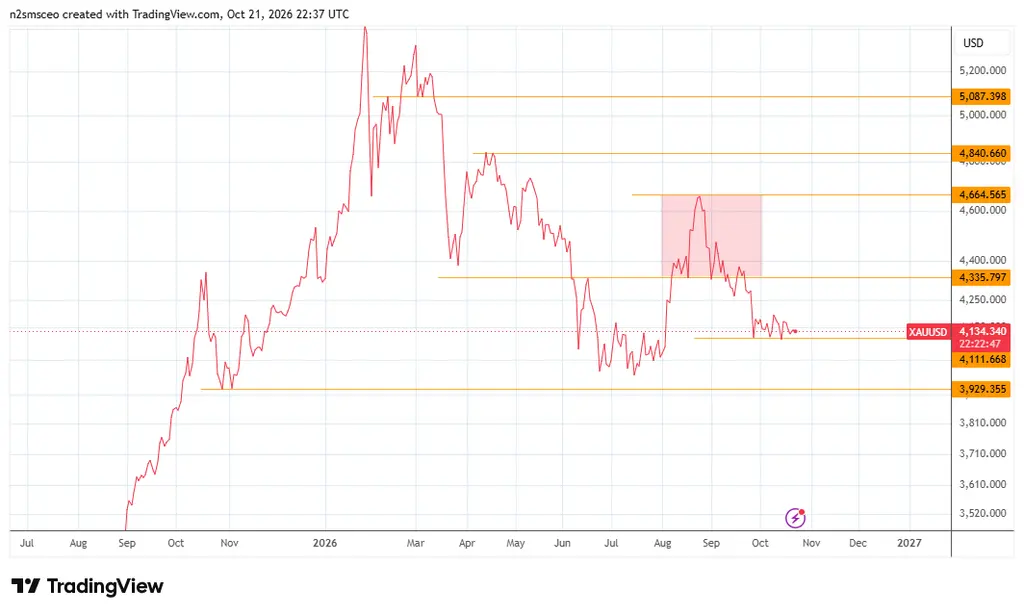
On the other hand, a break of 4200 ushers in the 4335 neckline barrier of the completed head and shoulders pattern, which also doubles as the prior low of 31 December 2025. Above this level, upside targets at 4664 (pattern head and high of 25 August) and the 4840 high of 14 April become the new upside targets.