



- Discover the causes and historical context of stock market crashes, with an analysis of the global markets that faced downturns in 2026.
Stock Market Crash: a sudden and violent 10% or greater fall in share prices over a matter of days due primarily to panic-selling. A correction is a 10% decline from the peak, a bear market is 20% or more, and a crash can be the violent, rapid version of either.
Famous Crashes in History
The 1929 Wall Street crash, Black Monday in October 1987, when the Dow dropped some ∼22% in one session, the financial crisis of 2008, and the pandemic plunge of March 2020 were quite the reference points. Each was supported by stretched valuations, high leverage, and a low-interest-rate trigger that revealed weak hands.
Markets That Crashed in 2026
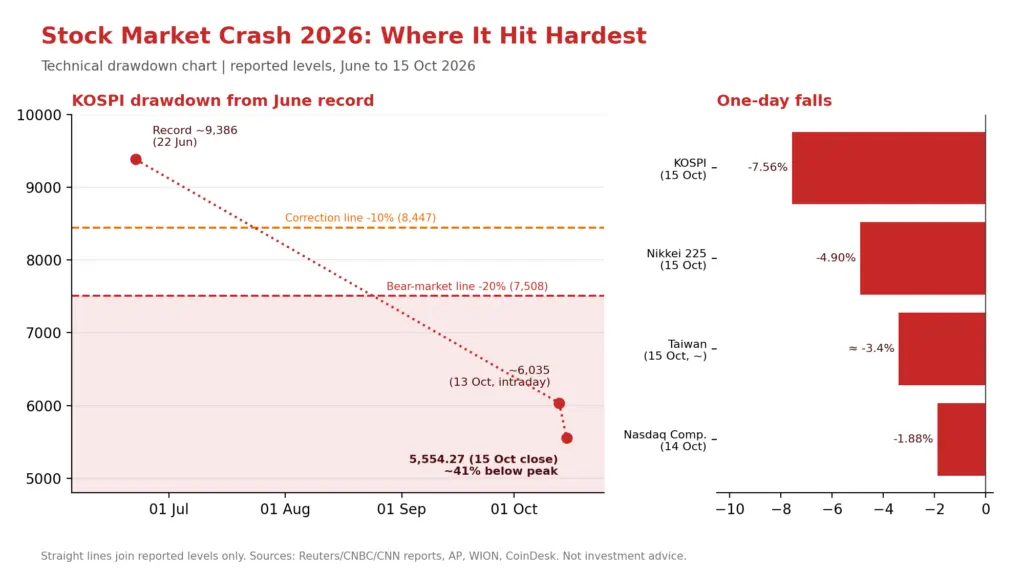
South Korea has suffered most. The Kospi reached an all-time high of around 9,386 in June and then shut at 5,554.27 on 15 October following a one-day fall of 7.56%, about some other roughness underneath its summit (41%). It had its worst week since October 2008, according to reports citing Bloomberg. The Nikkei 225 finished the same day down 4.9% at 64,425.95; Taiwan closed down around 3.4%; and the Nasdaq Composite on October 14 fell (-1.88%), its worst session since July. Hong Kong, China, and more recently Taiwan also sold off in June, indicating the weakness is regional and certainly not isolated to Seoul.
Chip stocks are about 20% below their June peak, with more detail in both Nasdaq futures and the AI rebound and the Hang Seng’s global tech sell-off.
India is a slower bleed. The Nifty 50 fell for eight straight weeks to early October, and our report on the Sensex and Nifty falling on oil and foreign selling explains why. UK investors pulled £15 billion from equity funds, according to our analysis of UK fund outflows, though the FTSE 100 remains near record highs.

A pattern of repetition, not a first strike. On June 5, the Philadelphia Semiconductor Index recorded its biggest drop since March 2020 with a drop of 10.3%, erasing about US$1.3 trillion, while three days later the Kospi plunged more than 8%. On Oct 14, US technology stocks shed more than $1 trillion worth of value as investors piled into Treasuries.
Why Circuit Breakers Exist
Exchanges introduce automatic trading suspensions to curb cascading forced selling. The Kospi entered bear territory last week, falling over 8 percent in a session a modern-day crash that lasts hours instead of weeks, prompting South Korea to trigger such halts back in June.
What Triggered the Sell-Off
September US inflation of 3.7% came in hotter than expected, reviving fears of more Federal Reserve rate hikes. Crowded chip winners took hits from AI debt fears, including sinking Core. Weave bonds; China’s claim on memory-chip play CXMT and a new DeepSeek model for chips. Above $100 could increase inflation pressure since Brent.
Technical Signals to Watch
The chart shows the Kospi’s fall versus its June high, plotted against the 10% correction and 20% bear-market lines; both have been crossed. Traders monitor for volume spikes, diminishing market breadth, the VIX, and price restoration of broken support. Brokerages declare AI stocks to be oversold but see a bumpy road ahead and find that queuing up for higher lows is wiser than catching falling knives.