


Current setup
The Lloyds share price extended recent losses after falling 1.12% on Tuesday. It is currently down 0.17% in early Wednesday trading as sentiment around the UK’s banking sector weakens. Recent drops in the Lloyds share price keep the stock below its most recent 52-week high of 123p. , reached on 15 October.
The medium-term outlook for the Lloyds share price remains positive, as stronger income generation, earnings growth, capital returns, and technology-led efficiency are expected to support it. The main headwind is a potentially tougher credit environment, as the Bank of England closely watches to see if the geopolitically-driven rise in oil prices is pushing the UK into an inflationary environment. Higher interest rates could result, which could have a double-edged effect on UK banking stocks. Reports of an impending increase in the UK bank profits surcharge, which could be announced as early as 28 October in the UK budget presentation, worsens an outlook that is already pushed by near-certain market bias for a BoE rate hike is also being
Lloyds Share Price: Macro Drivers
1. Strong H1 Earnings
First-half profit before tax rose 23% year-on-year to £4.3 billion, while total income rose 13% to £10.6 billion. Net interest income (NII) rose 10% to £7.1 billion. Returns on tangible equity showed the bank’s strong operating performance. The 17.1% gain indicates stronger profitability. These metrics have strengthened the investment case and contributed to the recent surge in share price. However, earnings sustainability in an uncertain interest rate environment could be a short-term circuit breaker.
2. Buybacks and shareholder returns
The bank announced an additional £1 billion share buyback program. It also reported total first-half capital returns of approximately £1.9 billion, enabling it to raise its interim ordinary dividend by 30% to 1.58p per share. The improved shareholder return policy enhances the stock’s investment case.
3. BoE Policy and Mortgage Margins
The Bank of England’s interest-rate pathway directly affects deposit costs, lending demand and mortgage pricing, as well as yields on fixed-income assets. Higher rates boost net interest income, but there is a trade-off: weaker loan demand, deposit repricing and pressure on mortgage margins can quickly erode any interest income benefits.
4. AI and Cost Efficiency
Lloyds Bank is actively driving an aggressive cost-cutting regime using new technologies such as AI agents. Reduced costs and improved productivity ultimately support margins and boost longer-term profitability targets. Execution and the ability to turn the cost of deploying these new technologies into earnings growth and sustainable revenues are key to the outlook for the Lloyds share price.

Lloyds Share Price Forecast Scenarios
Bull case: A recovery in UK banking shares, stabilization of UK gilt yields and positive investor response to the earnings results being released by several banks could steer the course of the Lloyds share price back to the bullish side of things. In this scenario, a sustained move above 105p is possible, which could then open the door toward 108p and higher targets.
Base case: Investors balance strong H1 profitability against potential headwinds from UK uncertainty or consumer inflation pressure on mortgage margins. This scenario drives consolidation, with 100p and 108p as potential boundaries.
Bear case: Raised expectations of credit loss, broader banking sector pressure, weakening of UK growth, and a greater squeeze on consumer spending and the mortgage sector from imported inflation are all potential spoilers for the Lloyds share price. In this scenario, the 100p support could break.
Technical Outlook
The support at 101.95 is currently being tested. A breakdown here unlocks access to downside targets at 97.48 (10 June low) and potentially, 93.86 (12 December 2025 low and 12/15 May 2026 double bottom).
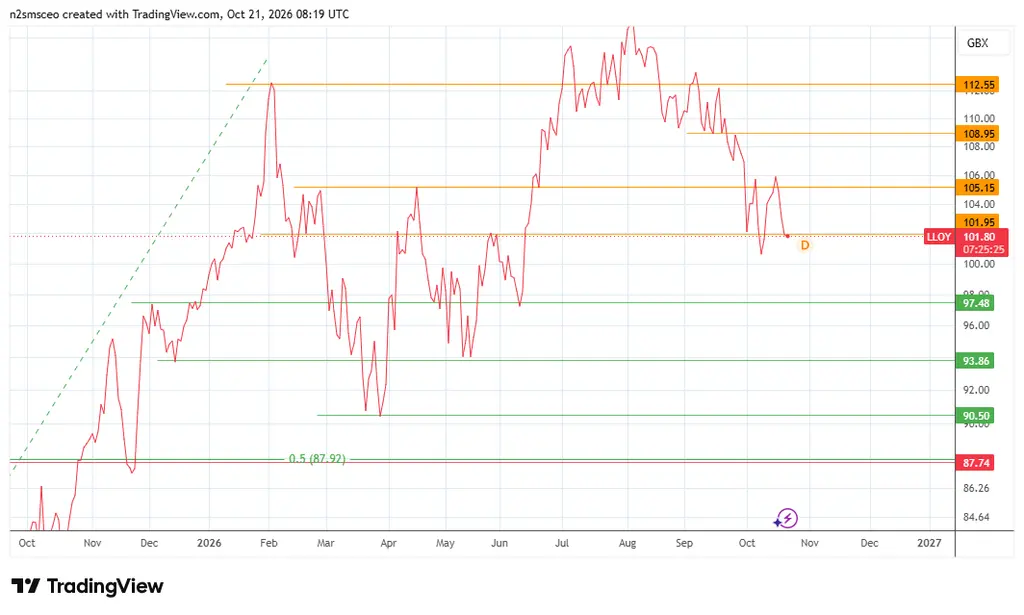
On the flip side, a bounce on the current support keeps the stock between the 101.95 support and the 105.15 high seen on 25 February and 17 April 2026. If the range ceiling is uncapped, a potential move towards the 108.95 high of 25 September could be on the cards. Only when this new cap is cleared can we see a push toward the 3 February and 15 July highs at 112.55.