



What Is the Supertrend Indicator?
The Supertrend Indicator is a trend-following technical analysis indicator developed by French trader and analyst Olivier Seban. It was introduced in 2009 and is designed to help traders identify the current market trend and potential trend reversals.
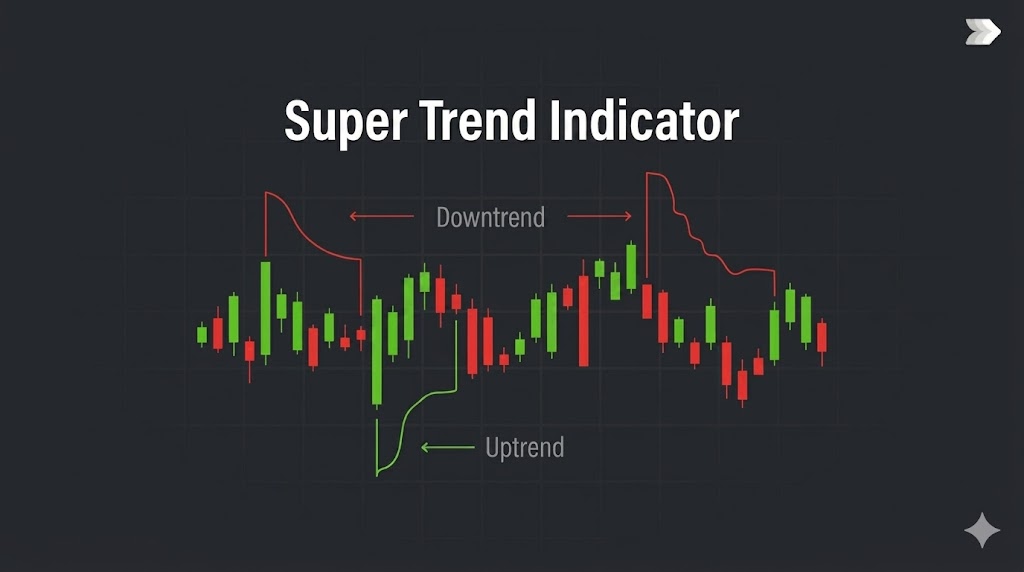
Unlike oscillators that appear in a separate window below a chart, the Supertrend Indicator is plotted directly on the price chart. It uses the Average True Range (ATR) to measure market volatility and calculates a dynamic line that shifts above or below price depending on market conditions.
When the indicator is below price, it generally signals an uptrend. When it moves above price, it suggests that the market may be in a downtrend.
Because it provides a clear visual representation of trend direction and adapts to changing volatility, the Supertrend Indicator is widely used across forex, stocks, commodities, indices, and cryptocurrencies.
How Does the Supertrend Indicator Work?
The Supertrend Indicator is calculated using the Average True Range (ATR), a volatility indicator developed by J. Welles Wilder. ATR measures how much an asset typically moves over a specified period. The Supertrend then applies a multiplier to the ATR value to create a dynamic level above or below the current price.
As volatility increases, the distance between price and the Supertrend line expands. During quieter market conditions, the line moves closer to price. Most trading platforms use a default ATR period of 10 and a multiplier of 3. These settings are widely used because they offer a balance between responsiveness and stability.
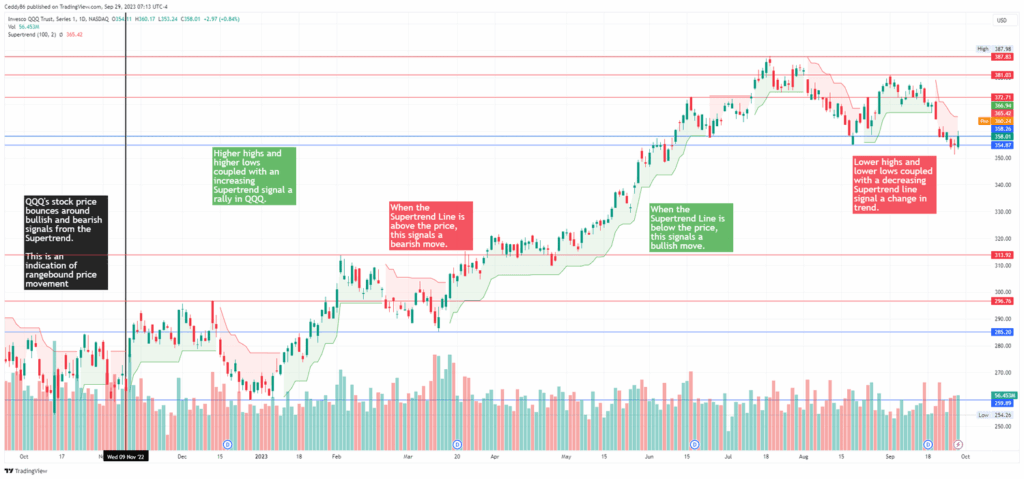
When price closes above the Supertrend line, the indicator typically switches to a bullish trend. When price closes below the line, it changes to a bearish trend. Although these changes are often interpreted as trading signals, traders generally consider additional factors such as market structure, support and resistance levels, and broader trend conditions before making trading decisions.
Best Supertrend Indicator Settings
There is no universal Supertrend setting that works across every market and timeframe. The most suitable settings depend on the asset being traded, prevailing volatility, and the trader’s strategy.
Lower multipliers make the indicator more sensitive to price movements. This can produce earlier signals but may also increase the likelihood of false signals. Higher multipliers reduce sensitivity and can help filter out market noise, although signals may appear later.

Commonly used settings include:
| Trading Style | ATR | Multiplier |
|---|---|---|
| Scalping | 10 | 2 |
| Day Trading | 10 | 3 |
| Swing Trading | 10 | 4-5 |
| Position Trading | 10 | 6-8 |
Many traders begin with the default settings and then adjust them based on backtesting results and the characteristics of the market they trade.
How Traders Use the Supertrend Indicator
The primary use of the Supertrend Indicator is trend identification. When price trades above the indicator, traders may look for buying opportunities. When price trades below it, traders may focus on selling opportunities.
For example, if a currency pair has been declining and then closes above the Supertrend line, some traders may view this as evidence that bullish momentum is emerging. Others prefer to wait for confirmation from additional indicators or price action before entering a position.
The Supertrend is also commonly used for trade management. Some traders use the indicator as a trailing stop, remaining in a trade until the Supertrend changes direction. This approach can help traders stay invested in strong trends while maintaining a predefined exit strategy.
The Supertrend Indicator can be effective in trending markets, but its reliability depends on market conditions, indicator settings, and whether it is used alongside other forms of technical analysis.
Many traders reduce false signals by combining the Supertrend with moving averages, RSI, MACD, or other confirmation tools. Trading in the direction of the broader trend can also help improve signal quality.
There is no single best indicator. However, moving averages, RSI, MACD, Bollinger Bands, Fibonacci retracements, and the Ichimoku Cloud are among the most commonly used tools alongside the Supertrend.
Yes. The Supertrend Indicator is widely used in forex trading and can be applied to different currency pairs and timeframes. Like any indicator, its effectiveness depends on market conditions and how it is incorporated into a trading strategy.