


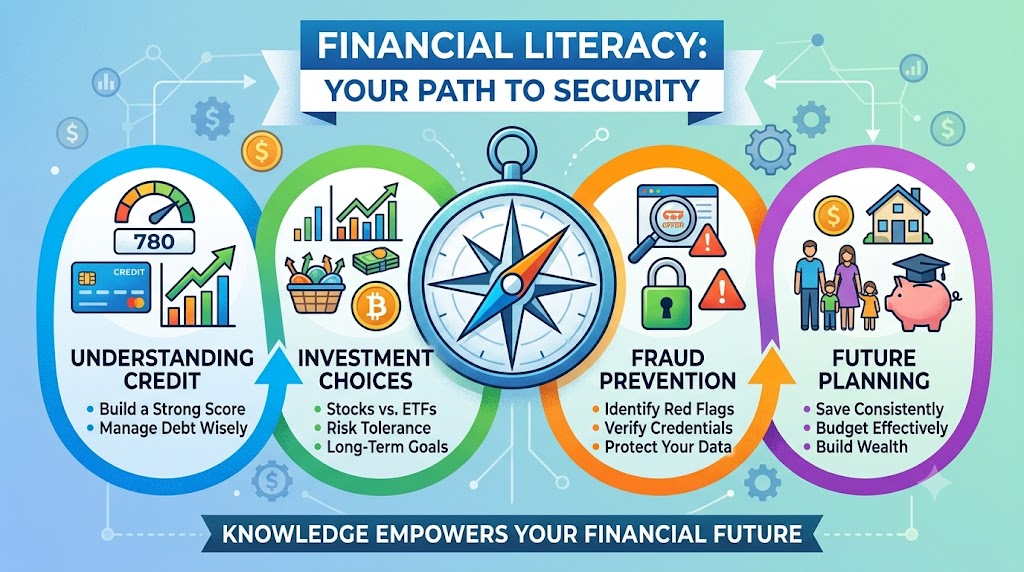
- Learn what financial literacy is, why it matters, and why financial literacy is important for your future. Improve your credit score, save, invest, avoid debt, and build long-term wealth.
Financial literacy is the ability to understand and manage money effectively. It includes knowing how to budget, save, borrow responsibly, use credit wisely, invest for the future, and protect yourself from financial scams. Strong financial literacy skills can help you make better decisions, avoid costly mistakes, and build long-term financial security.
Key Takeaways
- Financial literacy is the foundation of good money management.
- It helps people make informed decisions about spending, saving, borrowing, and investing.
- Understanding credit, debt, and compound interest can prevent expensive mistakes.
- Modern financial literacy includes knowing how to navigate digital banking, investing apps, and online scams.
- Small financial habits often have a greater long-term impact than major financial decisions.
What Is Financial Literacy?
Financial literacy is the ability to understand and manage your money effectively. It includes knowing how to budget, save, use credit responsibly, manage debt, invest, and plan for future financial goals.
A financially literate person can make informed decisions about spending, borrowing, and investing while avoiding common financial mistakes. These skills help build financial stability, reduce money-related stress, and improve long-term financial outcomes.
In simple terms, financial literacy helps people make better choices with the money they have today while preparing for the financial challenges they may face tomorrow.
Why Financial Literacy Is More Important Today
Financial literacy is more important than ever because people face more financial choices, risks, and opportunities than previous generations. Understanding how money works can help individuals make smarter decisions and avoid costly mistakes.
Key Reasons Financial Literacy Matters Today
- Growing Access to Credit: Credit cards, personal loans, and buy-now-pay-later services are widely available. Financial literacy helps consumers borrow responsibly and avoid excessive debt.
- Rise of Digital Banking and Online Payments: Mobile banking, digital wallets, and online transactions have made managing money easier, but they also require users to understand security, budgeting, and financial planning.
- Increasing Investment Opportunities: People can now invest in stocks, ETFs, mutual funds, and cryptocurrencies through mobile apps. Financial knowledge helps investors understand risks and make informed choices.
- Protection Against Financial Scams: Online fraud, phishing attacks, and investment scams are becoming more common. Financial literacy helps individuals recognize warning signs and protect their money.
- Better Budgeting and Money Management: Understanding income, expenses, and savings strategies allows people to create effective budgets and achieve financial goals.
- Improved Debt Management: Financially literate individuals are more likely to understand interest rates, repayment terms, and strategies for reducing debt efficiently.
- Preparation for Emergencies: Knowledge of emergency funds and financial planning helps people handle unexpected expenses such as medical bills, job loss, or major repairs.
- Retirement Planning: With longer life expectancies and changing retirement systems, financial literacy helps individuals save and invest for long-term financial security.
- Avoiding Misinformation: Social media and online platforms often contain unreliable financial advice. Financial literacy enables people to evaluate information critically and make decisions based on facts.
- Building Long-Term Wealth: Understanding concepts such as compound interest, investing, and asset growth can help individuals increase their wealth over time.
Financial literacy empowers people to navigate today’s complex financial environment with confidence, make informed decisions, and build a stronger financial future.
What is a credit score and why does it matter?
A credit score is a three-digit number that reflects how responsibly you manage borrowed money and credit accounts over time. It matters because lenders, landlords, insurers, and employers use it to evaluate your financial reliability and assess risk.
Who looks at your credit score? Your credit score is reviewed by lenders, landlords, insurance companies, and occasionally employers to determine your financial reliability before approving applications or contracts.
What factors affect your credit score? Your credit score is determined by several key financial factors:
- Payment history and timely bill payments
- Credit utilization ratio
- Total outstanding debt balances
- Length of your credit history
- Recent credit inquiries and new applications
- The variety of credit accounts you maintain
How does debt affect your credit score? Your credit score is heavily influenced by how much outstanding debt you carry and your credit utilization ratio. Lower overall balances and keeping credit utilization low generally lead to a stronger credit score.
How can I improve my credit score? You can improve your credit score by consistently paying bills on time, reducing your outstanding debt, keeping credit card utilization below 30%, avoiding unnecessary credit inquiries, and regularly checking your credit reports for inaccuracies.
What is the ideal credit card utilization ratio? To maintain a healthy credit score, you should keep your credit card utilization low, ideally below 30% of your total available credit limit.
Why should you keep old credit accounts open? Maintaining older credit accounts helps your score because the length of your credit history is a key factor in calculating your financial reliability. A longer history can positively impact your total score.
What are the benefits of having a good credit score? A good credit score helps you qualify for lower interest rates, more favorable loan terms, higher credit limits, and significant financial savings over the lifespan of a loan or mortgage.

How Much Should You Save Each Month?
There is no single amount everyone should save each month. A common guideline is to save about 20% of your after-tax income, but the right number depends on your income, expenses, debt, and goals.
Start by building an emergency fund, then save toward goals such as retirement, a home purchase, or investing. If your employer offers a retirement match, try to contribute enough to receive the full benefit. Most importantly, save consistently. Even small monthly contributions can grow significantly over time through compound interest.
Debit Card vs Credit Card: What’s the Difference?
Understanding the difference between debit cards and credit cards is an important part of financial literacy because it helps consumers avoid debt that can quickly become difficult to manage.
| Feature | Debit Card | Credit Card |
|---|---|---|
| Source of Funds | Uses money directly from your bank account | Borrows money from the card issuer up to a credit limit |
| Transaction Approval | May be declined if sufficient funds are not available | Can be approved as long as available credit remains |
| Interest Charges | No interest because you are spending your own money | Interest may apply if the balance is not paid in full |
| Credit Building | Typically does not help build credit history | Can help build credit history when used responsibly |
| Cash Flow Management | Limited to available account balance | Can provide short-term borrowing flexibility |
| Potential Risks | Overspending is limited by account funds | Carrying balances can become expensive due to interest charges |
How Can You Get Out of Debt Faster?
Debt can be difficult to manage, particularly when balances are spread across multiple loans or credit cards.
Two common repayment strategies are:
- Debt avalanche: Pay off the highest-interest debt first while making minimum payments on all others. This method typically minimizes total interest costs.
- Debt snowball: Pay off the smallest balances first to build momentum and stay motivated.
Whichever approach you choose, progress depends on making consistent payments, limiting unnecessary spending, and avoiding new debt. The ultimate goal is not just becoming debt-free, but freeing up income for savings, investing, and other financial priorities.
What Is Compound Interest and Why Is It So Powerful?
Compound interest is the process of earning interest not only on your original money but also on the interest that has already been earned.
It is one of the most important concepts in personal finance because it allows money to grow at an accelerating rate over time. As interest accumulates, future interest is calculated on a larger balance, creating a snowball effect that can significantly increase the value of savings and investments.
Imagine two people saving the same amount each month. The person who starts earlier generally benefits from more years of compounding, allowing their money more time to grow.
This is why financial experts frequently encourage people to begin saving and investing as early as possible. Time can often be a more powerful factor than the size of individual contributions. Understanding compound interest helps people appreciate the long-term value of consistent saving and investing habits.
Should you invest in stocks, ETFs, or cryptocurrency?
Choosing between stocks, ETFs, and cryptocurrency depends on your risk tolerance and investment goals. Stocks offer high growth potential through individual company ownership but carry higher risk. ETFs pool multiple assets to provide instant diversification with lower risk. Cryptocurrency is a highly volatile, speculative asset that offers the potential for massive returns alongside a significant risk of total capital loss.
What is the difference between stocks and ETFs?
A stock represents an equity stake in a single company, meaning your investment performance relies entirely on that specific business. An ETF (Exchange-Traded Fund) holds a basket of different stocks or assets, allowing you to diversify across an entire index, sector, or commodity with a single investment, which lowers individual company risk.
How can you identify and avoid financial scams?
You can avoid financial scams by verifying the regulatory credentials of any platform before investing, ignoring promises of guaranteed high returns, and never sharing your private passwords or security keys. If an investment opportunity pressures you to act immediately or sounds too good to be true, it is likely a fraudulent scheme.
What are the warning signs of an investment scam?
The primary red flags of an investment scam include:
- Guarantees of high, risk-free returns
- High-pressure tactics demanding immediate payment
- Unregulated platforms operating without financial authority oversight
- Vague or overly complex strategies that refuse to explain how profits are generated
- Direct requests for cryptocurrency, wire transfers, or gift cards
Conclusion Why is financial literacy important for your future?
Financial literacy is the foundation of long-term financial security. Understanding how to manage credit, choose the right investment vehicles, and protect your capital from fraudulent schemes empowers you to make informed decisions that build sustainable wealth and secure your financial future.