


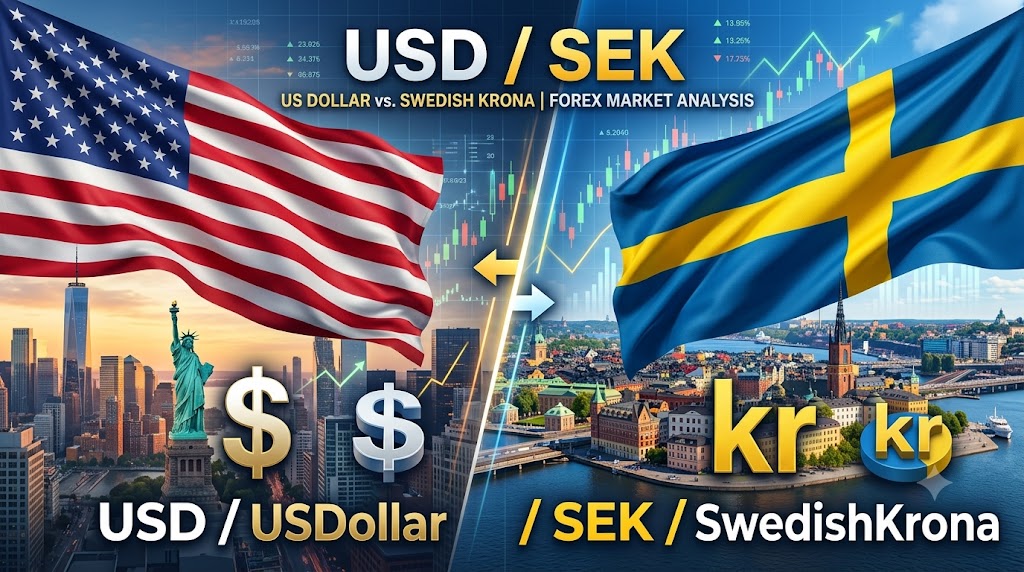
- USD/SEK remains supported as geopolitical tensions keep demand for the US dollar elevated despite softer US inflation.
- Sweden's resilient economy and a cautious Riksbank continue to provide medium-term support for the Swedish krona.
- Traders are watching Fed expectations, oil prices and global risk sentiment for the next move in USD/SEK.
The USD/SEK currency pair remains in focus as investors weigh two competing macroeconomic themes: renewed demand for the US dollar as a global safe-haven asset and growing optimism surrounding Sweden’s economic outlook.
While softer US inflation data has eased expectations for aggressive monetary tightening by the Federal Reserve, geopolitical tensions in the Middle East and elevated Treasury yields have continued to support the greenback. At the same time, the Swedish krona has shown resilience after the Riksbank signaled it remains cautious on inflation, limiting expectations for rapid policy easing.
The result is a market where USD/SEK continues to trade within a relatively stable range as investors wait for the next major catalyst.
Safe-Haven Demand Keeps the US Dollar Supported
The US dollar has remained resilient even after recent economic data suggested inflationary pressures are gradually easing.
Both the Consumer Price Index (CPI) and Producer Price Index (PPI) for June came in softer than expected, reinforcing expectations that inflation is moving closer to the Federal Reserve’s long-term target. Under normal circumstances, weaker inflation would reduce demand for the dollar by lowering expectations for additional interest rate hikes.
However, the latest escalation in tensions between the United States and Iran has shifted investor attention toward safety. Rising geopolitical uncertainty has increased demand for traditional safe-haven assets, helping the US dollar recover despite improving inflation data. Higher US Treasury yields have also continued attracting global capital into dollar-denominated assets, providing another source of support for the world’s reserve currency.
Sweden’s Economic Fundamentals Continue to Support the Krona
While the US dollar has benefited from global uncertainty, the Swedish krona has remained underpinned by relatively solid domestic fundamentals.
The Riksbank recently left interest rates unchanged while warning that inflation risks have not completely disappeared. Policymakers acknowledged that geopolitical developments and higher energy prices could complicate the inflation outlook, reinforcing expectations that interest rates may remain elevated for longer than previously anticipated.
Sweden’s economy is also expected to recover gradually during 2026 as consumer demand improves and inflation continues to moderate. Several analysts believe the krona remains undervalued relative to its long-term fundamentals, supporting expectations for gradual appreciation once global market volatility begins to ease.
This combination of resilient economic growth and a cautious central bank has helped prevent a sharper decline in the Swedish currency.
Geopolitical Risks Are Becoming a Key Driver for USD/SEK
Recent developments in the Middle East have become one of the biggest influences on currency markets.
Renewed military tensions have lifted crude oil prices and increased uncertainty across global financial markets. During periods of heightened geopolitical risk, investors typically move capital toward safe-haven currencies such as the US dollar while reducing exposure to smaller, more risk-sensitive currencies, including the Swedish krona.

Although Sweden is not directly affected by the conflict, changing global risk sentiment continues to influence demand for SEK as investors adjust their exposure to European currencies. As long as geopolitical uncertainty remains elevated, safe-haven flows could continue supporting the US dollar against the krona.
Federal Reserve and Riksbank Policy Divergence Remains in Focus
Interest rate expectations continue to play a central role in the outlook for USD/SEK.
The Federal Reserve has maintained a cautious approach, indicating that future policy decisions will depend on incoming inflation and labour market data. While softer inflation has reduced some expectations for additional tightening, policymakers continue to stress that inflation risks have not completely disappeared.
Meanwhile, the Riksbank has adopted a similarly cautious tone. Although Swedish inflation has moderated significantly from previous highs, officials remain reluctant to signal rapid interest rate cuts while geopolitical risks continue to threaten energy prices.
This narrowing policy gap between the two central banks has helped prevent larger swings in USD/SEK despite ongoing volatility across global markets.
What Could Move USD/SEK Next?
The next direction for USD/SEK will likely depend on several important developments.
Investors will closely monitor upcoming US economic data, including retail sales and labour market indicators, for fresh clues about the Federal Reserve’s policy path. Additional comments from Fed officials could also influence Treasury yields and the broader US dollar.
In Sweden, markets will continue assessing inflation data and any new communication from the Riksbank regarding future monetary policy.
Global developments may ultimately prove just as important. Oil prices, geopolitical headlines from the Middle East, and broader risk sentiment are expected to remain major drivers of demand for both the US dollar and the Swedish krona over the coming weeks.
For now, USD/SEK reflects a balance between continued safe-haven demand for the dollar and improving confidence in Sweden’s medium-term economic outlook, leaving traders focused on which of these forces ultimately gains the upper hand.
USD/SEK is finding support as investors move into the US dollar following renewed geopolitical tensions and higher Treasury yields. Safe-haven demand has outweighed the impact of softer US inflation data.
The most important drivers of USD/SEK include Federal Reserve interest rate expectations, Riksbank monetary policy, US and Swedish inflation data, Treasury yields, geopolitical developments, and overall global market sentiment.
The Swedish krona is considered a cyclical currency that often reflects investor sentiment toward European economic growth. It is also influenced by Riksbank policy, inflation trends, and global risk appetite.