


- The FTSE 100 index remains in consolidation despite rising oil prices due to its heavy leaning on energy stocks.
A backdrop of rising energy prices, resilience in corporate earnings, and heavy weighting towards global diversified firms is providing structural support for the FTSE 100, despite its lower opening on the day. The index is relatively insulated from the current geopolitical situation and the renewed concerns that are following the closure of the Strait of Hormuz. This is because the index hosts some oil majors who typically benefit from rising oil prices.
Investors are simultaneously monitoring the BOE’s policy direction and U.K. inflation for clarity on the FTSE 100’s direction, which is currently trading in a consolidation.
FTSE 100 Macro Drivers
1) Energy Sector Support
The FTSE 100 has the distinction of being one of the developed market indices with a heavy weighting towards the energy sector. It also has one of the largest oil company listings of any developed market index. Due to the support provided by this sector, and the fact that the index leans heavily towards it, the rise in oil prices has led to a corresponding rise in the share prices of the stocks in this sector, providing structural support for the FTSE100.
2) Support from Chinese Mineral Demand
The FTSE 100 also hosts several global mining companies that produce copper, aluminum, and/or precious metals. These metals usually go to China, where they are sold as the feedstock for the Chinese industrial complex. These metals are also components of several global infrastructure projects. For instance, India’s power generation companies specializing in renewable energy typically use some of these minerals to produce solar panels. Therefore, the FTSE 100 will continue to show sensitivity to Chinese industrial demand, as it has a global currency demand.
3) BoE Policy
The resumption of hostilities between the U.S. and Iran has led to an increase in oil prices. This could put inflationary pressure on the U.K. economy and alter the Bank of England’s monetary policy direction. Markets will also continue to view local inflation data to see if there is a spillover from the euro-political situation. If inflationary pressures become a concern for the Bank of England, it could influence decisions such as whether to raise rates at the end of the year. On the flip side, lower interest rates tend to improve valuations of rate-sensitive sectors and support an increase in domestic economic activity, both of which are considered FTSE 100 supporting factors.

FTSE 100 Price Catalysts (Near-term)
1) Oil prices
The FTSE 100’s heavy energy leaning makes the index susceptible to changes in oil prices. Info: Brent crude oil prices remain a significant price catalyst for the FTSE 100 in the near term.
2) U.K. Economic Data
Key data such as U.K. inflation, retail sales, and employment data are expected to influence the Bank of England’s future monetary policy actions. Therefore, traders who are active in the FTSE 100.
3) Global Risk Sentiment
The composition of the FTSE 100 makes it more susceptible to global macroeconomic developments that shift risk sentiment ahead of purely domestic news. Therefore, any situation that alters global risk sentiment and is more likely to be affected by global warming will compete with multiple data trends as they track the direction of the FTSE 100.
FTSE 100 Technical Outlook
The 10513 resistance level is the immediate barrier for the bulls amid the current consolidation. If this barrier is uncapped, it would allow the bulls to recapture the 10724 resistance level, formed by the 8 April and 6 July 2026 highs. The 10932 all-time high lies beyond this point and only becomes visible on a break of 10724.
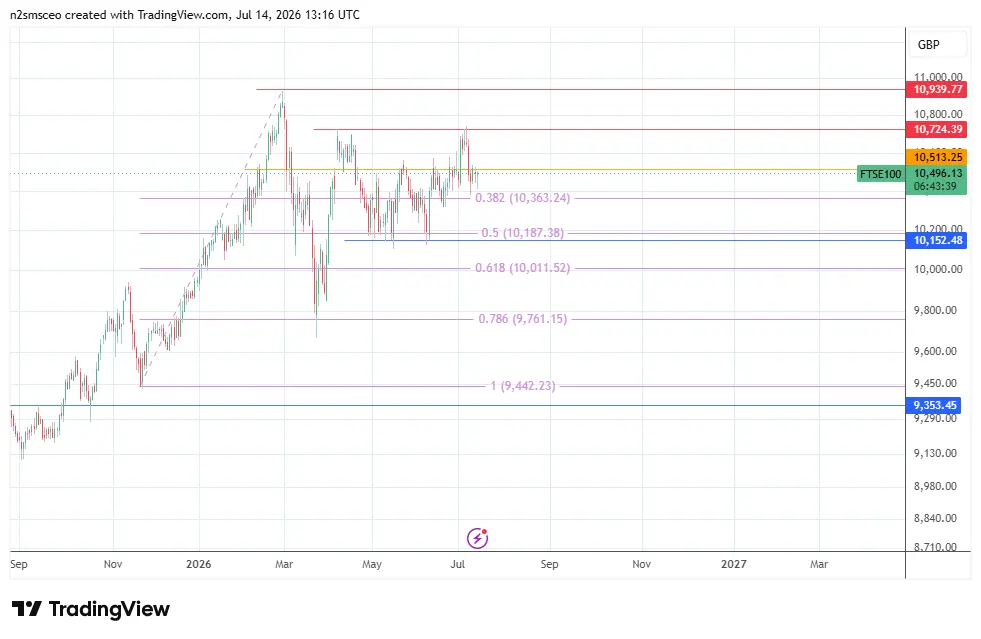
On the flip side, failure to breach the 10513 resistance keeps the asset range-bound, with the 10152 support forming the base of the range and formed by the prior lows of 15 May and 11 June 2026. Below this support, a decline towards the 7 June 2026 low and 61.8% Fibonacci retracement of the 20 November 2025 – 27 February 2026 upswing at 10011 could gain momentum, leaving an additional downside target at 9761 (78.6% Fibonacci retracement level) on the horizon.