




- The Bank of England's hawkish stance has created a divide within the FTSE 100. Higher interest rates have boosted banking stocks, providing support to the index, while weighing on consumer and defensive sectors. This has helped limit broader market gains and kept sector performance uneven
This article explores the technical outlook for the FTSE 100, highlighting the key price levels, trends, and indicators shaping the benchmark index’s direction. It also examines the major fundamental developments that could influence the index’s broader market performance. In addition, the article discusses the latest geopolitical events and assesses their potential impact on investor sentiment and the FTSE 100‘s movements.
FTSE 100 Technical Outlook:
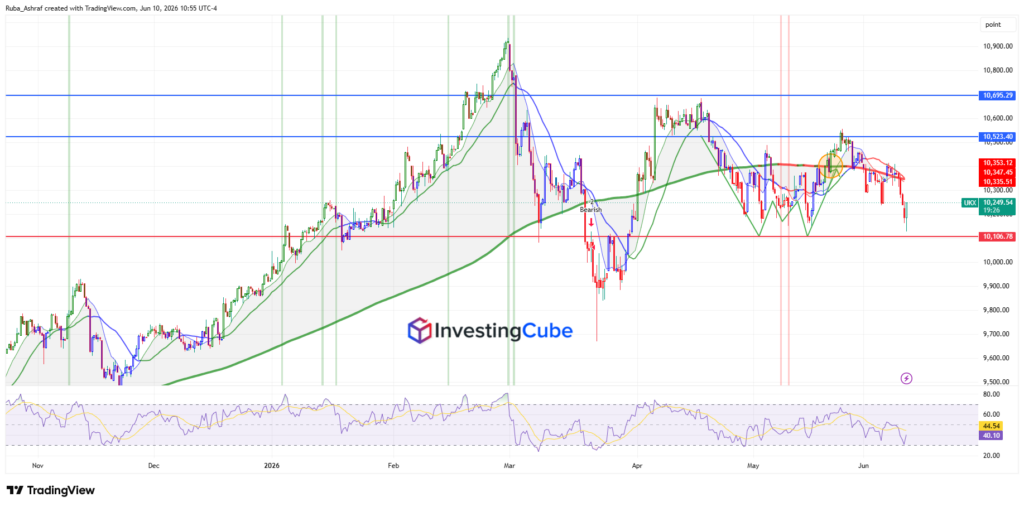
The 4-hour chart of the FTSE 100 index shows that the price action has turned increasingly bearish after failing to sustain a recovery above key moving averages. The FTSE 100 attempted to extend its rebound in late May and early June. The yellow-highlighted circle represents a failed bullish breakout.
The price moved above the major moving averages and tested the resistance zone around 10,340-10,380. But buyers lost their momentum there. Then the index quickly fell back below these averages, confirming the breakout was unsustainable. Such failed breakouts often signal that institutional investors are using rallies as selling opportunities rather than initiating new long positions.
The short-term moving average (blue) has crossed below the medium-term moving average (green). The longer-term average (red) is also beginning to slope lower. This alignment suggests that downside momentum is strengthening. Furthermore, the index is now trading beneath all three moving averages. This indicates that sellers currently have control across multiple time horizons.
The nearest resistance lies around 10,320-10,380, where the moving averages are clustered. A strong resistance zone is located at 10,523, followed by 10,695. Both of which previously capped upside attempts.
On the downside, the FTSE is approaching a critical support level at 10,106. This area has acted as a floor several times in recent months. A decisive break below 10,106 could expose the next support near 9,926. This represents a major swing low established earlier in the year. The Relative Strength Index (RSI) adds to the bearish bias. The RSI has fallen to around 41, below the neutral 50 level, indicating weakening buying momentum.
Bank of England’s Hawkish Hold and Its Market Impact:
Nowadays, market participants are closely watching the Bank of England’s June monetary policy review. The base rate is highly expected to be held at 3.75% due to the hawkish stance of the BOE.
Unlike the Federal Reserve, which is dealing with a strong labor market, the Bank of England is facing persistently high service-sector inflation, which remains at 5.3% year-over-year. As a result, policymakers are reluctant to cut interest rates too quickly and are likely to keep borrowing costs elevated for longer.

How did this reflect on the FTSE 100 performance?
This environment has generally benefited major UK banks such as HSBC, Lloyds, and Barclays. Higher interest rates allow banks to earn more from lending activities. This in turn supports the bank’s profitability and helps drive gains in their share prices.
However, the higher-for-longer interest rate outlook creates challenges for other sectors of the FTSE 100. Companies in the consumer staples sector, such as Unilever, tend to face valuation pressure when interest rates remain elevated. Because investors become less willing to pay a premium for their stable but slower-growing earnings. Consequently, while banks continue to benefit from the current policy backdrop, defensive sectors remain exposed to the negative effects of higher borrowing costs.
Sterling (GBP) Fluctuations and Their Impact on the FTSE 100:
The British pound has entered an aggressive recovery to hover around 1.33 against the US dollar. The rally has been driven by growing expectations that the Bank of England will keep interest rates higher for a longer time. At the same time, investors have become less certain about the Federal Reserve’s policy path. This widening the gap between two central banks has increased demand for the pound and helped the currency rise higher.
For the FTSE 100, however, a stronger pound acts as a headwind. Many of the index’s largest companies generate a substantial portion of their revenues and profits overseas, particularly in US dollars. When the Pound appreciates, those foreign earnings are worth less when converted back into Sterling. This can reduce reported revenues and profits, even if the companies’ underlying business performance remains unchanged. As a result, the recent strength in the pound may limit the FTSE 100’s upside potential.
Geopolitical Developments:
Geopolitical tensions in West Asia have escalated after consecutive U.S. airstrikes on Iran and disruptions near the Strait of Hormuz, raising concerns over global oil supply. This has triggered a risk-off mood in global markets, with investors reducing exposure to riskier assets.
The FTSE 100 is relatively resilient in this environment due to its heavy weighting in energy and mining stocks, including Shell and BP. Rising oil and commodity prices tend to support these sectors, helping offset broader market weakness.
Higher energy prices weigh on growth sectors like technology but benefit commodity-linked companies. As a result, the FTSE 100 has held up better than many indices dominated by growth stocks.