


- The FTSE 100 remains caught between supportive energy prices and rising macroeconomic risks. Persistent inflation, higher bond yields, and renewed geopolitical tensions continue to shape short-term market sentiment.
- Technically, the failure to hold above 10,500 has shifted momentum to the downside. The 10,432 support level is now the key level to watch, as it will likely determine whether the index rebounds or extends its decline toward lower support zones.
Renewed tensions between the US and Iran are weighing on the UK stock market. The FTSE 100 is heavily weighted toward mega-cap oil producers. As a result, the index is highly sensitive to movements in the energy sector. The collapse of the US-Iran ceasefire agreement triggered fresh market concerns. US military strikes inside Iran further increased uncertainty. In response, crude oil prices surged by as much as 5%.
The FTSE 100 reacted by reversing lower from the 10,500 resistance level. This level held, as we expected in our previous analysis, following the US-Iran ceasefire agreement. But the latest escalation shifted market sentiment. Buyers lost control, pushing the index back toward 10,440. Risk appetite also weakened. Rising crude oil prices renewed concerns about higher inflation.
Let’s take a technical outlook at the FTSE 100 chart, highlighting the potential scenarios:
In our last FTSE 100 analysis, the index was trading around 10,249. At that time, we expected a recovery toward the 10,500 resistance zone, with the view that the market could hold above this level as long as the US-Iran ceasefire deal remained intact. However, we also warned that any renewed escalation could push the index back below this resistance level and send prices toward lower support zones. That is exactly where the market stands right now.
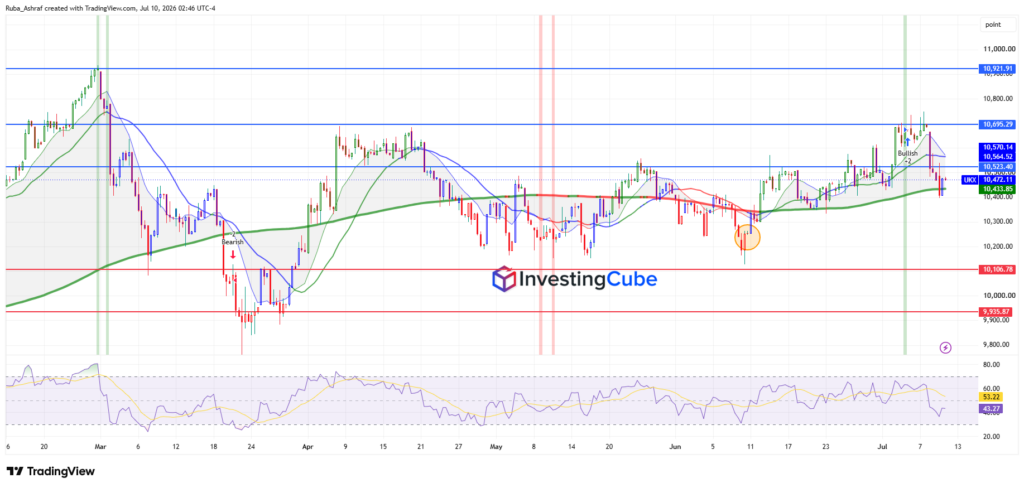
The FTSE 100 successfully rallied from the 10,249 area and climbed above 10,500, reaching the 10,600–10,690 resistance region highlighted on the chart. The move was supported by improving sentiment and a recovery in risk appetite following the ceasefire agreement.

However, the latest re-escalation in Middle East tensions triggered a sharp reversal. The index failed to hold above the resistance level and has now fallen back toward 10,450. This move confirms that buyers lost momentum near the upper boundary of the range.
The chart shows that 10.523 remains a key resistance level, while 10.432 is acting as the nearest support. The price has slipped below the short-term moving averages. This signals weakening bullish momentum. In addition, the RSI has dropped toward the low-40s, indicating that momentum has turned bearish but is not yet in deeply oversold territory.
The next market move will likely depend on whether support around 10,432 can hold. A successful defense of this level could trigger a rebound toward 10,523, followed by another test of the 10,600–10,690 resistance zone. Such a move would require geopolitical tensions to cool and risk sentiment to improve.
If the index breaks below 10,432, bearish pressure is likely to increase. In that case, the next downside targets become 10,300, followed by the major support at 10,106. A deeper deterioration in sentiment could even expose the 9,935 support zone over the medium term.
The primary catalysts driving the FTSE 100 include:
- The biggest driver of recent intraday volatility has been the sharp shift in monetary policy expectations. UK core inflation remained stubbornly high at 2.80%, signaling that price pressures have yet to ease. This has forced investors to rethink the outlook for the Bank of England. Instead of pricing in near-term rate cuts, markets are now increasingly considering the possibility of further rate hikes to bring inflation under control. The hawkish shift pushed UK gilt yields above 4.9%.
Higher bond yields also reduced the appeal of equities. Higher bond yields also reduced the appeal of equities. As a result, major FTSE 100 heavyweights, including AstraZeneca, came under selling pressure, dragging the index lower. - The FTSE 100 is heavily weighted toward mega-cap oil producers. This makes the index highly sensitive to developments in the energy sector. The collapse of the regional ceasefire renewed geopolitical tensions across the Middle East. US military strikes on targets inside Iran further escalated the conflict. As a result, Brent crude oil prices surged by more than 5%.
Higher oil prices increased cost pressures for manufacturers, airlines, and retail companies. However, they also improved the earnings outlook for energy giants such as Shell and BP. Since these companies carry significant weight in the FTSE 100, stronger gains in the energy sector helped cushion the broader index from deeper losses. - Another factor supporting the FTSE 100 is the ongoing rotation of institutional capital. Investors have been reducing their exposure to expensive technology stocks after a prolonged rally driven by artificial intelligence. Instead, many fund managers are shifting toward value-oriented markets.
The FTSE 100 has become an attractive destination because it has limited exposure to technology companies. Instead, it is heavily weighted toward defensive sectors such as consumer staples, financials, energy, and mining.
The index also trades at significantly lower price-to-earnings (P/E) multiples than major US indices. This relatively attractive valuation has encouraged international investors to rotate capital into UK large-cap stocks as they seek stability amid continued volatility in AI- and semiconductor-related shares.