



- Persistent inflation is delaying rate cuts and weighing on rate-sensitive FTSE 250 sectors.
- The FTSE 250 lacks the energy and defense giants that help shield the FTSE 100 during geopolitical uncertainty.
The FTSE 250 is driven by a different set of factors than its large-cap counterpart, the FTSE 100. As the index is heavily weighted toward domestic mid-cap companies, its performance serves as a barometer of the health of the UK economy and consumer spending.
Given its strong exposure to domestic mid-caps, the FTSE 250 is currently being influenced by several key themes, including the Bank of England’s interest rate dilemma, corporate restructuring activity, and the annual index rebalance. In addition, persistent inflationary pressures continue to shape the index’s performance.
The FTSE 250 continues to reflect the strength of the UK domestic economy and investor sentiment. This article explores the key market movers driving the index and analyzes its current technical outlook.
The FTSE 250 Key Movers:
- The Bank of England’s Interest Rate: UK interest rates are currently a key driver of the FTSE 250. While investors initially expected lower inflation to pave the way for faster rate cuts, inflation has edged up to 3.3%. The Bank of England has kept rates at 3.75%. Higher borrowing costs continue to weigh on domestic sectors such as retail, housebuilding, and real estate. This limits the index’s upside potential.
- The June Annual Index Rebalance: The upcoming FTSE index reconstitution on June 19, 2026, is driving portfolio changes across the market. Seraphim Space Investment Trust (SSIT) will be added. This reflects a shift in investor interest. Focus is moving toward strategic sectors. These include defense, space technology, national security, and sovereign data infrastructure.
FTSE 250 Technical Outlook:
The FTSE 250 price action reflects a broader consolidation phase following a sharp selloff and subsequent recovery. After the strong decline seen in March, price action rebounded and transitioned into a sideways structure. This has resulted in a market that is now largely range-bound. As buyers and sellers are repeatedly failing to establish clear dominance.

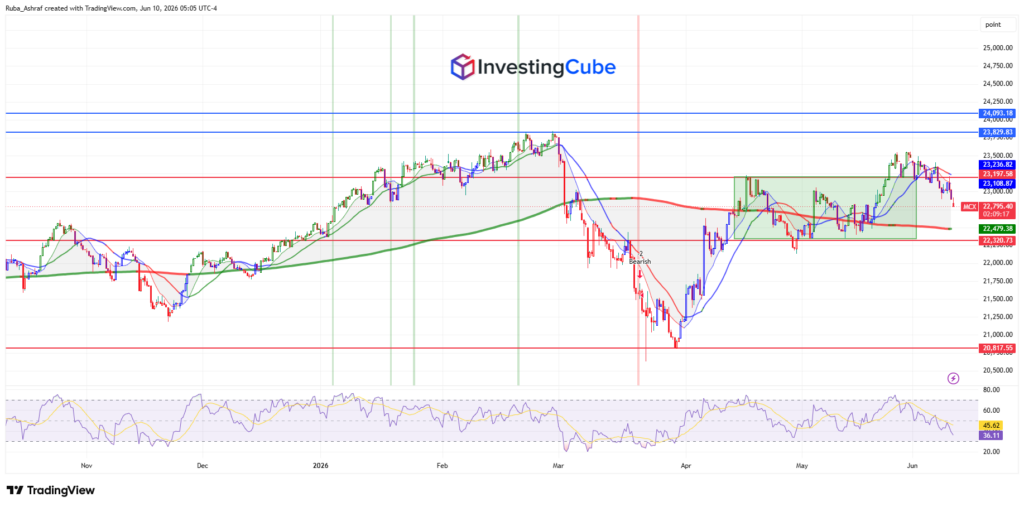
On the upside, the key resistance zone sits around 23,800 to 24,100. This area consistently acted as a supply region where rallies were being sold into. This area prevents a meaningful breakout from occurring easily. Each attempt to move higher has been met with rejection, reinforcing this level as a key ceiling for the market in the short term.
From a trend perspective, moving averages reflect the absence of a strong directional bias. Looking at the short-term averages, they are frequently crossing each other. This signals choppy and indecisive price action. On the other hand, the longer moving average is flattening, reinforcing the idea of a neutral, range-bound environment rather than a trending market.
RSI is also consistent with consolidation conditions. The indicator is oscillating mostly between 40 and 60, without sustained overbought or oversold readings. This suggests a lack of strong directional momentum, with the market instead rotating within a defined range.
The FTSE 100 is made up of large global companies that earn most of their money outside the UK. This means that they depend more on global growth and exchange rates.
The FTSE 250, however, is mostly mid-sized UK companies that rely on the local economy. This means they are more affected when UK inflation rises and interest rates go up. Because consumers spend less, borrowing becomes more expensive.